Friday, May 27, 2022

From a strange planet - 46

Churches interpreted as power places 

Many years ago I was interested in German books about "power places". These books all start from the same hypothesis. They assume that in older times, there was a class of powerful people and organisations who knew the places with optimal landscape energy. That's where they built their castles and churches. So by exploring churches, castles, holy shrines and places of pilgrimage you can map the most energetic places in the landscape. This might look like this:

St. Michael’s Church - Google Streetview

One of my favourite books from that period describes a project - nicknamed by the authors: the Rally Santa Maria -  where two German researchers travel around churches all over Germany and locate the most powerful energy spots by using pendulums and dowsing rods. They document their findings in huge detail.

On a smaller scale, the same mechanism applies inside buildings. The placement of altars and holy relics inside churches is also governed by energy,  ley-lines and directions of energy radiation. This might look like this:

St. Michael’s Church - Google Streetview

Personally I don't believe in this mysterious landscape energy, but I'm a big fan of churches as places of contemplation and healing. So I have sympathy for this endeavour even though I'm not supposed to believe in pendulums and dowsing rods.

Irish webcam churches interpreted as the focus of the landscape

 Since my discovery of the Irish church webcams I've been inspired to look at these churches from two viewpoints.

The first one is the traditional Catholic viewpoint of the the Real Presence of Christ, which I tend to feel most intensely in the empty church at night, when the only light in the church shines from the altar lamp. For me this is a deeply significant, almost mystical experience. And I feel it even through the medium of the webcam, in the night.

St Peter's Church - Google Streetview Our Lady Queen of Peace Pastoral Area

The second one is inspired by an experience during an Irish bus ride. When we drove past a church one of the older men on the bus made the sign of the Cross. This made me aware that the Real Presence was not only felt and acknowledged in the vicinity of the Tabernacle, but maybe from all places where the church was visible.

St Peter's Church - Google Streetview Our Lady Queen of Peace Pastoral Area

So, in the investigations below, I present the view of the church at night, and then I explore the visibility of the in the surrounding landscape. I try try to find the furthest places that are influenced by the presence of the church as their focal point. I hope you enjoy this exploration as much as I do.

Parish of Kill, Ardclough & Johnstowns - Google Streetview

At night there are just a few lights in the dark. Like:
And the light shines in darkness; and the darkness comprehends it not.
By day there is light and activity.
We explore the places from where we can see the church and its tower.
This is from the other side of the biggest provincial road.
This is from the parking lot in the back of the church area.
And this is from far away, from the other side of the golf course.
The church tower must be there, behind the trees, but it is hidden.
Like:
Indeed, you are a hidden God, you God of Israel, the Savior.

Friday, April 15, 2022

Rilke and "deep topography"

His main focus was on the landscape, the dwellings of men, the indigenous people going back to the origins, the historical past where old forms and their mysterious influences are still present in buildings, emblems and the national character; where historical forces still resonate in the present-day and, as a subterranean rhizome, permeate the soil and nature, bringing lifeblood to humanity. Here Rilke feels attracted and he entrusts himself to his environment.
He himself understood the strong interest which he gave to this hospitable country, which was recharged again and again with each change of abode, only as a permanent entry into all that had grown and had become, as a connection with the living and the dead, with a current situation, which he preferred to regard and understand in the light of his own past.
The meaning that the poet placed in things and people in this way, always created an enrichment for them. And as a recipient he processed internally all that pleased him and that suited him inwardly and placed it inside his microcosm, which adhered to a mysterious ordering principle.
 
For example, it is not indifferent to the understanding of Rilke's world, if one hears that every time he visited a city or village, he used to orient himself very carefully about its location, he made sure he knew the dates of its history and its remarkable buildings, he researched the dwelling places of the old indigenous families, he paid attention to their coats of arms, and soon knew all of them; finally, he never left a place without visiting the churchyard where he visited the graves and old tombstones.
This discovery of the bygone and the old-fashioned is for Rilke, even there where it appears like something of a hobby and a dabbling in history, a way towards himself, a portal to his literary productivity.
When he studied, decoded and recorded genealogical almanacs and armories, epitaphs and inscriptions on old houses and city gates, stories lifted from the darkness of old times, the history of a family or a castle this activity was always a necessity, a pursuit for fertilisation en energization. His letters from this Swiss period are full of relevant notes and descriptions, they testify that it never was a meaningless play on words that the poet collected and expanded in this manner, but that he brought all things into a meaningful relationship and connection, that he built up a world in this way, into which he gradually cocooned himself and from which, when the time came, he ventured the flight into the distance.
Source
J.R von Salis, Rilke in Zwitserland, Biografie van Rilkes laatste levensjaren, Uitgeverij De Driehoek, 's Graveland 1936 - Band en omslagontwerp Roel Knobbe

Thursday, April 14, 2022

From a strange planet - 51

It's the 14th of April 2022. Already it's hot in the sun outside. 

So I'm searching for the last traces of snow. These seem to lie along a horizontal line just above Bergen. In the coming weeks we should see this line advance to the North.

Rv. 2 Sorma


Sunday, February 6, 2022

From a strange planet - 49

 We continue our trip along the webcams of the E39. We follow a small fragment of the E39 and we still are not connected to our previous trips. We will need several blog posts for that.

As always we are the unofficial curators of landscape views. Could we sell them as an NFT?

E39 Saglandsbakken - Google streetview
E39 Saglandsbakken II - Google streetview

Two ordinary landscape views.
With all of my over hyped imagination 
I cannot find a suitable metaphysical narrative here.
Maybe if we go further down the road?

And yes! Just around the corner, 
empty landscapes and buildings obscured by trees.
Just what I'm looking for.
Let your imagination do the walking. 
Find your inner Peter Handke:

I don't read my own books,
but sometimes if there is a new edition 
I open it and then
 I feel this life of a writer 
was not so hopeless, not so bad.
All I can say is:
The fields, the fields! They move me deeply.
But I cannot explain why ...
And around here, there are silent waters and calming country roads.
A place to stop your car, pause and look around.
Look at the single tree.

The biggest achievement is to create silence.

E39 Buekrossen 1 - Google streetview

I have followed this view for a long time already.
At first sight it looks very promising,
because it has trees, water, houses, bus shelters, streetlights, curves in the road.
Everything needed to make the view interesting.
But somehow it lacks atmosphere.
Somehow the mystery is lacking.
Snow makes it slightly better.
But in the hills there's a TV tower.
It stands coolly above the landscape.
It is inaccessible from Streetview.

Rv. 44 Kvassheim - Google streetview

Further down, along the coast.
Unchanging monumental flatness.
Both on the webcam and on Streetview.

I am a writer and not a judge.

The so-called world knows the truth.
But I don't know the truth.
But I watch. I feel.
I remember. I question.

Monday, December 27, 2021

From a strange planet - 44

Today we once again follow highway E39. Supposedly it is 1100 km long and runs through six counties and fifty municipalities. Total travel time is around 21 hours, including seven different ferry  connections. But we travel just a fragment of it's length, because we take several side roads. During our trip we see some beautiful landscapes, far away from the cities. And we explore the local dead ends of streetview.

 E39 Osestad - Google Streetview
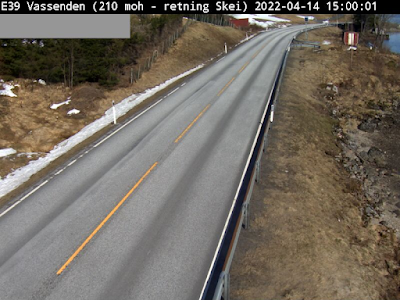
In this webcam view we see a hilly landscape and we see the main road going off to the left. But on the right we see an unpaved rural road going up the slope. We cannot follow this road on Streetview and we don't know where it's going. This gives some mystery to this picture, especially because this side road is obscured by trees and we can't see it clearly.

The side road is partially hidden and the feeling of mystery is intensified in winter, when the snow has fallen. The road looks more inaccessible and unused. It must go to a very lonely place. 
On Google Street View we can follow this side road for a short while, before it branches off to the right and we lose sight of it. But still, we don't see where it goes.
While exploring the surroundings we see beautiful fjords and birch trees with autumn colours. The landscape looks calm. Somewhere here the endpoint of the side road is hidden from view.
Could it look like this?
The local museum has a nice mysterious picture form this area.
Lindesnes Bygdemuseum - Den gamle alma i Osestadbakken
The photographer is unknown.

E39 Vatland - Google streetview

We see a tunnel where nothing ever happens. In this picture the seasons change but the view stays practically the same. In winter there are some rays of sunlight that illuminate the snow and the box, but otherwise nothing much happens.

We are far away from everywhere. There are some houses in the woods and they are far from the road. They hide in the woods and watch us with weary eyes. They are inaccessible from Google Streetview. They sleep in winter.

We see a wide asphalt road going off toward the horizon and a wide road going off to the left. We are not interested in these. We are interested in the side roads. Two side roads are going up the hill, one to the left and one to the right. There is a house with parked cars.

In winter, when snow falls, left road looks darker and more mysterious as it vanishes into the wooded hills. We cannot follow that road on Streetview.
But we can go right and we can go a uphill until we finish at a dead end in the woods. I love those silent landscapes. Maybe I'm the only one who sees this stored data, who sees the information in this frozen landscape of Streetview. Here I share it with you,

The local dead ends of Streetview