Showing posts with label geology. Show all posts

Friday, November 13, 2020

Interesting artists found during spring cleaning - 1

During spring cleaning I decided to throw away a big stack of magazines. My wife wanted the floor to be visible. But I still wanted to remember some of the most interesting artworks and artists. So these are my notes. - I'm always amazed at how many good artists there are and how many different ideas exist.
1) The stark minimalist art of Fernanda Gomes.
2) The strange obsessions of Paul McCarthy. Well known in Rotterdam for his Santa Claus with buttplug statue.
3) The Cosmopolitan Chicken Project by Koen van Mechelen.
4) Cassette tape cyanotypes by Christian Marclay. Also known for his plunderphonics music pieces.


5) Mikael Olsson photographed and documented the deserted house of the Swedish architect Bruno Mathsson. 

6) A haunting picture by Adriana Lozano.


7) Exploration and photography around the disappearing Aral Sea by Anton Ginzburg.


8) The monastic landscape art made by Julie Brook. She lives on lonely islands and makes site-specific artworks in those far away places.

Sunday, September 6, 2015

Book envy - geologic version

Last week I had an appointment in The Hague, in the offices of TNO, a Dutch research institute. While waiting for my host I noticed a large, heavy book in one corner. A gorgeous photograph of a layered outcrop on one page and a detailed geologic description, with several maps on the other page. So large that you had to plan your moves before turning a page.
Other pages contained more delights. The geology under Europe ... layers, ages, structures ... maps, pictures, text. More than any human could absorb. In a monumental A2-size. Something physical, like from another age but seemingly modern. A scientific achievement to be proud of.
I want to have this book. It's expensive but not unreachable for 225 euros, the price of a modern smartphone. But I'm not going to buy this book. I would never find time to read it and it would just gather dust somewhere. But it's uplifting to know that it exists and that such Mercator-like books are still being made.

Note: This book is so different that Amazon doesn't even list a price.

Sources:
Petroleum-geological-atlas-of-the-southern-permian-basin
amazon.com - Petroleum-Geological-Atlas-Southern-Permian

Friday, July 17, 2015

Beach phenomena - Maasvlakte

Usually I encounter mysterious and frustrating phenomena on the beach. Here are examples from The Netherlands and from Spain. But today I visited the new artificial land created at the Maasvlakte and I found some mysteries that proved easily solvable.
The Maasvlakte is a fascinating moonscape at the outer edge of the Rotterdam harbor. It is far from the city and I don't come there often. But each time I visit I return inspired, enlightened and relaxed. The total strangeness and emptiness of this artificial landscape are strangely soothing.
Today I discovered a beach at the edge of the Maasvlakte. It is unexpected, in between the heavy industry and the logistic installations. A strong wind, warm sea and sunshine made for a beautiful walk. The ice-cream afterwards made it extra interesting.
I enjoyed the seascape but I looked down much too often. The beaches of the Maasvlakte have been dredged from deep sand beds dating to the ice ages. This means that you can find fossil teeth and bones there. I'm addicted to that kind of thing. There is a whole website that catalogues and identifies the finds from this beach.
I was not looking for fossils, I was looking for ventifacts. I was triggered by the sand blowing in the wind at ankle height, stinging my bare feet. And indeed I found many wind-polished stones, with a shiny top and a matte bottom. Strange stones I had never seen before. The size, colour and sheen of fresh chestnuts. The weight, feel and sound of flint.
At first I thought they might be fossilized bones, vertebra, teeth or something similar. But after breaking two specimens with a hammer I saw that they had the colour and consistency of sandstone, not of bone, and also not of flint.

Finally I got a hint from the beach find website: nodules of the mineral limonite. It fits all the criteria: it breaks in a shell-like manner and produces a yellowish mark when scratched against a rough surface. It contains a high concentration of iron. Excellent pictures can be found here. Limonites are often erroneously identified as meteorites. But not by me!

Sources:
https://en.wikipedia.org/wiki/Maasvlakte
http://www.oervondstchecker.nl/alle-vondsten
https://en.wikipedia.org/wiki/Dreikanter
http://earthsciencesociety.com/2013/05/13/dreikanter-the-biography-of-my-favourite-ventifact/
https://en.wikipedia.org/wiki/Limonite
http://meteorites.wustl.edu/id/concretions.htm

Saturday, May 30, 2015

Formless non-shapes in 3D

Joanne Lee has published a wonderful meditation on chewing gum. Not just chewing gum but also artistic creation, project management and aesthetics. You can order the booklet, read the PDF or listen to the essay on Soundcloud. One of her subjects caught and focused my attention on shapes and especially on formless shapes.
She writes:
... I’ve found myself increasingly preoccupied with the conceptual category of the ‘lump’. The OED tells us that it designates, ‘a compact mass, especially one without a definite or regular shape.’
And I cannot resist thinking of H.P. Lovecraft:
There were geometrical forms for which an Euclid could scarcely find a name—cones of all degrees of irregularity and truncation; terraces of every sort of provocative disproportion; shafts with odd bulbous enlargements; broken columns in curious groups; and five-pointed or five-ridged arrangements of mad grotesqueness.
 

In more detail:
I explored its synonyms: there is of course the idea of a piece of material, communicated through words like block, wedge, slab, cake, nugget, ball, brick, cube, pat, knob, clod, wad and hunk; wetter stuff is suggested in dollop, glob, gobbet and gob; and then there’s the sense too in which it refers to a swelling, bump, bulge, protuberance, protrusion, growth, outgrowth, nodule or hump…  
And again H.P. Lovecraft:
Never were things of such size seen before, and they held strange colours that could not be put into any words. ... and began to weave itself into fantastic suggestions of shape which each spectator later described differently ...
 How to get a grip on shapelessness? And could it be even worse? Let us speculate:
  • In The Violet Death Gustav Meyrink speculates about a word that cannot be uttered without turning the listeners into violet cones.
  • In The funniest joke in the world the Monty Python team speculates about a joke so funny that it kills its listeners.
  • In Snow Crash Neal Stephenson describes a viral graphic pattern that wipes a human brain.
Could such noxious shapes exist? I'm afraid not, because they would have been weaponized and we would have been wiped out. Our evolutionary existence disproves the hypothesis.
More speculation:
  • Want about invisible shapes? Shapes designed to leave no trace in memory? Shapes that force you to forget or repress their existence?
  • Or shapes of such extreme ugliness that you turn away in disgust?
Joanne Lee has already noticed this effect:
In fact, excrement is probably the lumpiest stuff I can think of ... surely the most definitively lumpy is the dog log that fractures into nodular sections as it is expelled ... the dismembered chunks we find in parks and pavements remain pretty irredeemable ... dog shit, deposited onto a perfect lawn (and against a backdrop of orange nasturtium flowers) perfectly catches the true aesthetic horror. 
But here it's not the shape itself, it's the other sensations that cause disgust that are associated with the shape. It's unclear if a shape - all by itself, without additional layers of meaning - could cause any significant effect.

Let me postulate one more speculative shape, one that really could exist and that I'm currently looking for. See the pictures on this page:
  • The unfathomable shape - A shape so shape-less that it erases the memory of its own creation. A shape created by some unfathomably complex series of actions, by conscious creation combined with random accretion and erosion. A shape that combines artificiality and naturalness in an irritating manner.
  • The indescribable shape - A shape that cannot be summarized into a simple description. A shape that fits no simple mathematical function or set (circles, squares), that cannot be summarized by deterministic fractal mathematics (Menger sponge) nor by stochastic fractal mathematics (clouds). A shape that inhabits some in-between world of Kolmogorov complexity.
I believe that such a shape could be found in geology, detritus or art. I'm looking for it right now.

Sources:
http://www.joannelee.info/_/gumminguptheworks.html
http://www.joannelee.info/_/pam_flett_press_files/Gumminguptheworks.pdf
http://www.hplovecraft.com/writings/texts/fiction/mm.aspx
http://en.wikipedia.org/wiki/Kolmogorov_complexity

Sunday, September 1, 2013

Hopeless geology - 4 - Beach phenomena

Introduction
The motto of hopeless geology is a quote from Bob Dylan:
Because something is happening here
 But you don't know what it is
 Do you, Mister Jones ?
And it's main emotion is frustration. But we need not give in to frustration. We may not explain everything we see, but we may be proud that we noticed some phenomenon. That we noticed something that many others ignore.
 
Parallel questions - Hoek van Holland
A simple stroll in January along the beach can raise more questions than hours of (Internet) research can answer. And the situation becomes even more puzzling when two separate walks raise the same questions. 
During two walks I saw these little cliffs of shells at the beach. They raise questions like:
  • Were they created by accumulation like dunes?
  • Or were they created by erosion?
  • Are they old or recent?
I can only speculate, but I suspect that they are recent and that they have been created artificially when sand was suppleted to strengthen the natural dunes.

This again raises some questions:
  • Are the seashells recent or are they (young) fossils?
  • Are they near-shore or deep-sea species?
  • Where did the sand come from?
It is certain that sand was suppleted here in 2009. But I could not find more detailed information for Hoek van Holland. But there are suggestions that the shell-cliffs are artificial and that the sand comes from the deeper continental shelf. The strongest evidence is this piece of fossil bone. In the Ice Ages the Dutch continental shelf was dry and was inhabited by mammoths and sabre-tooth tigers.
Parallel questions - Rockanje
Similar shells cliffs can be found on the beach at Rockanje. These are lower and they contain much  strange material.
Some information is available in the magazine of the Geology Working Group of the Royal Scientific Society of the Zeeland Isles. Fossils from the Pliocene (5.3-1.8 My) and Tertiary (65.5-5.3My) epochs have been found. These come from sand that has been artificially moved here from deeper parts of the coast.
But here there is so much modern-looking material that I cannot understand where this came from: brick, burnt wood, gravel and slag. This cannot be fossil material. But on the other hand it looks old and eroded, like it lay in the sea a long time. A mystery.
For example, this piece of basalt cannot be natural. There is no volcanic rock anywhere in the Netherlands (or the whole Benelux). The rock is imported to strengthen the dikes. This rock means that the sand cannot be older than 300 years. It must have lain in the sea a long time because it has been polished smooth.
Even more mysterious is this heavy glistening pebble. It is not shale, it is not mica, it is not aluminum. I speculate that it is chromium ore. This must have lain in the sea a long time because it has been rounded by the wave action. 
Deeper in the dunes nature is reclaiming its territory. Much of the sand has been solidified, probably through colonization by algae. The first grass and plants are probing the empty area. Traces of wildlife are everywhere. 
 
Notice the color difference  between the sand from Rockanje (left) and Hoek van Holland (right). I would need a microscope to investigate this further. And I recently realized that the sand grains might be extremely old, even Precambrian.
There are no Precambrian rocks in the Netherlands and they are rare in the whole of Europe. But you can find Precambrian material even at the surface. Many of the grains of sand in Dutch rocks are breakdown products of rocks that were formed in the Precambrian and were recycled by geological history. These grains have roamed our surrounding areas. The average Dutch grain of sand is two billion years old!
Sources

Saturday, July 20, 2013

Hopeless geology - 3

Beach visit
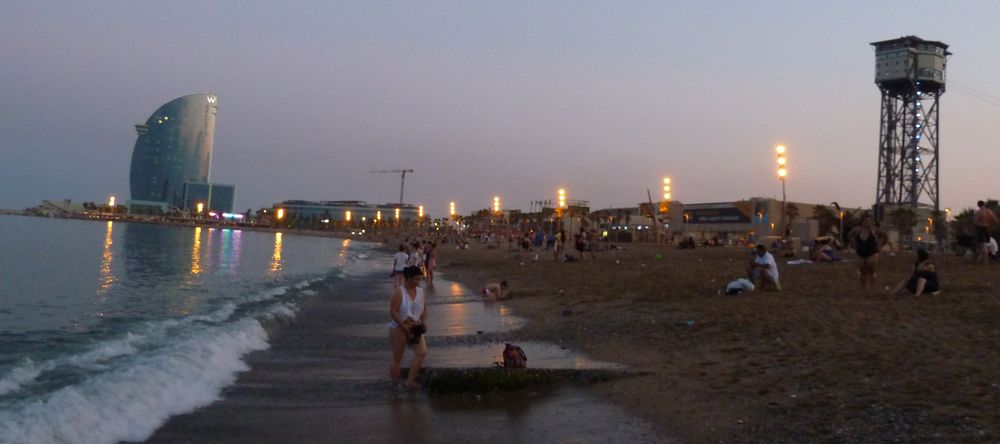
On our second day in Barcelona we visited the beach. It is impossible to describe this area with its combination of 17th, 19th and 21st century architecture so I will concentrate on the shoreline.
Barcelona beaches are a little dirty (sand and sea), especially the ones near the downtown. [8]
Catalonia is full of beaches since it is located in the east side of Spain and at the border of the Mediterranean sea. By coming at Barcelona, you are only at 25 minutes of the beach by walking from Plaza Catalunya. I will add that I don’t like much its beaches particularly the Barceloneta area, because it is dirty (sand and sea) – you can swim but it exists a high probability that you cross over a plastic bag in comparison to other ones. [10]

The gravel band
We dipped our feet in the water and I was immediately captivated by the mix of sand and gravel. The gravels were concentrated in a band of 2-3 meters width, parallel to the sea shore. There are two possible explanations:
  • This is caused by the size sorting effect of the waves.
  • This is a band (lens) of gravel that is enclosed between two layers of sand.
I can only speculate about the provenance of the gravel band. It might be local geology, but it might even be artificially transported foreign soil. In the city anything can happen.
The port area was quite amazing – the biggest floating mall in the world, a man made Egyptian sand beach, and lots of other businesses. [9]
Gravel sample
I did not have time to collect a large and representative sample. It was getting dark quickly and we were tired. And collecting stones is an antisocial activity if the others are not interested in geology. On my own I would have stayed longer and would have a more complete collection.
It is notoriously difficult to determine stone types. From this sample I can only recognize:
  • Granite - upper left
  • Limestone - center right - I should do an acid test to be completely sure, but I don't have hydrochloric acid available
  • Flint ? - lower right
  • Quartz ? - top middle right
All the others are a total mystery. Especially this one. 3 cm long with beautiful rectangular Crystals, a porphyritic structure. Very hard, certainly igneous rock.
Speculations
If the gravel band is natural it is most probably a river sediment. The rounded shapes are consistent with a long transport. It is most probable that the rounded shapes were not produced on the beach by wave action but during the river transport. This might have happened recently but also during one of the last ice ages.
[1]
 
Most likely the gravel comes from the Pyrenees or its promontories. The gravel might be relatively recent (1000-100.000 years).
Barcelona's coastal location and the proximity of the surrounding coastal mountain ranges leads to frequent flash flooding in the region. Many of the seasonal rivers on the outskirts of the city continue to pose flood risks. A normally dry river channel near Sant Pere de Ribes has evidence of a past flood level line in a river cliff. [3]
But the gravel might also be older (5-2 million years).
The lower Quaternary deposits overlie the Pliocene series, which is formed by a regressive sequence composed of marine blue marls followed by sands and marls associated with gravel lenses that pass progressively to the lower Quaternary sediments.
Quaternary alluvial detrital sediments are mainly composed of layers of red clay, yellow silt, and minor sand and gravel. The thickness of the alluvial detrital sediments is variable, attaining 20 m in the creeks. [2]
And the gravel might be even older (12 million years).
Twelve million years ago, the Mediterranean was taking on much of the shape it has today. Sea levels were dropping, and it would not be long, geologically speaking, before the Mediterranean became isolated from the Atlantic and, literally, dried up. Rivers were working tirelessly at the erosion of uplands old and new, pouring gravel, sand, and mud down to the ever-shifting coast. A great delta formed close to where Barcelona is today, its sediments eventually heaved up to form the mass of Montjuic. [11]
 And it might even be that the source of the gravel is an even older, conglomerate stone from the surrounding mountains.
 A spectacular example of conglomerate can be seen at Montserrat, near Barcelona. Here erosion has created vertical channels giving the characteristic jagged shapes for which the mountain is named (Montserrat literally means "jagged mountain"). The rock is strong enough to be used as a building material - see Montserrat abbey front at full resolution for detail of the rock structure. [4,5]
The granite
 The three rounded granites on the right are from the beach. The angular one on the left I picked up in a Barcelona park. They are definitely the same stone type.
Speculation
For economic reasons the granite I picked up in Barcelona must come from a nearby (max. 100 km) source. It would not be efficient to transport the heavy stone over long distances. This is confirmed by the same type granite I saw in the station at Figueres. (The colours look different in the pictures but in reality they were the same.)
Most probably it has been mined in one of the local stone quarries, like this one. I saw this one from the train between Barcelona and Figueres, but it is more probably a sandstone quarry that a granite quarry (from the shape of the incision).
This is further confirmed by this sample from the Barcelona museum. It is 600 - 300 million years old:

Granite: plutonic igneous rock - Dating:Upper Paleozoic - Provenance: Espanya,  Catalunya, Girona, Alt Empordà, Cantallops - The sample comes from the old quarry at Lamas, located on the highway from La Jonquera to Cantallops. The area is marked by widespread granite outcroppings from the axial zone of the Pyrenees, from the Upper Paleozoic superior. The granite has a granular texture with equigranular crystals of 4-6 mm. [6] 
And by this description of local Barcelona geology:
The Collserola mountain range forms the northern barrier to Barcelona's expansion. It overlooks the city. The Collserola is composed of two types of rock: metamorphic (slates, quartzites, metamorphic limestones) and igneous (granite). [7]


References:
http://www.planetware.com/map/spain-rivers-lakes-and-resevoirs-in-spain-map-e-e2.htm [1]
Variscan and Alpine structure of the hills of Barcelona: geology in an urban area,
Estructura herciniana y alpina de las colinas de Barcelona: geología en una zona urbana
P. Santanach, J. M. Casas, O. Gratacós, M. Liesa, J. A. Muñoz, F. Sàbat [2]
http://geographyfieldwork.com/besos_valley.htm [3]
http://geographyfieldwork.com/CovesdelCollbato.htm [4]
http://en.wikipedia.org/wiki/Conglomerate_(geology) [5]
Granite sample [6]
http://geographyfieldwork.com/Collserola%20Park.htm [7]
http://www.world-rt.com/travel/beach-barcelona.php [8]
http://sidetracked.gravel.co.nz/821 [9]
http://www.world-rt.com/travel/best-beaches-catalonia.php [10]
http://throughthesandglass.typepad.com/through_the_sandglass/2009/03/sandstones-of-barcelona-1.html [11]

Monday, April 29, 2013

The stones of home


Each time I visit Prague I discover new books by the psycho-geographer and psycho-geologist Vaclav Cilek. This writer has a special attraction for me, because he is not just a psycho-xxxx amateur (like me), he is a professional geologist, archaeologist and climatologist. But he combines his scientific thoroughness with the spatial, historic, cultural sensitivity and humour of writers like Nick PapadimitriouIain Sinclair and Phil Smith. Unfortunately none of his books have been translated into English.

The book Stones of Home describes a collection of rock and soil types that are most typical for the Czech landscape, history and national spirit. Each rock type is lovingly analyzed and connections are made between physical and geological facts and emotional effects. Who said science is cold and rational?

During my stay in Prague I went to visit some of the stones that Vaclav Cilek writes about. Below I have translated a few quotes from his book and added them to my own photographs.

And because I had been sensitized by Vaclav Cileks book I started seeing beautiful stones everywhere. And later, back in Rotterdam, I discovered several websites describing the stones of Prague. I know from bitter experience that determining rock types is extremely frustrating for the amateur. All rocks look the same and the one you try to determine is never mentioned in the encyclopedia (the same frustration applies to clouds, birds and plants). But with these guides it became a pleasant puzzle.

Prague stones mentioned by Vaclav Cilek in "The stones of home"
Granite - Facade of Komercni Banka, Vaclavske Namesti
Marble can be impressive on a small scale, but granite requires a large scale to be effective, a scale we know from Egyptian sculpture. If we want to experience this "Egyptian" monumentality on our own territory, we can respectfully circumambulate the obelisk of the Legionnaires near the Emmaus church or the gigantic semi-pillars of the Commercial Bank at the Venceslaus Square, that were carved from one single piece of rock.
Granite - Facade of Komercni Banka, Vaclavske Namesti
Granites and granodiorites are monotonous, practical stones that are more likely to suppress the imagination than to stimulate it. But we should realize that, if we didn't have granite and granodiorite, we would be using more concrete and artificial stone, and our lives would be poorer. Granite is like iron. It is not easy to become friends with it, but if you succeed, you will gain faithful and strong allies.
Pecerad gabbro - Facade of Komercni Banka, Vaclavske Namesti
Gabbro is a festive rock, but the fine grained dark varieties create a funereal atmosphere. It is interesting to consciously experience a graveyard dominated by light, usually limestone gravestones, and a graveyard with heavy dark stone, like for example the Old Jewish graveyard in the Old Town, compared with the New Jewish graveyard in the Olsany quarter. In the first one we may smile and listen to the birds, in the second we are compelled to compulsory sadness and formal heaviness.
 Black and white marble - Vaclavske Namesti
Red marble - Vaclavske Namesti
Czech red marbles are much older than all the other middle-european varieties. They are 350 million year old Devonian marbles called "slivenecky mramor". We used to think that the red colour was caused by iron oxides. But today we know that the situation was more complex and that the red colour is caused by bacteria living on the walls of tiny channels inside the limestone.
Sandstone - Charles Bridge
The trajectory of sandstone starts on the continent, where rocks crumble, rain dislodges sand grains and rivers deposit them onto beaches and into shallow shelf seas. There they are caught by strong sea currents and spread along the whole coast. Sandstone belongs to the Czech territory in the same way marble belongs to the Mediterranean. Czech sandstones have the colour of local bread and the taste of potatoes.
Prague stones mentioned by other urban geologists
Pozary granite (diorite?)- Pedestal of the King Venceslas statue, Vaclavske Namesti
Sedlcanska granite (?) - Metro station exit Museum,
Vaclavske Namesti, above the King Venceslas statue

Unknown but interesting stones I found myself
Syenite (?) - New wing of the National Museum, Vaclavske Namesti
Granite (?) - Stairs of the National Gallery, Veletrzni Palac
Granite - Facade at Vaclavske Namesti (forgot to note which one)
 
Sources:
Decorative Czech stones:
Stones of Prague monuments: