Sunday, September 16, 2018

Urban mushroom diary 21 - autumn 2017

Urban mushroom diary - autumn 2017

I've changed my method. It's so difficult to determine mushroom species that I hesitate to publish my pictures. So I'll start publishing the pictures as soon as I've made them. Naming will come later.

This is (part of) my backlog from 2017.

And I've made a label for this series: mushroom diary.

8 October 2018 Hoek van Holland
Coprinellus disseminatus


13 October 2018 Rotterdam


Bijschrift toevoegen


Urban mushroom diary 20 - autumn 2017

Urban mushroom diary - autumn 2017

I've changed my method. It's so difficult to determine mushroom species that I hesitate to publish my pictures. So I'll start publishing the pictures as soon as I've made them. Naming will come later.

This is (part of) my backlog from 2017.

And I've made a label for this series: mushroom diary.

3 October 2017 - Agaricus sp.


4 October 2017


Artomyces pyxidatus


Urban mushroom diary:


Sunday, August 19, 2018

Urban mushroom diary 23a - summer 2018

03 June 2018, Hoek van Holland - In the grass besides to sport fields. Impossible to name. It could be Infundibulicybe geotropa (?), but I'm just guessing.
In the city park, between the suburbs and the dunes. It's interesting to see how different the mushroom flora (fauna?) is from Roterdam. The park looks similar and has the same age, but there are other mushrooms here.
I really should buy a better camera, because mushrooms grow in dark places and a smartphone works badly in those circumstances.
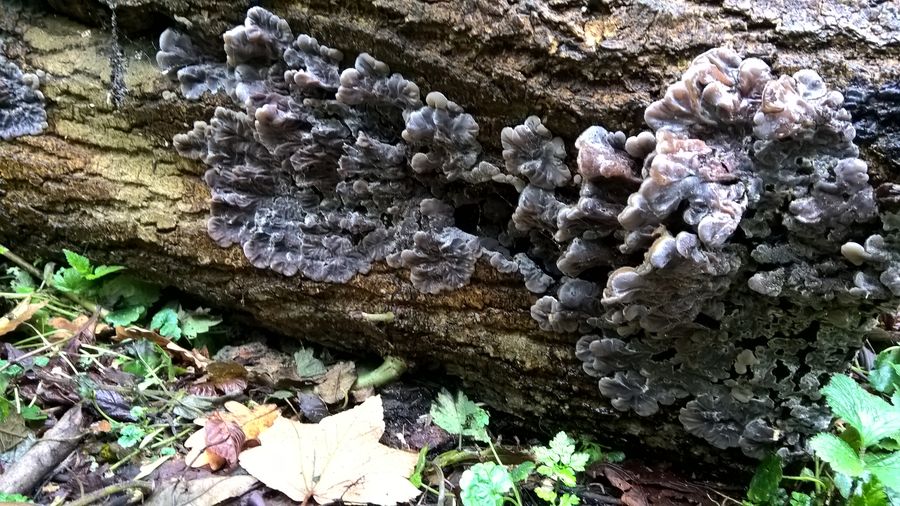
My guess: Xylaria polymorpha. Notice the slugs.
My guess is: Ganoderma applanatum. I don't think it is Fomes.
Another example where the smartphone camera fails. It's impossible to get a sharp image of the miniscule growths. Slime mold or fungus? Difficult to say. It might be Typhula erythropus.

Saturday, August 18, 2018

Urban mushroom diary 19 - spring 2018

02 May 2018, Amsterdam - There are a lot of hallucinogenic mushroom for sale in Amsterdam. I'm somewhat tempted to try them - purely out of mycological curiosity. But most probably I'll never do it.
Passing outside a hipster restaurant in the park, I saw this display of vegetables, including Agaricus bisporus in two versions (common and Portabello). But still the same species.
11 May 2018, Rotterdam - I was surprised by this display of Ornithogalum umbellatum along a suburban artery. It used to be a protected species but here it is very common.
And near this clump I saw my first mushroom of the year. I have no idea what it is. There were only two so I didn't pluck it. Itcould be Lepista or Clitocybe. Will have to look next year.
12 May 2018 - On a stump in the city park I saw this strange mushroom. I couldn't identify it then. After watching the stump for weeks I think this is Paxillus involutus (Krulzoom). An interesting poisonous mushroom.
One of those frustratingly difficult mushrooms on a log in the city park. I had to look through the whole book for this one. This could be Pholiota mutabilis, but the stipe looks different and the spores are darker. But most likely Hypholoma fasciculare. Also possible: Hypholoma capnoides. Improbable: Galerina marginata.
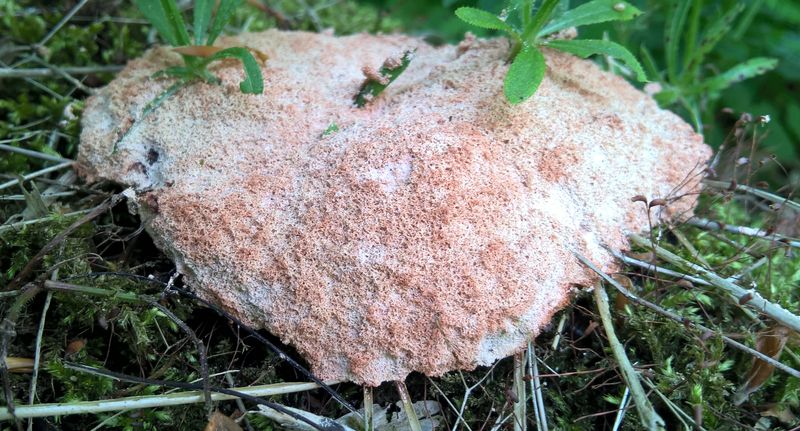
A slime mold, Enteridium lycoperdon also called false puffball. A fascinating organism.
19 and 21 May 2018 - Polyporus squamosus. One of the easy mushrooms. They are very common around here.
27 May 2018 - Coprinus comatus. One of the easy mushrooms. I forgot to watch this space, and the mushrooms were already gone. There were less of them than last year. At this time I still expected a good mushroom year. I hadn't expected the extreme drought.
1 June 2018 - Blown glass Amanita muscaria in a Prague glass shop. The prices are in Czech crowns (CZK).


Sunday, August 12, 2018

Topology for artists - workshop sketch 4

Topology for artists, walkers and other non-mathematicians
One of my little dreams is to make and give a workshop about topology for artists, walkers and outher outsiders. It might be called: The topological toolkit. What you didn't know about spaces. These are preliminary notes: YouTube topology, Styles of topology, Spaces and maps. and Translation. I try to post small updates often, to keep myself working on this.

I love the remarks of John Ciardi about his Dante translation. They are a perfect example of spatial and structural thinking. Here, once again, he describes the structure of languages and the difficulty of mapping from one space to the other. He describes the complex structure of words and uses a spatial metaphor:
We tend to use only the top slice of a word in speech usage. But once the other levels of a word are allowed into consideration, no word is a simple thing. It becomes a complex. But if a single word is a complex, then a phrase is a complex of complexes, and a line is a complex of complexes of complexes, and a stanza, and a poem are ... and so forth and so on.
And the picture is even more complicated. It reminds me of these complex fractal spaces:
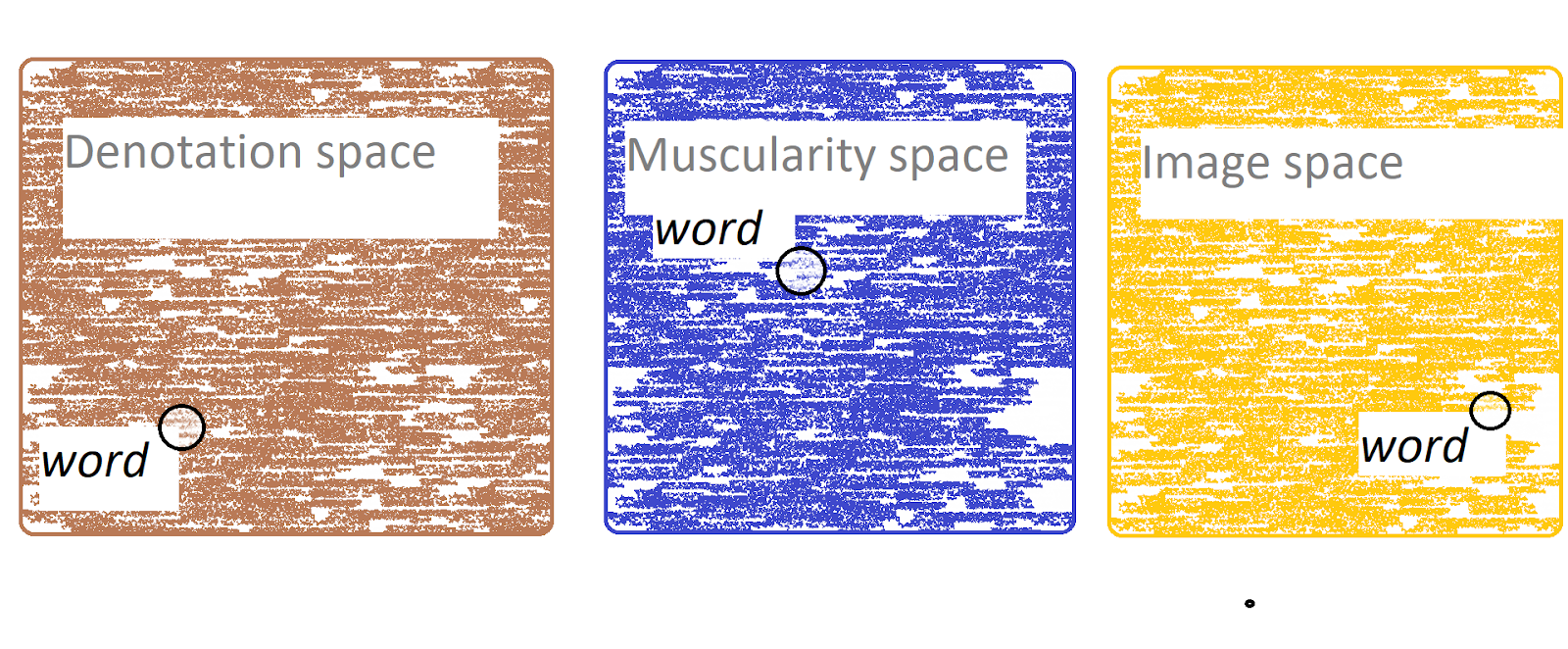
The word has different positions in this space, in different planes of meaning and feeling. You can build many spatial models for this situation and below I use the simplest one:
The American word “daisy,” for example, labels the same flower the French intend by "la marguerite" and the Italians by "la margherita" ... those are the words one would naturally use in these three tongues for labeling any particular daisy. Semantically, that is to say, the denotations are reasonably firm.

But words consist of much more than denotation. Every word has a certain muscularity. That is to say, it involves certain speech muscles. Certainly any man who is a word-sensitive is likely to linger over the difference between the long-drawn Italian "carina" and the common, though imprecise, American usage “cute” when applied to an attractive child. …
Every word has an image locked into its roots. The English word “daisy” is a contraction of the earlier “day’s eye,” which is to say, “the eye of day”— a lovely root image. Marguerite and margherita also have a root connotation of all girls named Margaret/Marguerite /Margherita—and bless them all as lovely images. … 
And the place of the word inside its spaces of meaning and feeling changes over time. Complicating the picture further:
Every word, moreover, has a history. Sometimes the history changes out from under the word very rapidly. English “broadcast” once meant specifically “a way of sowing” and was borrowed by radio as an analogy. Meanwhile new machines all but eliminated the old methods of broadcast-sowing, and the word has just about lost all farm-connotation. …
This complexity of the language spaces precludes simple translation even at the world level:

Translation is, in fact, the wrong word for the process of rendering from one language to another. The idea of “translation” seems to suggest that there exists in Language A some word that will equal any given word in Language B, and that the translator need only find that equivalent word and put it in place … But such an assumption ignores the nature of words.
One could say that the space of language is complicated, deep and wild. I will talk about "wildness" in one of the next posts.

Sources: