Sunday, August 5, 2018

Topology for artists - workshop sketch 3

Topology for artists - workshop sketch 3
One of my little dreams is to make and give a workshop about topology for artists. It might be called: What you didn't know about spaces. Topology for artists. These are preliminary notes: YouTube topology, Styles of topology and Spaces and maps.

I started reading popular and introductory texts about topology two years ago. Since then I've become more sensitive to spatial metaphors. That's why I think a topology workshop might be interesting for artists. See for example the concept of a mapping between two complicated spaces.

Let's use music and language as examples of large, complex spaces. In his translator's note to Dante's Inferno John Ciardi writes:
When the violin repeats what the piano has just played, it cannot make the same sounds and it can only approximate the same chords. It can, however, make recognizably the same "music," the same air. But it can do so only when it is as faithful to the self-logic of the violin as it is to the self-logic of the piano.

Language too is an instrument, and each language has its own logic. I believe that the process of rendering from language to language is better conceived as a "transposition" than as a "translation," for "translation" implies a series of word-for-word equivalents that do not exist across language boundaries any more than piano sounds exist in the violin.
What must be saved, even at the expense of making four strings do for eighty-eight keys, is the total feeling of the complex, its gestalt.
This is an interesting metaphor and it can be translated into a spatial (and set-theoretic) model, that does not feel threateningly mathematical.
Some observations:
  • The spaces of piano and violin possibilities are both huge. But they are smaller than the space of all musical possibilities. But somehow they must fit within this space, they are subsets embedded in the larger space.
  • The mainstream parts of these spaces have been exhaustively explored by composers like Mozart and Beethoven.
  • The virtuoso parts of the spaces have been explored by composers like Liszt and Paganini.
  • The experimental parts of the spaces have been explored by composers like Cage and Ferneyhough.
  • Large parts of the piano and violin spaces are as yet unexplored.
  • Both spaces must have some shape and must have boundaries, because there are constraints on both the piano and the violin (neither can play infinitely loud of infinitely fast, neither can play an infinite number of notes at the same time etc.).
  • Most likely there exists a distance measure in this space, because the distance between Mozart and Beethoven should be smaller than the distance between Liszt and Cage.
  • As far as I know there are few transcriptions (mappings) from piano to violin.
  • We could add ideas from coding theory and information theory. We could mention principal component analysis.
The mapping idea becomes easier in these musical spaces:
Again these spaces must be huge and must have some shape. And there exist many mappings between those spaces, in both directions. There exist transcriptions of orchestral pieces for piano but also arrangements of piano pieces for orchestra.

John Ciardi continues:
The notion of word-for-word equivalents also strikes me as false to the nature of poetry. Poetry is not made of words but of word-complexes, elaborate structures involving, among other things, denotations, connotations, rhythms, puns, juxtapositions, and echoes of the tradition in which the poet is writing. It is difficult in prose and impossible in poetry to juggle such a complex intact across the barrier of language.
These are pictures made by the Arsuaga Vazquez Lab (Topological Molecular Biology lab at UC Davis) and for me they illustrate how the complicated structure of such poetic spaces might look. The first one uses knots and the second one uses simplical complexes. Both are topological devices.
And finally John Ciardi writes:
I have foregone the use of Dante's triple rhyme because it seemed clear that a rendering into English might save the rhyme or save the tone of the language, but not both.

It requires approximately 1,500 triple rhymes to render the Inferno and even granted that many of these combinations can be used and re-used, English has no such resources of rhyme. Inevitably the language must be inverted, distorted, padded, and made unspeakable in order to force the line to come out on that third all-consuming rhyme.

In Italian, where it is only a slight exaggeration to say that everything rhymes with everything else or a variant form of it, the rhyme is no problem: in English it is disaster.
This shows that some mappings (functions) between certain spaces are impossible. There are constraints on spaces and constraints on the mappings between them.

Sources:

Tuesday, July 31, 2018

Topology for artists - workshop sketch 2


Topology for artists - workshop sketch 2
One of my little dreams is to make and give a workshop about topology for artists.
It might be called: What you didn't know about spaces. Topology for artists.
These are preliminary notes. Previous ones are here: YouTube Topology, Workshop sketch 1.

I started reading popular and introductory texts about topology two years ago. Since then I've become more sensitive to spatial metaphors. That's why I think a topology workshop might be interesting for artists. See for example the concept of a mapping between two complicated spaces.
For example:
When Mary speaks to Peter, she has a certain meaning in mind that she intends to convey: say, that the plumber she just called is on his way. To convey this meaning, she utters certain words: say, ‘He will arrive in a minute.’ What is the relation between Mary’s intended meaning and the linguistic meaning of her utterance?
A simple (indeed simplistic) view is that for every intended meaning there is a sentence with an identical linguistic meaning, so that conveying a meaning is just a matter of encoding it into a matching verbal form, which the hearer decodes back into the corresponding linguistic meaning.
But, at least in practice, this is not what happens. There are always components of a speaker’s meaning which her words do not encode. ... Indeed, the idea that for most, if not all, possible meanings that a speaker might intend to convey, there is a sentence in a natural language which has that exact meaning as its linguistic meaning is quite implausible.
… While it might seem that a speaker’s meaning should in principle be fully encodable, attempts to achieve such a full encoding in practice leave an unencoded, and perhaps unencodable, residue.
Here we see a mapping (a function, a relation) from the space of intended meanings to the space of sentences, (verbal utterances,  linguistic meanings). Then the nature of this mapping is discussed.

In topology we might ask how the two spaces look like and what their properties are.

We also might ask whether the mapping is homeomorphic. This will depend upon the nature of the mapping but also on the properties of the two spaces.
Very roughly speaking, a topological space is a geometric object, and the homeomorphism is a continuous stretching and bending of the object into a new shape. Thus, a square and a circle are homeomorphic to each other, but a sphere and a torus are not. However, this description can be misleading. Some continuous deformations are not homeomorphisms, such as the deformation of a line into a point. Some homeomorphisms are not continuous deformations, such as the homeomorphism between a trefoil knot and a circle.
I believe in the idea of the workshop. But at this moment I'm still in this stage. Bear with me and help me if you can:
Sources:
Some interesting links for future use:

Sunday, July 29, 2018

Urban mushroom diary 18 - spring 2018

In the spring of 2018 it looked like it might become a nice mushroom year. While not actively searching for fungi I saw several interesting ones.
8 April 2018 - A very common parasitic mushroom Kretzschmaria deusta.
And on the same tree Trametes hirstutus. Both these mushrooms are present all year round, so these do not predict if it will be a good mushroom year. I used to ignore them as "not really interesting" but I've changed my opinion.
And in this same arboretum (Arboretum Trompenburg) there is a plantation of Shii take mushrooms. But in this season I didn't see any yet.
22 April 2018 - The first "real" mushroom. I was waiting for it because it's quite common in our city park. Polyporus squamosus. Wikipedia says: The mushroom's smell resembles watermelon rind. That's right and it's not a very tasty smell.
The underside of the mushroom is very beautiful, with its pore pattern. You can see those patterns in other species too. 
24 June 2018 - I saw the same mushroom once again in June, but then it was smaller and very dry. It could also be Polyporus tuberaster.
20 April 2018 - Then in April I saw this bundle of mushrooms. At first I thought that these were remains from last year. But I doubted that they could survive the winter. Then I saw more of them in other places in the city park. And when I looked in the mushroom book I knew I should have recognized them: coprinus! They have all the signs of the species. More precisely: Coprinus micaceus.
28 April 2018 - I went to look for mushrooms in the Rotterdam Museum of Natural history. They have two exhibits. Here are: Basidiomycota. In front you see: Ganoderma applanatum, Polyporus badius and Trametes versicolor.
And here are Ascomycota. In the glass jar: Morchella hortensis.


Urban mushroom diary:

Saturday, July 14, 2018

Urban mushroom diary - 16 - autumn 2017

Urban mushroom diary - 16 - Rotterdam, autumn 2017
I'm always looking for city mushrooms in nature and culture.
Interesting to see how fungi invade our world.

Like I said in the previous post: this is a wretched obsession. It is pure drudgery to find the names of fungi and often they're impossible to name. Here I'll try to name the unnamable ones.
28 September - Besides an asphalt road leading to offices in Gouda. The picture shows why I'm interested in fungi. This one is as beautiful as a flower but stranger and more ephemeral. Maybe it's: Parasola plicatilis. It certainly looks like a member of the Coprinus genus. But this genus now has been split into four different ones and I don't know which name is correct. And I love mushroom experts complaining about the difficulty of the trade:
Simply getting some inky caps home to study can be a challenge, since many are so ephemeral that they appear, liquefy, and turn into black goo within a matter of hours. Identification of these short-lived mushrooms (did I mention that they all look pretty much the same?) hinges on microscopic examination of various erudite features, and is an enterprise best left to folks who enjoy such endeavors. 
This might be another inky cap: Coprinus micaceus. Seen in the city park.
This might be: Panaeolus foenisecii. Or: Panaeolus olivaceus. This was in the parking lot of a suburban hotel. One of the most common mushrooms. It grows anywhere near grass. In my book it's next to Psilocibe, but this one should not be hallucinogenic.
And this could be: Tricholoma argyraceum. In the same hotel parking lot.
And this could be: Hebeloma mesophaeum. These were found in the shrubbery next to an office block next to the train station. It was an unpleasant, rubbery and slightly slimy mushroom. Inedible and bitter, says the book. I wonder if I'll see them again next year. 
This could be some Marasmius, but I'm not sure.
Marasmius? Entoloma? Mycena?
This could be: Pholiota mutabilis. Excellent mushroom, says the book. But it often grows together with a similar, but deadly mushroom: Gallerina marginata. But more probably, it could also be: Armillaria mellea. I should have returned a week later, when they had matured.
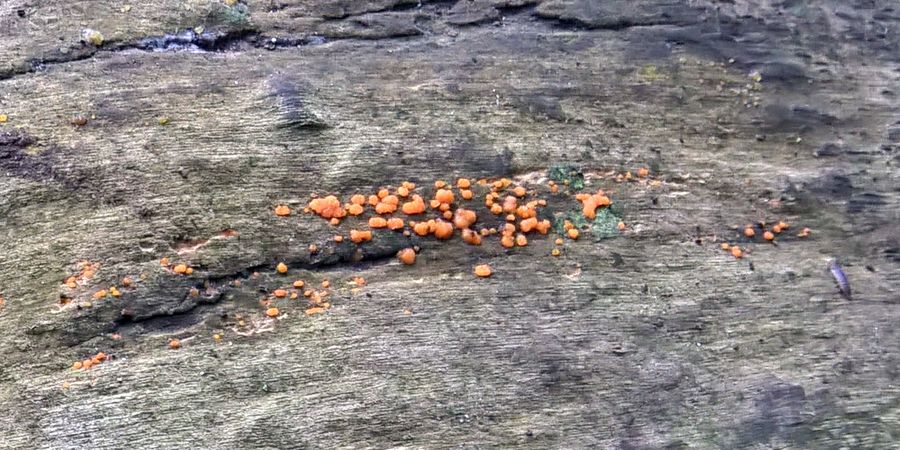
This might be: Dacrymyces stillatus. It's microscopic and only visible because of its color. One day it was there and the other day it was gone. I despaired of ever determining it, but it seems to be very common and it had a prominent place in my new mushroom book.

Urban mushroom diary:

Thursday, May 10, 2018

Topology for artists - workshop sketch 1

One of my little dreams is to make and give a workshop about topology for artists.
It might be called: What you didn't know about spaces. Topology for artists.
These are preliminary notes. Previous ones are here: YouTube Topology

I've learned that there are two starting points for topology. The first starts in geometry and shapes and is artistic. The second starts from point set topology and is philosophical (even including Husserl, see below). These paths are connected, but I don't know how (yet).

Note: I used a spatial metaphor in the above paragraph unintentionally. Unconsciously I map topology itself onto some abstract space. Connectedness and path-connectedness are topological terms themselves. You can even map the whole of mathematics onto a space.

Looking for inspiration I found the following semi-popular books about topology. This is the geometric approach. I will maybe order both of them, but the second one is quite expensive:
From the first book: the projective plane built from a Mobius strip. This shape can only exist in the fourth dimension:
From the second book: a hexagonal Mobius strip with one twist. This on exists comfortably in three dimensional space:
Then there is interesting free material on the internet by Matilde Marcolli. This is also more geometric:
With a nice illustration of the four possibilities for folding and gluing a two dimensional surface, yielding three and four dimensional objects:
Then I found this inspiring article, where topology is extended into mereology. This is more (analytically) philosophical. I knew about the term mereology from this book, but I didn't know it used topological building blocks. This is exactly where I would like to go:
A basic introduction of topological ideas (and there is also a very interesting section on Husserl that I don't quote here):
... topology takes as its starting point the intuitive notion of boundary. ... Imagine a solid and homogeneous ... sphere. We can distinguish ... two parts of the sphere which do not overlap (they have no parts in common): on the one hand is its boundary, its exterior surface; on the other hand is its interior, the difference between the sphere and this exterior surface (that which would result if, per impossibile, the latter could be subtracted from the former).
And (this is mereology):
The property of being a (single, connected) body is a topological spatial property, as also are certain properties relating to the possession of holes (more specifically: properties relating to the possession of tunnels and internal cavities). The property of being a collection of bodies and that of being an undetached part of a body, too, are topological spatial properties. It is a topological spatial property of a pack of playing cards that it consists of this or that number of separate cards, and it is a topological spatial property of my arm that it is connected to my body.
And a more formal look at the concepts:
We may define a closed object as an object which is identical with its closure. An open object, similarly, is an object which is identical with its interior. The complement of a closed object is thus open, that of an open object closed. 
To be continued.

Saturday, April 28, 2018

A strange country

The past is a foreign country; they do things differently there.
 L.P. Hartley, The Go-Between

I was again reminded of the truth of this wisdom (or platitude, or both) when I prepared to clean out this book I got from the second-hand market. This is 1966, but it looks different, ancient and also strangely modern. It looks like a parallel timeline that never really happened. But it did happen. And now it's gone more completely than the Middle Ages.
At the municipal graveyard

This is from Toon, Foto's van Robby Pauwels, 1966, by Toon Hermans, Robby Pauwels, Andries Blitz, (De erven de wed. J. van Nelle N.V., Rotterdam). A book about a well known and talented Dutch entertainer (he called himself a clown). He died not too long ago. But how different it all looks!
Innsbruck, just before we would start decorating the Christmas tree

It might have been in the depths of the Cold War, with the hippies, student revolts and the invasion of Czechoslovakia a few years into the future. Charles de Gaulle and Harold Wilson were in power. How calm and peaceful this time looks, compared with today.
Wall flowers

Saturday, April 7, 2018

The flaming sun and De Chirico - 2

I'm always intrigued by the presence of the surreal "sun in splendor" in ordinary surroundings, creating a strident contrast. Especially in the boring suburbs of Rotterdam. I have written about this symbol before and will give more examples below.

It also reminds me of the late work of Georgio de Chirico. This Neometaphysics (1968-76) period is usually ignored by art critics but I find it very fascinating. It resonates with my interest in sky mysteries. See for example the Sun on the Easel from 1973.
The official explanation says the following, and this could be an explanation for the ubiquity of the symbols:
... while thinking of Italy, its cities and ruins ... the suns and stars had returned to earth like peace-loving immigrants. Without doubt, they must have turned themselves off in the sky, because I saw them light-up once again at the entrances and gates of many of these houses ...
But another very interesting explanation says the following. I encourage you to read all of it:
In this canvas, Sun on the Easel, the theme of insight and out-sight is clearly apparent as he places a glowing sun (representing exterior sight) and a bright moon (interior thought) inside his studio with their darkened counterparts outside.
And I agree with this assessment of the quality of the late work of De Chirico:
The final Metaphysical paintings are powerful poems on the sun. Painters have painted sunsets, none have painted the idea of the sun, the power of the sun, the enigma of the sun. This is an amazing series of paintings.
The suns that we see on the outskirts of Rotterdam and in shopping malls are just as surreal as the De Chirico paintings.
The sun symbol is old (Medieval) and irresistible. It infiltrates our bland modern surroundings.
And the black sun in the De Chirico paintings could be the black sun of the night:
For the Mexicans there were two suns, the young Day Sun and the ancient Dark Sun. Some scholars regard the mythological Black Sun as the ancient female origin of all, it is both tomb and womb.
Another interpretation holds that the sun god Huitzilopochtli crossed the underworld during the night bestowing light to the forgotten souls, however, he demanded human blood as payment to his tasks.

But it might also be related to alchemy:

Sol niger (black sun or the crows head) can refer to the first stage of the alchemical magnum opus, the nigredo (blackening). In a text ascribed to Marsilio Ficino three suns are described: black, white, and red, corresponding to the three most used alchemical color stages. 

And the motif of the moon embracing the sun can also be seen in the De Chirico paintings. This website says the following, but they forget to mention the moon!
Interestingly, one gem of the Di Donna effort is de Chirico’s “The Two Suns,” a wonderful late painting from 1969 in which art triumphs over life: A vivid sun blazes from the artist’s easel while a black one sets over the city beyond.
Most likely we will never know the correct interpretation of the De Chirico symbolism. Many ideas above are plausible, but they don't explain the cables linking the black and the golden sky bodies. Is it just an electric cable? Are these artificial sceneries in a theatre, that will be hauled upwards by some mechanism? We can only wonder and remember when we see a mysterious sun in the forgettable outskirts.