Sunday, January 27, 2013

Argonaut Park

Rotterdam - places of pilgrimage - 4
Emergency meeting, drove me round and round the park in a car, yelling blue murder. Said I was so plastered these days I didn't know fact from fiction. All that stuff.
This afternoon I took my bicycle to inspect some parks in the North of Rotterdam. I had memories of one park looking like London. A green area surrounded by city buildings. Tops of city buildings poking through treetops. I was not sure which park it was: the Melanchton or the Argonaut park. Conclusion: it was the Argonaut park, but the park has been restructured in the meantime, destroying the London effect.
Better still, the neighbourhood possessed no social identity and demanded none. Some of the houses had been turned into one-roomed flats, and had ten door bells laid out like a typewriter. Some were got up grandly and had only one.
The cause of the destruction was this completely new quarter. It was not there when I last visited the area (5 - 10 years ago). Generic modern buildings. Apartments costing 250.000 euros. The park had been re-landscaped to accommodate this project.
It was terribly cold. The wind seemed to come from the river, across the park. He looked up and down the road. It was empty. He walked a hundred yards or so toward the power station, changed his mind and turned back. He was sleepy. It was a curious illusion that even in the street he still heard the telephone ringing.
In some directions the London effect was still visible. Older city buildings at the edges of a wide green field. A clear border, an enclave. A few people walking their dogs. Some families with children. Cold wetness. Typical Dutch winter weather.
And come the dawn, do you know what we did? I will tell you. We walked solemnly down to the parks, I sit on a bench with a stopwatch, big Jim gets into his running kit and lopes twenty circuits. Twenty. I was quite exhausted.
At home I did some research on the place. There were a lot of documents on the restructuring of the park with many interesting details. Things I wouldn't have thought about:
  • Bicycle and pedestrian traffic will be separated.
  • Trees with different colours and shapes will be planted (amelanchier - krentenboompje).
  • Digging more ponds is not possible for geotechnical reasons. The ponds will get sloping, more natural banks enhancing biodiversity.
  • Asphalt paths are less natural than sea-shell paths. But sea-shell paths are difficult to maintain. Grass grows through them. Wheels leave tracks.
  • The dog- and child areas have been separated. The dog area cannot be moved towards the water. Water quality would suffer. Dogs cannot roam freely, playing children dislike free running dogs.
  • The police has advised to keep several paths dark so that people will not walk there at night.
  • The work had to be interrupted because of the nesting season of the wood pigeons. (In the countryside the shoot these, as pests.)
He went to functions, lectures, strolled in the park, played a little tennis and short of giving sweets to the kids he couldn't have been more respectable.
Some comments from the public:
  • The child playing area is always swampy.
  • Parents won't let their children play in one park area because it is too dark. This will not be changed. Maybe some bushes can be thinned-out.
  • Asphalt paths and the new bridge might attract unwanted scooter traffic from the neighboring school.
  • Park benches along the water might attract boisterous youths. Also the stairs and the green slope might attract loiterers. (The area has a higher than average percentage of old folks.)
The pickups were variously contrived. At Green Park, by way of a recognition signal, he carried a Fortnum Mason carrier-bag. At the embankment, on the other hand, he clutched an out-of-date copy of Time magazine, bearing by coincidence the nourished features of Chairman Mao on the cover. Big Ben struck six and Jerry counted the chimes, but the ethic of such meetings requires they do not happen on the hour nor on the quarter, but in the vaguer spaces in-between, which are held to be less conspicuous.
General remarks about the area:
  • In 2008 someone left mysterious packages in several parks on the north side of Rotterdam. Black garbage bags containing many platsic wrapped packages. Each package containing a coconut and one half lemon. Or a coconut and cotton wool. Or a coconut and some coloured powder. This has never been explained.
  • There are problems with the ground-water levels damaging the foundations of buildings.
  • The older parts of the area lie much higher because the village of Hillegersberg has been built upon a fossil sand dune from the ice age.
Sources
Samenvattend verslag van de informatieavond schetsontwerp Argonautenpark op donderdag 1
juli 2010 vanaf 19.30 uur in het deelgemeentekantoor van de deelgemeente Hillergersberg-Schiebroek - http://www.deelraadinfo.nl/dsresource?objectid=59983&type=org
De herinrichting van het Agonautenpark loopt volgens planning - http://www.rotterdam.nl/DG%20Hillegersberg%20-%20Schiebroek/PDF/2012-09-20%20-%20stand%20van%20zaken%20Argonautenpark%202011.pdf
http://www.rotterdam.nl/DG%20Hillegersberg%20-%20Schiebroek/PDF/Gebiedsvisie%202011-2014/Analyses,%20ambities%20en%20actiepunten%20Hillegersberg-Noord.pdf
Mysterie: kokosnootpakketjes in parken - Argonautenpark - http://www.ad.nl/ad/nl/1038/Rotterdam/article/detail/2111351/2008/04/10/Mysterie-kokosnootpakketjes-in-parken.dhtml
THE LOOKING GLASS WAR - John LeCarré
Tinker Tailor Soldier Spy - John le Carré

Friday, January 25, 2013

The nonexistent Eruv of Rotterdam

Nostalgia for a Rotterdam eruv
The thin line of the eruv stretches through space, reminding us of Shabbos and delineating the permissible from the forbidden.
Rotterdam does not have an eruv but I wish it had. I would feel more at home in an enclosed city, a city with a reliable and stable boundary. A city with walls, however symbolic. In the last decade of the 17th century Rotterdam still had an eruv as cited in Jewish literature.
During the latter part of the 17th century cities had outgrown their walls and newer cities were built without walls altogether. Teshuvos written at that time addressed the possibility of utilizing canals and rivers as the necessary walls to enclose cities such as The Hague and Rotterdam. During the latter part of the 19th century, as telegraph, telephone, and electric wires sprung up all over the countryside, they were incorporated into the community eruv as well.
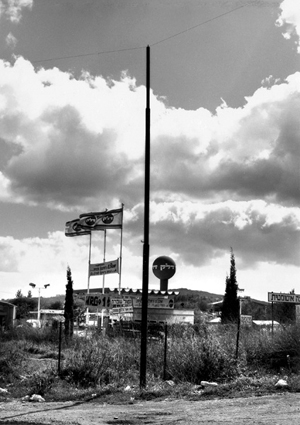
I had a sudden attack of nostalgia for the eruv when I saw this roundabout in the North of Rotterdam, with its high lampposts and horizontal electricity cables. I wish I had a symbolic city boundary that I could visit. That I could touch. Unfortunately all chances of this have been destroyed by the cruel history of the 20th century.
While the number of active eruvs in Europe was reduced as a result of the decimation of its Jewish population by the end of the Second World War, eruvs still support ritual life in London, Antwerp, Rotterdam (!), Strassbourg and The Hague. Eruvs are common features of cities with significant Jewish populations.
There is a slight temptation to trace a possible route for a Rotterdam eruv. It would give me an excuse to read some of the wonderful rabbinic literature on the rules for the eruv. And I would learn a lot about Jewish history and about Rotterdam. But I will resist that temptation. It would be incredible arrogance for a non-Jewish amateur to attempt something like that. Chutzpah indeed. And Rotterdam has not always been a tolerant city.
Immediately after Dutch women acquired the right to be elected in the Dutch parliament - in 1919 - Jews tried to apply the same right to the Synagogue board of Rotterdam. However, all these efforts were suppressed by the Dutch rabbinate.
The Eruv spatial concept
I find the Jewish idea of the "eruv" very sympathetic:
A ritual enclosure that some communities construct in their neighborhoods as a way to permit Jewish residents or visitors to transfer objects from one domain type to another, such as carrying an object from indoors (a private domain) to a public street (a public domain) on Shabbat, which they would otherwise understand to be prohibited by Jewish law. An eruv accomplishes this by integrating a number of private and public properties into one larger private domain.
Eruv examples
There are several pictures of an eruv on Flickr. At first sight the eruv can be very inconspicuous. According to this New York urban explorer - HoboMatt - the Manhattan eruv is made of fishing line:
If you look closely at the very top of the light pole, you might be able to make out two taut pieces of fishing wire running toward the top and left of the photo. They make up a small part of the Manhattan Eruv, a ritual enclosure that allows observant Jews to carry objects within its bounds on Shabbat. The eruv is inspected regularly, and a break was found a few months ago on a Friday afternoon, hours before the start of Shabbat.
Nowadays the status of an eruv is announced through Twitter. I can imagine the practical problems when an eruv is not kosher on the Shabbat.

Antwerp eruv
According to Wikipedia there is a visible Eruv in Antwerp around the Singel street.

In Belgium the only city with a eroew is Antwerp . The Antwerp eroew can be found along the green line between the Singel and the Ring. The thread is mainly formed by the nr.59 railway line. Some entry gates (for example, the bridge over the Ring, next to the Sint-Church) have been symbolically provided an extra span.

During my recent visits to Antwerp I had no time to search, but it is still on my to-do list.
As in other cities with large Jewish communities, Antwerp is surrounded by a wire called "eruv" (Eiroew in Dutch). Different from the eruvs in New York or other large sities, the Antwerp eruv surrounds the whole city center. The presence of this eruv allows Jews to interpret the city as one big house, making it easier to avoid breaking some Sabbath regulations within it. The wire constituting the eruv can be found close to the Singel at a height of 6 meters.
Stadsgeschiedenis 2 (2007) 1: Afbeelding 2: De Antwerpse eroev (Tourist Traveler Guide fot the Jewish visitor by Machsike Hadass Antwerp [Antwerpen, 2001] 23)
Although the eruv borders are clearly defined and evident for those for whom its function has a meaning, the evidence of the eruv is generally unnoticed by the larger population, and it is by no means a tool of "exclusion". Most inhabitants of Antwerp are unaware of the existence of such a delineation for Orthodox Jews in the city. The borders of the eruv are not guarded or border-controlled areas and they remain essentially "invisible" (and irrelevant) to non-Orthodox inhabitants of the city. Antwerp thus has a porous, and  for most of the population, even invisible borders of religious significance.
Amsterdam eruv
Amsterdam has an eruv too, but I do not know if it is visible or tangible (it is tangible but the location is not disclosed out of fear of vandalism). It is a future project to walk this route that is more than 20 km long.
Eruv of greater Amsterdam - Amsterdam and its suburbs (Amstelveen, Aalsmeer and Uithoorn) are part of the greater Amsterdam Eruv, re-established by the Amsterdam Beth Din in March of 2008. A map of the Eruv indicates the Amsterdam Center and Buitenveldert areas.
I like the pictures of the rabbis with the Amsterdam map. It looks as if they had fun performing their religious duties. (That's one of the things I find sympathetic in Jewish religion.) I don't want to give offense by copying non-CC pictures, so here are the links:

 And here is an interesting eruv video:


Eruv and art
The peculiar symbolic, ritualistic and spatial properties of the eruv are irresistible for modern artists. Many artworks have been made around this concept.
Elliott Malkin has reconstructed a part of the the former Third Avenue elevated train line in lower Manhattan. This train line was part of the eruv for Orthodox Jews on the old Lower East Side. Using semacodes, the former boundary is reconstructed and mapped back onto the space of the city.
Elliott Malkin also built a laser eruv. Rather than wire, each side of the eruv consists of a single laser shot directly into the lens of a small surveillance camera across the street, creating a bloom of laser light. If a beam is interrupted, the surveillance camera registers the absence of its bloom, easily pinpointing the portion requiring maintenance.
And in 1996 Sophie Calle made an artwork about the The Eruv of Jerusalem:
Calle asked fourteen residents of the city, both Israeli and Palestinian, to take her to public places they consider private and share their personal associations with the sites. The narratives reflect the complexities and contradictions that accompany the notions of territory and “other,” as well as the seemingly banal, yet ineffable memories experienced by everyone.
Sources
There is so much to say about this fascinating subject. This will certainly not be the last article. Even though the list of resources is long I still have more ...

A Discussion of the Halachic Issues Regarding Eruvin in Brooklyn
The Contemporary Eruv: Eruvin in Modern Metropolitan Areas, Yosef Gavriel Bechhofer
American Sanctuary: Understanding Sacred Spaces, Louis P. Nelson
Eruv - http://en.wikipedia.org/wiki/Eruv
Manhattan eruv - http://imjustwalkin.com/2012/01/30/the-manhattan-eruv/
Local eruv - http://www.flickr.com/photos/imjustwalkin/6921823167/
Antwerp eruv - http://en.wikipedia.org/wiki/Jewish_Community_of_Antwerp
Antwerp eruv - http://antwerphoto.wordpress.com/2013/01/13/antwerps-eruv/
Stadsgeschiedenis Antwerpen - http://www.stedengeschiedenis.nl/Downloads/Stedengeschiedenis/2007-SG1.pdf 
Borders and Boundaries in and Around Dutch Jewish History, Judith Frishman
Jewish Amsterdam map
Jewish Community of Amsterdam website and eroev pictures
Amsterdam Eruv in the newspaper
Shabbat pole in Amsterdam - http://nl.wikipedia.org/wiki/Sjabbatpaal 
L'Erouv de Jérusalem - Sophie Calle, M'as-tu vue - Exhibition curated by Chrisline Macel
Centre Pompidou, 19 November 2003 - 15 March 2004, Prestel Verlag - Éditions du Centre Pompidou, Éditions Xavier Barral - 2003

Tuesday, January 1, 2013

Urban soil analysis - 3

Not trying to be scientific - I'm in a hurry
I have lost a USB stick with pictures from an urban expedition. It must be somewhere in the house. I have done everything possible - even said a prayer to St. Anthony - but nothing helps. So I'm just cleaning house and I hope it will emerge from the chaos.

One part of the chaos was my collection of soil samples from other urban expeditions. So I had to clean that up in a hurry. I had no time for detailed analysis. So this was just an experiment with aesthetics of presentation.
 
 
First results are promising - will do a better job when I have more time
  • Urban soil is really interesting. It may not be authentic, it may have been transported long distances. It may have been disturbed and mixed many times. But that history makes it interesting. Can we read some of that history?
  • Urban soil samples are very different. It is interesting to compare them. Colours, textures and composition are all different. What can we learn from that?
Ideas for improvement
  • Next time I should note more exact locations. Better labels.
  • Adding a coin for scale may be scientifically correct but it spoils the picture. I should find a more aesthetic scale marker.
  • Adding a place tag is easier than writing it on the underground. But it does not look aesthetic.
  • Next time I should use natural light. It gives much better colors. And maybe use gray paper for background. White gives extreme contrast and kills color. Especially with the dark soils. But right now I cannot take these pictures outside because of wind and rain.
  • Little heaps are aesthetically more pleasing than flat spreads. Sideways is better than from the top.
  • I will have to look in real scientific publications how they photograph little heaps of soil. If they do that at all.
  • Study more. Possible Sources: FORENSIC GEOLOGY CASE HISTORIES - FORENSIC GEOLOGY.

Sand
Real natural sand from the beach at Hoek van Holland. Notice the seashell fragments, the fine grains and the many dark minerals. Notice the cleanness and the absence of clay. But even this sand is not entirely natural. Sand is added to this beach periodically, otherwise it will disappear.
Street sand from Gouda. Fresh sand. Notice the much coarser texture. Probably sand from river deposits.
Street sand from Rotterdam, Hillegersberg. Fresh sand. Notice again a different texture, and a slightly different color.
Street sand from Rotterdam. Blaak, from the other side of the street where the metro station is. Sand that was dug up when the foundations for the Blaakhaven building were laid. Probably old sand that had lain under the pavement a long time. Maybe as old as the construction of the metro.
Street sand from Rotterdam. 4e Westewagehof. Old sand exposed during the renovation of the quay wall. Contains particles of cement and brick. Might be from the 1950's or older.

Clay
Strangely red and fine clay from under a demolished house in a German ghost town. Around Pesch and Spenrath. The dark gritty material is from the same place. It looks artificial, maybe slag.
Dirty mixed clay from a dry pond next to the library in IJsselstein. Near the Basiliekpad. Probably just some random old soil used to fill a hole.
Clay from a farmers field near Lopik (the sign in the picture is wrong). And some rich soil I collected from a molehill by the side of the road. Near the bus stop "Radiozender" (Transmitter) of bus line 505.

Mixed soil
Mixed soil from a wood near Zundert. Collected along a footpath. Sand mixed with clay, humus and a lot of biologic material.

Friday, December 28, 2012

Spam likes me

Simple honest praise

Hello, I love reading through your blog, I wanted to leave a little comment to support you and wish you a good continuation. Wish you best of luck for all your best efforts.

Fantastic post and thanks for sharing this info. It's very helpful. 

Hello! I could have sworn I've visited this website before but after going through a few of the posts I realized it's new to me. Anyhow, I'm definitely happy I discovered it and I'll be book-marking it and checking back regularly!

I always spent my half an hour to read this weblog's posts every day along with a mug of coffee.

Greetings! I've been following your weblog for some time now and finally got the bravery to go ahead and give you a shout out from Atascocita Texas! Just wanted to say keep up the excellent work!

Keep on working, great job!

I blog frequently and I genuinely appreciate your information. This great article has truly peaked my interest. I am going to take a note of your website and keep checking for new information about once per week. I opted in for your RSS feed as well.

I truly love your site. Great colors & theme. Did you develop this website yourself? Please reply back as I’m wanting to create my very own site and would love to learn where you got this from or exactly what the theme is named. Cheers!

Every weekend i used to pay a quick visit this web site, because I wish for enjoyment, for the reason that this this web page contains actually fastidious funny stuff too.

I was very happy to find this website. I wanted to thank you for ones time due to this wonderful read!! I definitely appreciated every bit of it and i also have you saved as a favorite to see new things on your web site.

Attractive section of content. I just stumbled upon your blog and in accession capital to assert that I get actually enjoyed account your blog posts. Anyway I'll be subscribing to your augment and even I achievement you access consistently rapidly.

Some minor difficulties

You actually make it seem so easy with your presentation but I find this matter to be actually something which I think I would never understand. It seems too complex and extremely broad for me. I am looking forward for your next post, I'll try to get the hang of it!

Hi there, I do think your website could possibly be having internet browser compatibility issues. When I look at your site in Safari, it looks fine however, if opening in Internet Explorer, it has some overlapping issues. I just wanted to give you a quick heads up! Apart from that, fantastic website!

Some product philosophy

An authentic handbag looks well from every aspect such as proportion. Perfect proportion is the most outstanding feature of a handbag. The handle is a detail for you to pay attention to a handbag that is completely centered in handle is real. If not, do not consider this handbag as it is a fake. 

And a little mystery

Great post. Within a analysis performed by subliminal investigator Vaghn Kaser and later on published from the Record regarding Scared & Mind Condition learned that even when you are usually getting to sleep the actual messages enter the brain and therefore are appreciated in awakening: "A subliminal sales message is usually read in the other than conscious level which is developed to make positive changes to way of thinking. There is absolutely no efforts to improve. You merely take note of the actual subliminal mp3s recording. You can transform any kind of actions or even catch the attention of prosperity into your life. It can be that straightforward.Inches Physician. Hal Becker, your attitudinal science tecnistions and also ex - member of A Tulane University Health Staff, looked into subliminal audio approach for many years along with released many exploration posts which can help the effectiveness of pleasure. "There isn't any doubt that will subliminal mp3s mail messages, ...

Thursday, December 27, 2012

Rotterdam - Places of pilgrimage - 3

Preliminary results
With 66 data points more patterns start to emerge. Most are very obvious:

  • Cartography and topography is hard work. Even with the modern tools.
  • The highest concentration is around the city center and the museums. That's because I come here most often. It's the area I know best.
  • The area is bounded by bicycle travel time. It's unusual to drive longer than 45 minutes to visit a place of pilgrimage.
  • Most places are in older areas of the city.
  • The southern part of Rotterdam is under represented. Most places are near to river crossings (bridges and tunnels).
  • I have exhausted the ready supply of places in memory. I will have to browse my picture archives for more. And I will have to redo some bicycle expeditions to remember forgotten places.
  • I will have to use the underground to explore more distant places.
  • It might be possible in future to make a map of boring and non-boring areas of Rotterdam.
  • I don't know if photographs of places would be better than the current text descriptions.


Third list and map
  1. View of the Erasmus bridge by night, Prins Hendrikkade, Noordereiland - A beautifully dystopian view of mechanical modern architecture, combined with 1950´s architecture behind your back.
  2. The Wilhelmina fountain, Burgemeester Hoffmanplein, Noordereiland - A beautiful old-style fountain from an undemocratic age when you still could build pompous monuments for queens. It should be done again. http://nl.wikipedia.org/wiki/Wilhelminafontein_(Rotterdam)
  3. Half-life atmosphere at night, Burgemeester Hoffmanlaan, Noordereiland - At night the stairs at the back of this building have a surreal, half-life like atmosphere. Pleasantly dystopian.
  4. Unexpected long back alley, Sleephellingstraat, Noordereiland - A long back-alley running along city-gardens and backs of storage spaces. Look through one windows and you see blank monitors showing white noise.
  5. Semi-forgotten playground, Marinestraat, De Ruyterstraat, Noordereiland - A scruffy playground surrounded by strangely clipped poplars. Last time I was there it was full of sparrows. You don't see these often in Rotterdam. According to some maps this should be the exact location of Rotterdam at N 51.55 - E 4.30.
  6. Green man, Nieuwe Binnenweg - A Green Man sculpture has been rescued from a demolished building and has been attached to the facade of the modern apartment building. Such is the power of these mythological images.
  7. Green man, Gouvernestraat, Nieuwe Binnenweg - One of the few remaining green man sculptures in Rotterdam. You find these on late 1800 - early 1900 neo-renaissance buildings.
  8. Green man, Westersingel - Most beautiful green man sculptures in Rotterdam. Four classic green man faces. You find these on late 1800 - early 1900 neo-renaissance buildings.
  9. The Caland monument at the Veerkade - A spectacularly different place. It feels tropical, like Curacao or Suriname. A southern atmosphere with the ethnographic museum and the monument to the engineer who designed Rotterdam's harbor connection with the sea. http://www.vanderkrogt.net/standbeelden/object.php?record=ZH58ap http://nl.wikipedia.org/wiki/Calandmonument
  10. Van 't Hoff monument, 's-Gravendijkwal. - Jacobus Henricus van 't Hoff was a Dutch chemistry researcher and the first winner of the Nobel Prize in Chemistry. The monument is one of the few "industrial age" statues in Rotterdam. It's an interestingly strange location between 19th century luxury houses (housing several Scandinavian churches) and a busy, dirty car tunnel.
  11. The LaPlace restaurant, Oude Binnenweg, Karel Doormanstraat - I was surprised to find several commercial establishments on my list. But this one has passable coffee, great cakes and sandwiches and - most important - a great view of Rotterdam. It's always inspiring to sit there and look out over the rooftops. A great starting place for walks.
  12. The Bijenkorf cafetaria, Coolsingel, Van Oldenbarneveltplaats - Another commercial establishment on my list. But this one has good coffee, passable cakes and good sandwiches and - most important - a great view of Rotterdam through its high and broad windows. It's always inspiring to sit there and look out over the busy streets.
  13. The invisible city park, Karel Doormanhof - An unexpected oasis of silence inside the busy city center. A bit unkempt with old trees, neglected backsides of building, a playground and a parking lot. It's relaxing to be inside this unexciting space.
  14. The statue of Christ, Wijkpark Oude westen, West Kruiskade - An unexpectedly Catholic statue of the Sacred Heart of Christ. Impressive and moving even though it's very traditional. One would not expect such a statue in the mixed Chinese / Muslim / old (protestant) area of Rotterdam.
  15. Old wall, Wijkpark Oude Westen, West Kruiskade - On very urban looking old wall. A bit run-down, eroded and dirty. It's a pleasure to look at. Feels more like France than Holland.
  16. Old windmill, Noordschans, Mathenesserdijk, Delfshaven - The rump of an old windmill. It's an anomalous object between the modern buildings. But there are more old remains in this area, probably one of the most authentic old parts of Rotterdam.
  17. Poplar alley, Waalhaven Oostzijde - Especially impressive on a calm Sunday afternoon in autumn. The sound of the rustling leaves along the silent railroad tracks is very romantic.
  18. The monolith, Frederikstraat, 1e Crooswijksedwarsstraat - Clive Barker, Imajica: But its truest name was also perhaps its plainest: the Pivot. Controversy had raged for centuries about whether the Unbeheld had set it down in the smoky wastes of the Kwem to mark the midpoint between the perimeters of the Imajica, or whether a forest of such columns had once stood in the area, and some later hand (moved, perhaps, by Hapexamendios' wisdom) had leveled all but this one. Whatever the arguments about its origins, however, nobody had ever contested the power that it had accrued standing at the center of the Dominions. Lines of thought had passed across the Kwem for centuries, carrying a freight of force which the Pivot had drawn to itself with a magnetism that was virtually irresistible.
  19. Santos warehouse, Brede Hilledijk - Beautiful relic from the "real" harbour times. Massive stone and brick, very closed facade. Santos was a source of coffee in colonial times.
  20. Jewish cemetery, Toepad - Beautiful old trees near the entrance. Biblical inscriptions. Sad gravestones. Atmospheric buildings. You can go inside if you cover your head. I prefer to look through the gate, I don´t want to disturb this place, I´m just a random outsider.
  21. Jewish cemetery, Oostzeedijk - You can see the gravestones if you look over the wall. You cannot go inside. A wonderful and mysterious enclosed island, that has somehow survived history.
  22. Jewish cemetery, Vondelweg - A few gravestones are left in the lawn. Two angels have been placed on the roof of the appartment building.
  23. Paradise church, Nieuwe Binnenweg - A neo-baroque church of the Old-Catholic parish (a more sympathetic version of the Catholic faith). Beautiful on the inside and a surprising island of old-school religion in this shopping area.
  24. Eendrachtskerk, Eendrachtsstraat - A beautiful but somewhat austere church. I witnessed a very impressive Good Friday service here.
  25. Straight line view, Schiedamseweg - One of the longest straight streets in Rotterdam. You can look a long way towards Schiedam without any obstacles.
  26. Long view, Laan op Zuid - Another long and straight street. You can look a long way towards the South from here.
  27. "Punched card monument", Plein Loods 24 - A wall with a strange texture reminiscent of punched cards or punched tape. It is part of a WW-II monument commemorating the Jews who were deported from here.
Google map

Sunday, December 16, 2012

The apparition of the Iron Duke


A few months ago I was sampling a thick volume of poems by Hans Faverey (1933-1990), a modern Dutch metaphysical poet that I like very much. Here I found one of his earlier poems, that I had never seen before:
Met lieslaarzen aan?

Met lieslaarzen aan.
De ijzeren hertog?

De ijzeren hertog.

Heeft hij de wind
in de rug? En roept
hij iets, hard?

Ja. De ijzeren hertog,
met de wind in de rug,
en met lieslaarzen aan,

riep iets heel hard.
Wearing waders?

Wearing waders.
The Iron Duke?

The Iron Duke.

Does he have the wind
at his back? And does he
shout something, very loudly?

Yes. The Iron Duke,
with the wind at his back,
and with waders on,

shouted something very loudly.
The moment I read this poem I had a vision of the "statue of the Iron Count". Really.
I saw the statue clearly. It was situated in Rotterdam. It was huge. It was invisible.
And it captured the essence of the city. It was a city god. An angel.

Since then I've been thinking about the Iron Count. Where is he exactly? I have found fragments of his enormous bulk and frame:
  • The cast-iron men of Antony Gormley had the correct material, weight and hardness. And they had the required feeling of mystery and slight menace. They were a good start. But they were too small.
  • The statue of the nationalist poet Hendrik Tollens has the right size if we include the pedestal. And the right proud and defiant posture. But the whiteness is all wrong. We need darkness for the Iron Count.
  • We even have a statue of a real count: William IV of Holland. And it is made of dark metal. And it has a menacing appearance because of the heavy helmet. But it is much too small. And the horse does not fit into the picture.
  • And then I saw the latest project of one of my favorite artists: Harmen de Hoop. This has the exact size, material, "look and feel" and placement. Wonderful. But it is not in the right place. In Rotterdam there are only two places suitable for the Iron Count: in the middle of the Kralingse Plas (our biggest artificial lake) or in the Nieuwe Waterweg (the harbour river).

Now I know where he is, I will greet him when I go by.

Notes:
There are two Iron Dukes and both fit the context of the poem:
  • Fernando Álvarez de Toledo (1508-1583), duke of van Alva. Nicknamed "the Iron Duke" in the Low Countries because of his harsh and cruel rule there and his role in the execution of his political opponents and the massacre of several cities.
  • Arthur Wellesley (1769-1852), duke of Wellington.  His name was given to Wellington boots, after the custom-made boots he wore instead of traditional Hessian boots.
And the boots also fit the context of the poem:
  • In his biography, it is reported that Wellington noted that many cavalry soldiers sustained crippling wounds by having been shot in the knee — a very vulnerable and exposed part of the body when one is mounted on a horse. He proposed a change in the design of the typical boot by having it cut so as to extend the front upward to cover the knee. This modification afforded some measure of protection in battle.
  • In World War II, Hunter Boot was requested to supply vast quantities of Wellington and thigh boots. In the Netherlands, the British forces were working in flooded conditions which demanded Wellingtons and thigh boots in vast supplies.
Hans Faverey was first pointed out to me by the Rotterdam artist Henri van Zanten. He has also shown met the beautiful rural poetry of Habakuk II de Balker.


Sources:
Harmen de Hoop: https://www.facebook.com/harmendehoop999 - http://www.harmendehoop.com/
Information on the The Iron Duke - Wikipedia

Friday, December 7, 2012

Churches on the horizon

Elements of the Dutch landscape - 8
 
After 1496 Erasmus visited Holland only on hasty journeys. There is no evidence that after 1501 he ever set foot on Dutch soil. He dissuaded his own compatriots abroad from returning to Holland. He spoke as a rule about Holland with a sort of apologetic contempt. 'I see that you are content with Dutch fame,' he writes to his old friend William Hermans, who like Cornelius Aurelius had begun to devote his best forces to the history of his native country.


Nieuwerkerk 
 
"If they are somewhat sensual and excessive at meals, it results partly from their plentiful supply: nowhere is import so easy and fertility so great. What an extent of lush meadows, how many navigable rivers! Nowhere are so many towns crowded together within so small an area; not large towns, indeed, but excellently governed."
Schoonhoven 
 "If a 'Batavian ear' means a horror of Martial's obscene jokes, I could wish that all Christians might have Dutch ears. When we consider their morals, no nation is more inclined to humanity and benevolence, less savage or cruel. Their mind is upright and void of cunning and all humbug."
Woerden  
 "Their cleanliness is praised by everybody. Nowhere are such large numbers of moderately learned persons found, though extraordinary and exquisite erudition is rather rare."
 
Woerden 
 "At that time I wrote not for Italians, but for Hollanders, that is to say, for the dullest ears. If the story is not very witty, remember it is a Dutch story."
 
Hazerswoude 
"In Holland the air is good for me, but the extravagant carousals annoy me; add to this the vulgar uncultured character of the people, the violent contempt of study, no fruit of learning, the most egregious envy."
 Hogebrug
  
Dutch proverb:
Al ziet men kerk en toren staan, dan is de reis nog niet gedaan.
When you see the church and it's tower the trip is still not finished.
 
 
All quotes from: ERASMUS AND THE AGE OF REFORMATION By JOHAN HUIZINGA
Huizinga's text was translated from the Dutch by F. Hopman and first published by Charles Scribner's Sons in 1924. The section from the Letters of Erasmus was translated by Barbara Flower.
 
I found this informative and extremely readable book at the Rotterdam second-hand book market. It cost me only 1 euro!