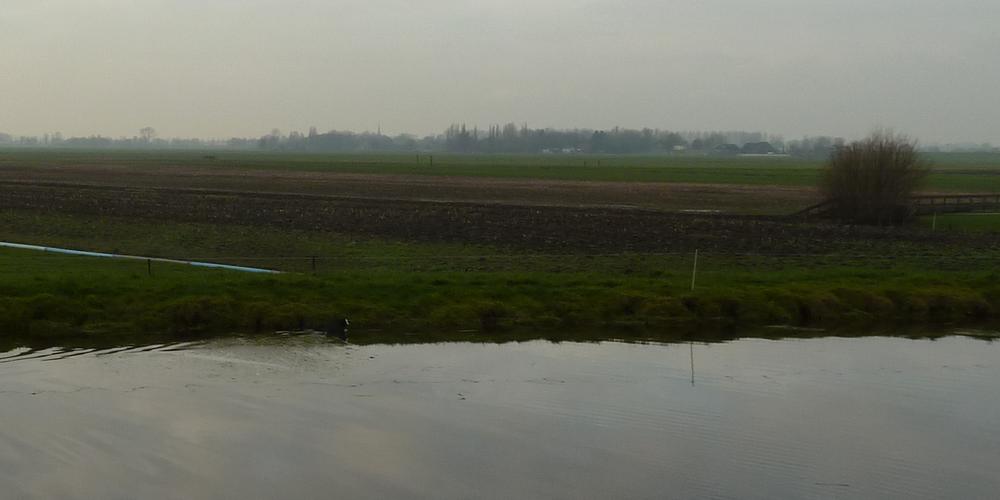
Monday, March 12, 2012

Philosophy = walking with a thermometer

Just taking a winter stroll with a thermometer can be an enlightening experience. Temperature is invisible and  the detailed differences are overlooked. But is the measurement accurate? Does it measure "reality"?

The same applies to just being in the landscape. Do I really see the landscape? Or do I see myself? Are my thoughts inspired by the landscape or are they just coming from the inside? Am I really seeing the outside world or am I just seeing what I expect to see?
+1.7 - What am I measuring? Is this the real temperature or am I measuring the behavior of the measuring device? Is this the "real" reality or is this the subjective impression of the observer? - It will become clear that the room thermometer is unsuitable for outside use. It adapts very slowly to outside temperature. It can take many minutes to cool from 15 to -3 degrees. 
+ 0.6 - Still measuring the thermometer temperature. But - we are *always* measuring the thermometer temperature. That's the way it works. There is no other temperature to be measured.
It would be very nice if this was a real measurement. It would prove that the suburbs are warmer than the open country. But if a difference exists it is probably smaller than this.
- 3.2 - This looks approximately right. From now on the measured temperature will sway around this temperature.
- 2.8 - Why is it warmer here? Is it because there is no wind? Because of the sunshine? Is it the way I'm holding the device? Is it measuring the real outside temperature or is it measuring me? 
- 2.9 - With all the possibility for error, how much does a difference of 0.1 degree really mean? How accurate is this thermometer actually? Am I seeing real differences or is it the inaccuracy of the device?
- 4.4 - This is in the middle of the open country. Here it is really cold. But maybe it is just that I'm shielding the thermometer from the sun and it is exposed to the wind. 
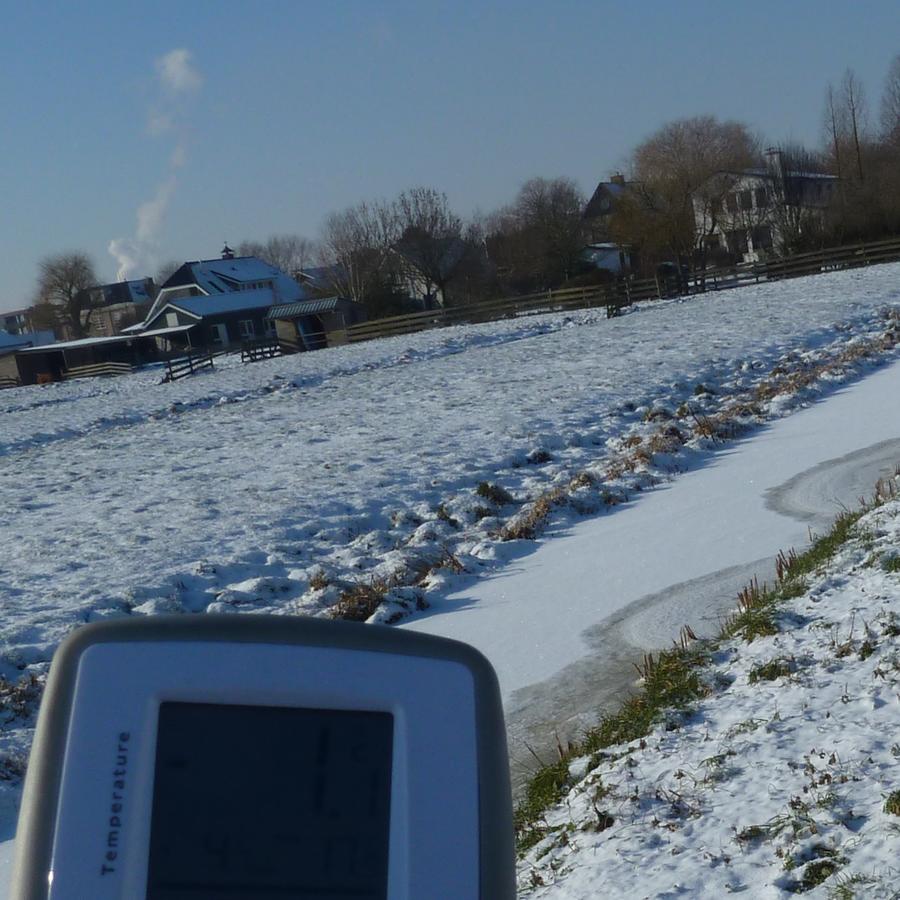
- 1.1 - It is unclear what explains this huge difference. Is it because there is more water around this area? Or is it just the orientation of the device with respect to the sun and wind? I'm walking in a North-West direction. Is that a possible clue?
- 3.9 - It looks like I measure a much lower temperature when I'm walking in a North-East direction than when I'm walking in a North-West direction. This would support the theory that I'm measuring myself.
- 4.2 - It is in this area that we measured one of the lowest temperatures: - 4.7. Maybe it's colder here because I'm in the shadows of the trees? Or has the device cooled sufficiently after leaving the pub where we warmed up? In the pub the device temperature rose to + 15 degrees.
- 4.7 - In this area we measured the lowest temperature overall: -5.7. But I have no photograph of that. Was it the wind blowing from the river? Or a pool of cold air that gathered below the river dyke? Or the wind blowing colder here? Or because we now were walking in a South-East direction? We really felt a difference between the -1 and -5 areas. This is a noticeable difference.

Sunday, March 11, 2012

The manual of detection

 I always browse the "sales" section at the back of the American Bookshop in The Hague. That random collection of books often hides little gems. And the books - if carefully selected - are almost too cheap for their value. One of those was The Manual of Detection by Jedediah Berry.


The book had a lot of positive reviews and I too have read it with pleasure. See the references below for more information. But what gripped me most were the opening quotes above the chapters. These come from the "Manual of detection" that every detective receives and that, as is revealed later, was not written by a detective at all. And there's a secret missing chapter that was censored from the official version.


What struck me most was the quote starting chapter 2 - On evidence:
Objects have memory too. The doorknob remembers who turned it, the telephone who answered it. The gun remembers when it was last fired, and by whom. It is for the detective to learn the language of these things, so that he might hear them when they have something to say.
This is something that I notice every day and that fascinates me. Objects indeed have a memory. I have written about that before. But they don't store individual memories but cumulative, statistical memories. The doorknob really remembers - but it remembers the statistical distribution of thousands of hands. And maybe that is more interesting than the memory of an individual hand.


And the floor of the train station remembers the spot where travelers stepped off the staircase. The city has developed a sore from this constant irritation. Lesions like these should be noticed and repaired. Who knows what will seep into this world if this membrane becomes too porous.


There exists a website that lists "entrances to hell". And it is inspiring to see the variety of portals that exist between our world and the mythical underworld. But all entrances are formed by discrete objects: doors, gates, holes, pipes and boxes. But maybe these are less threatening than this "thinning of the membrane". Martin Howse has described these lesions as "buboes on the skin of the city" that can be traced and excavated.

And this brings us to the opening quote of chapter 4 - On clues:

Most everything can be divided into two categories: details and clues. Knowing one from the other is more important than knowing your left shoe from your right.
One of the aims of my weblog is to combine real science and  (sometimes pseudo-scientific) imagination into a coherent structure. A structure that enriches the experience of everyday life so much that it makes travel redundant. Some ideas are "clues" - they add weight to the monster structure and make it even more precarious and this is good. Other ideas are just interesting, but they don't add to the structure. It is really difficult to distinguish between them.

References:
The manual of detection - Strange Horizons reviwew
The manual of detection - Amazon
Jedediah Berry - Weblog

Tuesday, March 6, 2012

Old news experiment

Last year I found a temporary source of free high quality newspapers. They were a few weeks out of date but for me that was not a problem. Because they were old, they were free from sensationalism. You could skip the unfolding events. Thus they become a great source for long-term opinions and weird factoids. Unfortunately the source has since dried up.

This was the harvest from March 2011. Let's see if I picked anything prophetic then:

Long term trends
  • Food shortages are driving food prices up. Prices of wheat, corn, sugar and oils are up. Droughts and floods of biblical proportion. Are they caused by climate change? Did they cause the Middle East uprising? A first taste of the disruption, economic and political, that we'll face in a warming world. (Paul Krugman)
  • Financial disruption: PIGS states - Threat of Greece defaulting - 10 year government bonds: 12.8% Greece, 9.5% Ireland, 7.5% Portugal, 5.5% Spain, 3.3% Germany - Euro and EU instability - Shadow banking and systemic instability - Pimco selling US government bonds - Meredith Whitney predicting defaults in US municipal bonds.
  • Russia is drowning in it's oil wealth like a mouse that has fallen in a bowl of cream. The profits from natural resources make the economy and society lazy and sluggish. Taxes are lower and so the citizens are not stimulated to scrutinize the actions of government. (Gerald Hosp)
  • Marine le Pen is campaigning against Monsanto, against open European borders and against globalization.
  • It might look as if civilians are angrier and more ready to protest, but in Germany the protesting crowds have a stable signature. Few Christian Democrats and a lot of Greens. Most were highly educated and most were not protesting for the first time. The numbers of protesters look stable over a 15 year period. But the position of the media has changed, they give more coverage to protests and when they predict further protests, their predictions fuel a self-fulfilling prophecy. (Marie Katharina Wagner).
Factoids


Ties of wealth: 
Bill Gross - Pimco - Mohamed El Erian - Pimco
Richard Oetker - Oetker - Andrea Enria - Bank of Italy.
  • Subway has grown bigger than McDonalds.
  • Youngest Mexican police chief has disappeared / fled from the town of Praxedis - Flickr is everywhere and has pictures.

What looks like an archaeological excavation is a reconnaissance photograph made by Tornado aircraft of  the German Luftwaffe in Afghanistan. (Adleraugen über Afghanistan, Stadtmuseum Schleswig) 

Sources:
Frankfurter Algemeine Zeitung - 9-10-11 March 2011
International Herald Tribune - 8 February 2011

Monday, February 27, 2012

How to use distant landmarks

How to use distant landmarks
Every walker has noticed distant landmarks. Anything can be used as a distant landmark: church towers are classic triangulation and orientation points but modern wind turbines, windmills, office blocks, microwave relay towers, transmission line towers and even trees can be used as landmarks. The landmarks need not be permanent - even a column of smoke is useful and welcome.
But does every walker know how to use a landmark correctly? How to use it for more than orientation? How to use it for psychogeography?


Horizon - A landmark can be used to mark your horizon. You can see the landmark from afar. You may see it many times during your walks. You may get to know it intimately. But still - you can never see all your landmarks up close.
Some landmarks - even most of them - will stay forever out of reach. You can look at them longingly from the distance but you will never touch them. This could make you sad - but it can also make you happy.
Be happy that at least you could see the landmark from the distance - you might not have seen and known it at all. Be thankful for the horizon and the discoveries it promises - and be thankful for the discoveries it hides.


The other side - Often you see the landmark from one side only. Your daily commute leads you past a prominent landmark but you never have time to explore it. Does it really have another side? Could other people see the other side? What is behind the landmark? What does it hide?
Make a decision now - explore or speculate? Destroy the mystery or leave it intact?
If the landmark is on your horizon you will have to walk far to see the other side. Walking far is good - but there will always be other sides that you wil never get to see. This could make you sad - but it can also make you happy.
Be happy that there are still some mysteries in this modern scientific world. Be thankful for the small revelations and mythologies - be thankful for the monsters in the white spots of your personal map.
Changes - Observe how the landmark changes as you move through space and time. Or how it does not change. Usually you travel faster than the landmark. Usually you change much faster than the landmark. This could make you sad - but it can also make you happy.
Be happy with the islands of stability in this unstable world. Be happy if the landmark will survive you - you share in its eternity. (Church towers are especially useful for this purpose.)
Background - Notice how the landmark stands out from the background. Look, think, analyze. What makes the landmark different from the background? Then notice yourself. Look, think, analyze. Probably you don't stand out against your background - at least not as much as the landmark. This could make you sad - but it can also make you happy.
Be happy with the role of observer - as part of the background you go unnoticed, you can see things that other people overlook. Be thankful that you can save your energy - being a landmark is a tiresome business.

Saturday, February 25, 2012

Flatness

Elements of the Dutch landscape - 1

My wife and I are halfway through the "Green heart of Holland" walking book. The walks are 10 - 15 km in length and at our snails pace each takes 3 hours of more. My wife hates it when I take photographs because she wants to walk, not to stand still. But I cannot resist.

Hitland - Capelle aan den IJssel - Towards the river
Gradually patterns emerge and beg to be recorded, documented  and shared. They are not spectacular and the reader may ask: "so what?". But for me there is a big difference between knowing something unconsciously and really becoming aware of it. What was background suddenly becomes foreground.
Zoetermeer
I'm playing a psychogeographic game of "go fish" with myself. I'm making a collection of "elements of the Dutch landscape". Each time I get a set of five I publish it. This means that the most obvious patterns will be published first. This is intentional because the most obvious patterns are sometimes the most invisible patterns (see E.A. Poe: The purloined letter).

The flatness
Schoonhoven
Somehow the flatness seeps into your pores and drains energy from you. The flatness is beautiful and is covered  by vast protestant skies. But it reveals everything at a glance and has no hidden corners and no subconscious. An inhuman Cartesian geometry of pure thought. There are no mysteries here - everything is like it is written, all content must be taken literally, no hidden meanings, "sola scriptura". The huge eye of God sees everything. No country for magicians and occultists.
Hitland - Capelle aan den IJssel - Towards Rotterdam
The landscape is unbounded and the eye finds no rest because lines of sight run to infinity. In hilly country I can breathe more easily. I don't need mountains, small hills are enough for me. But you have to travel far to find any. In the Dutch flatlands there is no visible history - the landscape is medieval but hides its age. Hilly country reveals its age more easily.

The classic poem
Woerden
The most obvious elements of the Dutch landscape have already been listed by Hendrik Marsman (1899-1940) in his famous poem about the Low Countries - in a beautiful translation by Paul Vincent:
Memory of Holland

Thinking of Holland
I see wide-flowing rivers
slowly traversing
infinite plains,
inconceivably
rarefied poplars
like lofty plumes
on the skyline in lanes;
and submerged in the vastness
of unbounded spaces
the farmhouses
strewn over the land,
tree clumps, villages,
truncated towers,
churches and elm trees -
all wondrously planned.
The sky hangs low
and slowly the sun by
mists of all colours
is stifled and greyed
and in all the regions
the voice of the water
with its endless disasters
is feared and obeyed.
I've made a list of landscape elements that I have noticed independent of this beautiful poem and that I will write about.  It's interesting to speculate why I missed the others, because they are very true also:
  • Noticed : wide-flowing rivers, infinite plains, poplars in lanes, skyline, submerged farmhouses, vastness of unbounded space, truncated towers, churches.
  • Missed : tree clumps, villages, elm trees, low sky, sun stifled by vapors.
And I don't really have a good idea why the landscape is so flat. Is it because it's an alluvial plain? Or is the flatness artificially enhanced by centuries of water management and peat burning? I will have to research that.

Horizon illusion
Woerden - On Google maps
Strangely enough these oppressive "infinite plains" and "vast unbounded spaces" look larger than they are. In the picture above the village of Kamerik is barely visible at the horizon. This is only 4 km distant. But still it looks infinite and unbounded. Not only in a photograph, in real life it also feels endless.
Hazerswoude - On Google maps
The same illusion occurs in Hazerswoude. Here the windmill of Rietveld is visible on the horizon, and possibly the poplars of the Spookverlaat and Galgweg ("Ghost-lock" and "Gallows-road" - I only noticed these names while searching Google maps - there must be some history behind this). The windmill is 1 km away and the poplars 4 km. Again closer than they appear. The same happens when we're walking: we reach distant-looking landmarks earlier than we expect.

Sources:
Many different translations of the Marsman poem
Detailed explanation of one translation of the Marsman poem
E.A. Poe - The Purloined Letter
Explanation of the Ghost-lock name
Map of the area from 1773

Tuesday, February 21, 2012

Landscape memory and tabby patterns

The fresh snow reveals memory patterns in the landscape. I never knew that cars making a U-turn make these interesting double triangles readable as the letter "M" or "W" or whatever you want to make of it. 

Meaning is inscribed on the landscape but most of the time the traces remain invisible. Are they still there when we don't see them? If they remain - even as very thin ghostly traces - then imagine how thick the accumulated layers of past events must be. Can we feel them? Are they recorded on the stone tape of the landscape?


And what to make of the similarity between the unexpected markings and the patterns of tabby cats? Is the landscape looking at us intently with the curious and menacing eyes of the predator? Or is it sleeping and dreaming of short-lived humans passing through in a flash?


Sources:
Sheba - by BlueRidgeKitties @ Flickr
Luna - by fwooper @ Flickr

Saturday, February 18, 2012

Bird concentrations, species and sex

Bird concentrations and species counts
When the ponds and canals freeze the birds concentrate in the last open spots. These bird concentrations invite basic analysis. Just simple observation and counting during two weekends:
In the open country - furthest from the suburbs:
11 swans (4 juveniles) - 5 ducks (3 male, 2 female) - 5 coots
In the open country - nearer to the suburbs:
47 coot - 1 crested grebe - 1 black headed gull

Inside the suburbs:
15 coot - 7 common moorhen - 131 ducks (83 male, 48 female) - 4 black headed gulls
Inside the suburbs:
Morning: 1 blue heron - 4 common coot
Afternoon: 2 common coot - 16 black headed gulls
Inside the suburbs:  97 black headed gulls - winter plumage
There are a few bigger-looking birds but I'm not sure they are different species - they might be herring gulls but I don't think they are really there
Inside the suburbs:
Morning: 5 ducks (male) - 4 ducks (female) - 5 jackdaws - 28 black headed gulls - 18 common moorhen - 10 common coot - 1 swan - 8 geese
Afternoon: 27 ducks (male) - 13 ducks (female) - 2 common coot - 2 swans - 5 geese
Inside the suburbs:
14 ducks (male) -10 ducks (female) - 1 common moorhen - 2 common coot - 6 egyptian geese

Analysis - did we learn anything?
The number of water bird species in (and around) the suburbs is very low. We counted only 9 species.
  • Ducks and seagulls are the most numerous birds.
  • There is no striking difference between open country bird populations and suburban bird populations. Only the crested grebe has not yet invaded the suburbs, it is seen only in non-urban areas.
  • The difference in numbers of male and female ducks is striking: 2 males for 1 female.
  • The population of a water hole varies significantly during one day.
And did we get any new questions for further research? Not many:
  • Do birds congregate in preexisting open water holes? Or do they keep the water hole open by swimming there?
  • How does the bird population vary during the day? Which birds come and go? Where do they go?
  • What causes the difference in duck sex numbers? Births? Deaths?
  • Do these birds stay in the suburbs in the spring? Or do they leave for the open country?
  • Why are some birds in the water (doing nothing much) and other birds on land (doing nothing much)?  Why do gulls just sit on the ice doing nothing? Why don't they all swim in the water?
Ducks and sex
Obviously ducks are the dominant birds of the suburbs. The difference in numbers of males and females is surprising! But it is correct - I counted very carefully. And I've seen it in smaller ice ponds in the suburbs too: (7 male, 5 female), (2 male, 1 female).

The asymmetry in duck sexes has been noticed by other observers. Amsterdam park administrators say that you should not feed ducks. If you do feed ducks the males have nothing to do and they keep stalking and bothering the females. Many female ducks are drowned that way. On some websites this theme is spun into Victorian prudishness:
Feeding ducks during mating season is very ill-advised. Ducks get bored. And where can you find the best entertainment as a sex crazed duck? By playing your most beloved game: seduction, mating, and stirring up trouble. The females play the males off against each other, which results in frequent and heavy fighting. Not every duck survives the fight intact.
An ironic observation on the sex life of ducks and the morality of men was written by Theo Jansen in his book "The great phantasist":

In my rough translation that does the original no credit:
In the seventies some women I knew started to agitate against endemic rape in duck communities. Not that they tried to prevent it. They understood that succesful measures were unrealistic. To navigate the waters in a vessel and to force the male ducks to practice sound foreplay - by use of sticks or oars - that went too far. Instead of acting they started to discuss the plight of female ducks at birthday parties - at least that was something constructive. They could not do more.

I have to admit that the mating of ducks is not a tender ritual. Each spring there is a lot of noise in the water near my house. Sometimes a female is mounted by two males at the same time. Harmony in nature goes hand in hand with injustice.
Sources:
De grote fantast - Theo Jansen