Sunday, April 8, 2012

Pumping stations - modern

Elements of the Dutch landscape - 3

When you walk in the Dutch landscape you encounter these pumping stations everywhere. This landscape requires a lot of care and maintenance. I keep thinking about the energy that is being used to keep our feet dry. What will happen if energy supplies fail?

But I'm also wondering about this huge invisible system. There is a whole organisation ("de waterschappen") set up to keep water levels at a tolerable level. Strange that it is so important and that I know so little about it. Time for more study ...

Alblasserdam
Hitland - Capelle aan den IJssel
Woerden
Hazerswoude
Hekendorp
Rotterdam
References:
Dutch Water Board
Unie van Waterschappen
Dutch water history

Friday, April 6, 2012

Place and memory

Blank spots on the memory map - Reading "Moonwalking with Einstein" has sensitized me to remembering and forgetting. And memory and place. The book uses spatial techniques - memory palaces - to store information. And according to the book the brain is good at remembering places. But how good is it really?

Last weekend we did a 37 km long bicycle tour around Rotterdam. Now - a week later - I'm trying to remember the route. This is the result:
The parts marked yellow are easy to remember. I can play back the tape. The unmarked spots are a vague blur of impressions. Why are some places easier to remember?
  • Because they are in known territory and I can link them to earlier routes. This applies to the whole area North of the river. I know that well and I have explored most parts of it.
  • Because they are surprising and I can link them to concepts I've been thinking about. For example the two unique spots are islands of history between modern buildings. Like the "Kakanien" of Robert Musil's The man without qualities.
Some parts of the route are more difficult to play back. My memory likes to skip the difficult parts and play "fast forward" to the easy parts. It is also difficult to start replaying at random points in the route. The most memorable spots "attract" the memory and are the most natural starting points.

Of course there is a lot of existing research about spatial memory. But als always with this blog: experience first, theory later.

The memorable outliers - And which parts of the route are most memorable? The ones that surprised me. Those are not tracks, but spots on the map.
Starting from top right counterclockwise:
What is the strange glass house with an indoor swimming pool and a lot of artworks in the garden where you can look into the sleeping room through the large windows? Who is so rich? And why is he acting so transparantly?
 A classic tennis court, hidden in a hollow inside the rich neighborhood. A little bit of class and luxury that the rich folks organized for themselves.
The deserted football fields - that I liked very much - are falling victim to a new residential area. New rich houses. I hope the garden allotments will stay - usually these also fall victim to capital investments.
A beautiful ride along the old canal through Delfshaven. Aelbrechtskade. Interesting unstructured businesses along the canal: car repair shops, small consulting firms. A few boats ferrying sand still moored along the quay.
An old dyke and a tiny island of old houses and a beautiful church in Charloois. A big surprise in the middle of the industrial area of the harbor. A nice protestant church in the middle of the village island.
There is a whole Karl Marx neighborhood in the south of Rotterdam. Sympathetic! This must have an interesting history! Did the socialists organize this in the 1930's?
An interesting underpass under the railroad. It is decorated with historic graffiti. I never knew that the IJsselmonde neighborhood was so old it had a Latin name: Islamunda.
Another interesting old dyke in the middle of a modern residential area. Does it still "work"? I should know more about this water protection infrastructure.
Extremely old and spooky trees along the river.
A very good but rather expensive new Italian restaurant in the middle of a rich neighborhood. Pleasant atmosphere. A lot of yuppies with babies, but not too irritating.
References
Moonwalking with Einstein: The Art and Science of Remembering Everything - Joshua Foer
Memory palace
Man without qualities - Kakanien
GPS Visualizer
Charlois
IJsselmonde
Spatial memory

Saturday, March 31, 2012

Animal tracks

A little bit of snow records the urban wildlife.
It is really difficult to decode the animal tracks. I'm not sure about a lot of them. 
It should not be this difficult. We should have better knowledge of our local animals.
I would make a terrible hunter-gatherer and would die of hunger in a few weeks.
If you recognize some tracks please tell me.

Lost chance at research
Later I realized I should have studied the tracks even better. I could have traced the track of one bird through the landscape. Especially one of the intelligent birds like magpies or jackdaws. I might have deduced something about its search pattern. Do birds use a random walk? Certainly not!

Heron (?).
Jackdaw (?). It is searching for something. But it also might be a pigeon or a magpie.
Common coot.
Hare.
Rabbit.
Unknown. It's too small for a rabbit. Rat? No ... no trace of a tail.
Unidentified - rabbit? No ... it's too regular for a rabbit. And it's too small for a rabbit. Could be a bird hopping through the snow?
Unknown. Hopping bird? Something that looks like the trace of a tail.
Unidentified - Probably a bird. Notice the tracks made by the feathers.
Cat. It is remarkably regular, more regular than a dog.
Dog.
Human and rabbit. Tracks probably not made at the same time.
Too small for a rabbit. Rat? No idea really.

Saturday, March 24, 2012

Fences

Elements of the Dutch landscape - 2
Therefore Jesus said again, "I tell you the truth, I am the gate for the sheep. Anyone who sneaks over the wall of a sheepfold, rather than going through the gate, must surely be a thief and a robber!
Gates to nowhere - Dutch fences are unnatural. Fences should run for a certain length, they should not be short like this. They should separate spaces and should hide what's behind them. Dutch fences don't work like this. They do not "fence off" anything. They are not meant for humans, they are designed for cattle.

Hardinxveld
When there's no cattle the fence can be left open. And the landscape is full of ditches anyway, so most of the fencing  is done by water. Each strip of land is like a medieval castle with a moat and the entrance is the only spot that has to be "fortified" with a gate.
Hekendorp
In rare cases the fence is meant for humans. This fence in Hekendorp gives access to a 1 km long plot of land and the house is on the other side. But by law the mailbox has to be close to the main road. The inhabitant has to make a daily long walk daily to collect his mail.
's Gravenweg - Nieuwerkerk
Exhibitionist spaces - The fences do not invite trespassers because nothing is hidden. There is identical flat space on both sides of the fence. Nothing is gained by climbing it.
Schoonhoven - Polsbroek
The Dutch landscape and its gates are the exact opposite of a "park landscape". According to William Boyd [1] a park has to meet the following criteria:
  • First, there must be tall, mature trees, the older and taller the better.
  • Second, the majority of the trees in the park must give the impression of random planting - no rectangles or neat lines, by and large. An avenue here or there is allowed, an allée, but we need the illusion of spontaneous, unplanned growth. 
  • Third, the ground must undulate in a significant way - flatness is not a park-criterion. 
  • Fourth, there is the question of scale: you mustn't be able to see all sides of the park at once - one boundary at least must be invisible from wherever you stand. 
  • Fifth, there must be a gated entrance: a park need not necessarily be fenced or walled but it must have a portal - or several. 
Woerden
Hazerswoude

References:
[1] 'It's all too beautiful'- William Boyd takes a literary tour of urban oases - William Boyd, The Guardian, Saturday 20 June 2009

Tuesday, March 20, 2012

Soil experiment

Noticing the soil - Lately I've been noticing the soil I walk on. Something that's so obvious that you overlook it completely. But without soil we would not be alive. A very precious resource that we should pay more attention to.

I have read several geology books but out in the field this paper knowledge is useless. Still I decided to experiment and research in my amateur manner. No preparation, no reading, no browsing. I bought a few cheap plastic containers in the graphic supply shop and immediately I felt very scientific.
Sampling - My first sample was taken on 4 december 2012 between Capelle aan den IJssel and Nieuwerkerk. A mole hill was very convenient. This was certainly local soil.
The second sample was taken on 8 december 2012 between Hogebrug and Oukoop. An extremely wet and sticky pancake of clay. Maybe it had been used to repair the dyke. But maybe it had been dredged up from the bottom of the canal.
The third sample was taken on 8 december 2012 between Hogebrug and Oukoop. This was just a random heap of sand. It was certainly not local. Probably it belonged to some repairs of the path.
Analysis - The three samples, from left to right: second (2), first (1), third (3). Of course this has no scientific value at all. the real source of the sample is unknown and there is no correlation with local geography. Still it feels very satisfying to bring a piece of the landscape home with you and to possess a physical sample of a place. An original souvenir, much more tangible than a digital photograph.
Sand - The sand seems to come from the seashore. Lots of transparent quartz and a few fragments of seashell, somewhat worn by the action of waves. The quartz grains still have some rough edges, they are not worn smooth. Impossible to determine what the dark grains in the sand are. Odorless.
Clay - Has dried since sampling and is very tough. Have to break the lump by force. No structure, no grains, just fine clay, like the clay used for pottery. No plant matter. Odorless.
Mixed soil - A mix of dark humus, probably some clay and some sand. Tiny amounts of plant matter. It is difficult to separate the components, the sand grains are stained by the dark soil and are difficult to see. Smells of earth, neutral, not unpleasant smell of moist soil.
Separation of components - I tried shaking the the soil and clay with water to separate the components. In 14 minutes the mix settles, but without separating into clearly different components. Probably the color is clay particles suspended in the water. There is not much difference in color. There is some difference in texture. This was a bit disappointing, so I tried another idea.
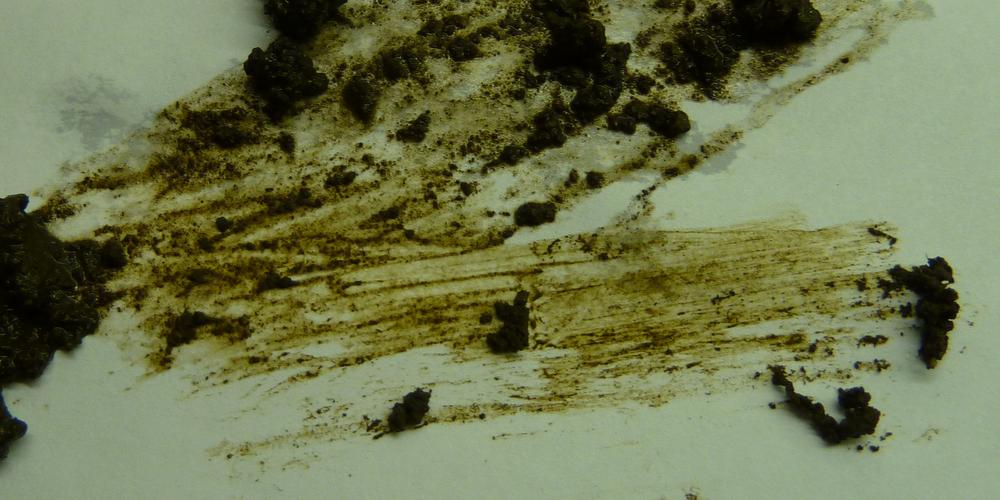
Thinking back on some of Andy Goldsworthys "stained snowball" I tried to separate the components by staining some paper with the solid components in the solution. Again there is some difference in color ad texture but much less than I expected.

Back to the drawing boards to study some theory. Already I have some new ideas. Step 1: buy a few sieves.

Resources:
Sampling and Analysis of Soil

Simple soil, water and plant testing techniques for soil resource management
Four Easy Do-It-Yourself Soil Tests