Tuesday, January 31, 2012

Death of a cryptoforest - 1

I discovered and explored this cryptoforest in April  2010. It was sandy and it had a nice growth of young birch and willow. Many interesting weeds were growing on this dune-like field. Huts and tree houses were  hidden in the urban jungle.

Of course this could not last forever.

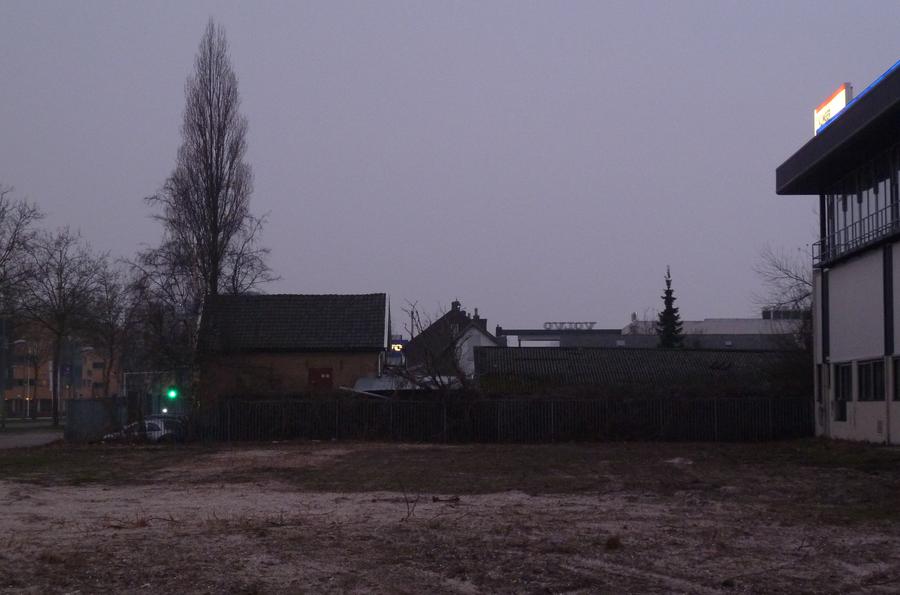
In the autumn of 2011 the site was cleared. It is still sandy and dune like, but it feels like an area after a forest fire. Only stubble is left. The ground is gridded by tractor tires. No trace of building activity yet. But that cannot take long.

In the meantime there is a beautiful view of the vague used car dealerships that still dot this area. They have yards full of wrecks guarded by vicious dogs. I'm afraid they will disappear too and will be replaced by huge modern car dealerships. You can see the Volvo building on the horizon. That's the way to the future.

Looking east - with forest.
Looking east - without forest. 
Looking west - with forest. Notice the bird nest in the poplar tree.
Looking east - without forest - vague car dealer and Volvo behind that.
Tree hut.
Ruins of the cryptoforest.

Friday, January 27, 2012

Pyramids & Roberto Bolano

Several times I have passed brick fragment sticking out of the ground like in the picture below.
I imagined and fantasised that this was just the small corner of a giant pyramid. A huge pyramid hiding deep under the ground. Who knows, maybe it goes through the whole earth and some of it's corners are sticking out in other continents.
If you pay attention you will see many of these pyramids in your neighborhood. If they can be found in Rotterdam, they can be found everywhere.

Recently I was reading The savage detectives by Roberto Bolano. I was pleasantly surprised that this great writer had come up with the same idea. And he came up with the idea several years earlier:
Hours later, as we were on our way back in my father's car, him in front and me in back, he said that there was probably some pyramid lying buried under our land. I remember that my father turned his eyes from the road to look at him. Pyramids? Yes, he said, deep underground there must be lots of pyramids. My father didn't say anything. From the darkness of the backseat, I asked him why he thought that. He didn't answer. Then we started to talk about other things but I kept wondering why he'd said that about the pyramids. I kept thinking about pyramids. I kept thinking about my father's stony plot of land and much later, when I'd lost touch with him, each time I went back to that barren place I thought about the buried pyramids, about the one time I'd seen him riding over the tops of the pyramids, and I imagined him in the hut, when he was left alone and sat there smoking.

Wednesday, January 11, 2012

The house that I inhabit

In the autumn of 2010 I organised a psychogeographic city walk centered upon the Koorenhuis in The Hague. A classicistic grain exchange built in 1660.
I started the walk with a short story by the Dutch artist Armando:
I walked through the rooms where many generations have lived. Who have lived here, what were their conversations like, how were their rooms decorated, who have been born there, who died there, and what about their personnel? 
I do not know. It would be important to know, but I do not know. Maybe I could have learnt some things, but somehow I don't want to. Once you start the task is endless. You can investigate and get to know some things, but you can never know everything. New questions will emerge to harass you. I should make peace with the fact that there are things I don't know and never will know.
Armando - Oude huizen - Voorvallen in de Wildernis | Old houses - Incidents in the Wilderness

Here Armando takes the opposite view of psychogeographers like Nick Papdimitriou who try to know all  about the places they inhabit so they can merge with  the topography. And the questions pondered by Armando are quite easy to answer.

A short search in the central library of The Hague yielded several pictures of the surroundings of the Koorenhuis that clearly show "who have lived there".

How the Koorenmarkt looked while in use as a grain exchange.
How the surroundings looked in 1755.

Sunday, January 1, 2012

Rooftops and human sacrifices

Recently I read the following sentence in The Savage Detectives (Los Detectives Salvajes) by  Roberto Bolaño:

Through the only window, as small as a porthole, you can see the neighboring rooftops, where human sacrifices are still performed, according to Ulises Lima, who got it from Monsiváis.
The sentence has no context. The sentences before and after do not help. It is a "one off" occurrence in the book and it raises a set of questions:
  • Which rooftops are most suitable for human sacrifice?
  • Have I seen roofs like that before?
  • Do we have roofs like this in Rotterdam?
  • Are human sacrifices still performed there?
Rooftops of the corporate domain - view from Groothandelsgebouw Rotterdam
But what the sentence really does - it opens a portal into alternative reality. Maybe we live in a reality where unspeakable acts happen on our own roofs - and we don't know about it. Maybe the reality we live in - capitalist, consumer oriented and controlled by corporations - is just a facade that hides unspeakable terrors.  Like the female homicides in Mexico, or the suicides in Apple factories. But:
  • Are the worst terrors out there in the corporate domain? Invisible because of their huge size? Like the devastating speculation in food commodities by Goldman Sachs or the Ponzi scheme of Bernard Madoff.
  • Or are they hidden in the private domain? Invisible because they are below the radar? Like the murders committed by Marc Dutroux of the incest hidden by Josef Fritzl.
Rooftops of the private domain - view from parking garage rooftop, Witte de Withstraat
One is reminded of the famous Sherlock Holmes quote about the city being safer than the country in The Adventure of the Copper Beeches:
All over the countryside, away to the rolling hills around Aldershot, the little red and grey roofs of the farm-steadings peeped out from amid the light green of the new foliage. "Are they not fresh and beautiful?" I cried with all the enthusiasm of a man fresh from the fogs of Baker Street. 
But Holmes shook his head gravely. "Do you know, Watson," said he, "that it is one of the curses of a mind with a turn like mine that I must look at everything with reference to my own special subject. You look at these scattered houses, and you are impressed by their beauty. I look at them, and the only thought which comes to me is a feeling of their isolation and of the impunity with which crime may be committed there."
"Good heavens!" I cried. "Who would associate crime with these dear old homesteads?"
"They always fill me with a certain horror. It is my belief, Watson, founded upon my experience, that the lowest and vilest alleys in London do not present a more dreadful record of sin than does the smiling and beautiful countryside."
"You horrify me!"
"But the reason is very obvious. The pressure of public opinion can do in the town what the law cannot accomplish. There is no lane so vile that the scream of a tortured child, or the thud of a drunkard's blow, does not beget sympathy and indignation among the neighbours, and then the whole machinery of justice is ever so close that a word of complaint can set it going, and there is but a step between the crime and the dock. But look at these lonely houses, each in its own fields, filled for the most part with poor ignorant folk who know little of the law. Think of the deeds of hellish cruelty, the hidden wickedness which may go on, year in, year out, in such places, and none the wiser.
In the future I will always look at rooftops with suspicion. They are more uncanny than I ever suspected. But which are the most suitable for human sacrifice?

In my years of - quite unspectacular - urban exploration I have seen many rooftops in Rotterdam. The ones best suited for human sacrifices could be found in Delfshaven, a suitably Lovecraftian part of Rotterdam. But I know from practice how hard it is to climb these rooftops without shattering rooftiles and making a lot of noise. And in between the rooftops there is insufficient space for any kind of ritual.
Rooftops of Delfshaven - Catharina Beersmanstraat - now demolished
British roofs look much more suitable. They are more mysterious and inaccessible. The chimneys are more surreal and threatening. The house seem more awake and aware.

Without the picture below I would not have written this blog entry. The picture shows the rooftops of Bath and it was published by els1999 on the urban exploration forum uer.ca. You can see more pictures and a longer description here on forever-changes.


The last unanswered questions are:
This is more difficult than it seems. I don't have the fantasy and the talent to do it. I can only search the city and hope that it will give me the right ideas. And sometimes it does. For example: what did a huge, dangerous magnet do in a back alley of Rotterdam? What was going on in that nondescript building in 2005? And there are more mysterious magnetic places in Rotterdam. I have to dig in my archive.

Thursday, December 29, 2011

Boring fashion colors

Fashion color software
I looked around me and I wondered ... are fashion colors really so boring nowadays or am I imagining it? To check my intuitive impression I wrote two simple Processing sketches:
  •  Color picker - you point your mouse at the clothes of people. The colors are stored as a list of RGB values.
  • Color plotter - you combine the RGB lists from several photographs into one long list. Then this program plots the color values. One row is the original sequence. One row is a sorted sequence.
This is a follow-up on the fashion outliers observation experiment. The results are consistent.

Results
In 2011 there are not many outspoken fashion colors at all.
Summer colors are brighter and more outspoken than winter colors.
Colors in the Netherlands are different from colors in Germany. There are more browns in Germany no tasteless pun intended). There are more blacks and blues in The Netherlands.

Critique
There is no color correction. Light color should be calibrated before using the program. It is possible that the camera makes the colors more bluish and less outspoken. This is something for future development.

Rotterdam July 2011 

Amsterdam October 2011 

Rotterdam August 2011 

Monchengladbach December 2011 

Rotterdam December 2011 

Processing code - Color picker

This code is based on the following program:
Color Picker by Andres Sanchez, licensed under Creative Commons Attribution-Share Alike 3.0 and GNU GPL license.  Work: http://openprocessing.org/visuals/?visualID=5092

PImage myImage;
PFont myFont;
color mouseColorS;
String colorPick;
String[] colorList = new String[0];
color blackCorr = color(0,0,0);
color whiteCorr = color(255,255,255);

void setup() {
  myImage = loadImage("r8.JPG");
  size(min(1000, myImage.width),min(700, myImage.height));
  background(180);
  smooth();
  myFont = createFont ("Helvetica",24);
};

void draw() {
  float rS;
  float gS;
  float bS;
  float rC;
  float gC;
  float bC;
 
  background(180);

  // drawthe image to the stage
  image(myImage, 100, 100, min(900, myImage.width), min(600, myImage.height));

  // find the color under the mouse
  color mouseColor0 = get(mouseX-1, mouseY-1);
  color mouseColor1 = get(mouseX,   mouseY);
  color mouseColor2 = get(mouseX+1, mouseY+1);
  color mouseColor3 = get(mouseX+1, mouseY-1);
  color mouseColor4 = get(mouseX-1, mouseY+1);
 
  rS = red(mouseColor0)/5 + red(mouseColor1)/5 + red(mouseColor2)/5 + red(mouseColor3)/5 + red(mouseColor4)/5;
  gS = green(mouseColor0)/5 + green(mouseColor1)/5 + green(mouseColor2)/5 + green(mouseColor3)/5 + green(mouseColor4)/5;
  bS = blue(mouseColor0)/5 + blue(mouseColor1)/5 + blue(mouseColor2)/5 + blue(mouseColor3)/5 + blue(mouseColor4)/5;
 
  mouseColorS = color(rS,gS,bS);

  //draw a rectangle filled with that color;
  fill(mouseColorS);
  noStroke();
  rect(0,0,100,100);

  // ad3d the text labels
  //red
  fill(255,0,0);
  textFont(myFont);
  textSize(16);

  //red
  text(round(red(mouseColorS)), 100,15);

  //green
  fill(0,255,0);
  text(round(green(mouseColorS)), 100, 35);

  //blue
  fill(0,0,255);
  text(round(blue(mouseColorS)), 100, 55);

  //hex value
  fill(255);

  text(hex(mouseColorS), 100, 75);
   
  colorPick = Integer.toString(round(red(mouseColorS))) + " " + Integer.toString(round(green(mouseColorS))) + " " + Integer.toString(round(blue(mouseColorS)));
};

void mousePressed() {
 
  if (mouseButton == LEFT) {
    fill(255,255,255);
    noStroke();
    rect(0,0,100,100);
    fill(255,255,255);
    text(colorPick, 100, 95);
    colorList = append (colorList, colorPick);
  }
  else if (mouseButton == RIGHT) {
    fill(0,0,255);
    noStroke();
    rect(0,0,100,100);
    saveStrings("colorList.txt", colorList);
  }
  else {
  }
}

Processing code - Color plotter

String[] textLines;
int nr;

void setup() {
  int i;
 
  textLines = loadStrings("colorList.txt");
 
  nr = round(900/textLines.length);
  size(textLines.length*nr, 600);
 
  for (i = 0; i < textLines.length; i = i+1) {
  fill(color((i%2)*155+50,(i%2)*155+50,(i%2)*155+50));
  rect(i*nr, 0, (i+1)*nr, 600);
  }
}

void draw() {
String[] pieces;
color[] colArray = new color[textLines.length];
color pick;
int i;
int j;

  colorMode(RGB);
  background(255); 
  noStroke();
  smooth();
 
  for (i = 0; i < textLines.length; i = i+1) {
    pieces = split(textLines[i], ' ');

    pick = color(int(pieces[0]), int(pieces[1]), int(pieces[2]));
    colArray[i] = pick;
    fill(pick);
    rect(i*nr, 0, (i+1)*nr, 300);
  }
 
  colArray = sort(colArray);
  for (i = 0; i < colArray.length; i = i+1) {
    fill(colArray[i]);
    rect(i*nr, 300, (i+1)*nr, 600);
  }
 
  save("color_plotter.jpg");
}


Thursday, December 22, 2011

Esoteric bookshop

I regularly passed this anarcho-esoteric bookshop and publisher. This was on the corner of the Benthuizerstraat and the Vinkenstraat : Uitgeverij Drukkerij Cagliostro. As you can see the books in the shop windows have been censored (protected?) by Google.

 Usually I walked by on Saturday - and then the bookstore was closed. When I found the time to visit on a workday the place had been sold to a new owner. I will never buy one of those weird books. And I will not get to know an interesting person. It is a great pity. These were the books on 20 January 2010.

Esoteric - Golden dawn - The hermetic museum - Vril - Building your own telescope - Starting out: modern benoni
New world order - Illuminati - Brave new world - The Syndicate: The Story of the Conspiracy Behind World Government - The unseen hand - Zpower: Zero point energy - Electricity and magnetism
Tarot and magic - Nicola Tesla - The chemistry of explosives - Meditations on the Sepher Yetzirah - Magnetic energy to heal the planet - Hoodwinked: watching movies with eyes wide open - How to lie with statistics
Occult - Mind control - Codex magica - Mind control, NLP and hypnosis - Media sexploitation - The big lie: 9/11 and the government complicity in mass murder
Quabalah - Magick - Embracing the dark: the magic order of Dragon Rouge - Fire & Ice - Quabala - Opium lords
Tarot - Underground - The tarot of the bohemians - The magical tarot - Meditations on the tarot - The biggest secret - Behold a pale horse
Rothschild Money Trust - 700 Kinderrijmen (700 children's rhymes) - Tesla said - Obama: the postmodern coup - America's secret establishment: The order of skull and bones - Konstantin Meul: Scalar waves - The plot to seize the white house - The legalized crime of banking - Places of the Soul: Architecture and Environmental Design as a Healing Art - A guide to German flying discs of the second world war


You immediately recognize some classics. And you see a clear prediction the the current financial and banking crisis. And during an earlier visit - on 23 August 2009 - the books were different. So there were some sales going on. A pity I never could buy one of these weird classics. They were not too expensive.

We still have one esoteric bookshop on the corner of the Witte de Withstraat and the Schiedamse Vest (why are those shops always on corners?) but that is a very tame, New Age and incense type of shop. This one was more feral and punk. The authentic anarchist thing. 
 Identity theft handbook - Vril - Starting out: modern benoni
 Excel 2007 Data Analysis for Dummies - A catalogue of angels
 Conspiracy theories - Solar technologies - Body language
 America's secret establishment: The order of skull and bones - A guide to German flying discs of the second world war - Places of the Soul: Architecture and Environmental Design as a Healing Art - The biggest secret - The energy revolution - The Seven Seals: a Practical Occult Experience - Build your own solar: cells, oven, car
Billions for the bankers - Rhythms of the brain - Langs Rotte, Maas en Schie (Along some Dutch waterways) - Fotografie en de natuur (photography and nature) - Luftwaffe fledglings 1935-1945


Finally I on 14 July 2010 I went by again - the store again being closed - and this time I photographed the books that were published by this specific publisher: Cagliostro Verlag Rotterdam - Uitgeverij Cagliostro Rotterdam. We have lost a tiny monument of Rotterdam:
 B. de Spinoza, Populaire bijdrage voor zijn Leven en Leer - Dr. Rudolf Steiner, Erster Naturwissenschaftlicher Kursus - Erklärung der Natur - R. Steiner, Occultisme en esoteriek
 Gedichten, D. Huisman - Die wahrheit über die anthroposofie und deren verteitigung gegen die unwarheit. - J. Mol, Graag verlaten - Basilius Valentinus, Les douze clefs de la Philosophiques
Denkschrift - Der esoterische jugendkreis - Rudolf Steiner, Theosofie - Briefe über die köningliche Kunst

Sunday, December 11, 2011

Fashion observation experiment

Since reading the book Zero History by William Gibson I've been paying more attention to fashion. Previously I had totally ignored it. Now I realize that:

  • It's an important part of our culture.
  • It limits our means of self-expression severely - at certain times you can only buy certain types of clothes - or only certain colors. Especially if you don't have the money or time to get more specialized clothes.
  • It might be an interesting subject to observe and analyze - because you see it in huge amounts all around you.
Recently I've started observing fashion actively. I'm only a beginner without knowledge and without a frame of reference. So the easiest way to start was to observe outliers. Establish a subjective baseline by looking at the crowd and then record anything that is different.
Now this is my first result:

Boring baseline
Interesting outliers
  • Dark colors - black or dark blue
  • Artificial materials
  • Stuffing and isolation - balloon style
  • Informal - generic
  • Bright or light colors
  • Attention to detail - caps - shawls
  • Formal, classic or idiosyncratic
  • Too cold for this season


Further observation may yield more useful criteria. And may answer some obvious questions:

  • Relation between age, income, gender, race and fashion choice?
  • Relation beween what is worn actively and what is being sold in the shops right now?
  • Relation between temperature, humidity and wind speed and fashion choices?
  • Relation between part of the city and fashion preferences?
  • Relation between weekday and time of day and fashion preferences?
  • How to quantify  and analyze the data?
Interesting questions that I would never have thought about before reading Gibson's book.