Sunday, October 25, 2015

Urban mushroom diary - autumn update 5

The previous chapters of this diary are: part-1, part-2, part-3 and part-4. This might go on while the urban mushrooms season lasts. I don't know when that will be.

10 October 2015 - Revisited the park at the outskirts of Hoek van Holland. This park lies between the suburbs of the village and the dunes. It feels old and wild. Does that still count as "urban"?
A beautiful autumn day with parents and children searching for fallen chestnuts. People walking their dogs. No one looking for mushrooms. The Dutch are myco-phobic.
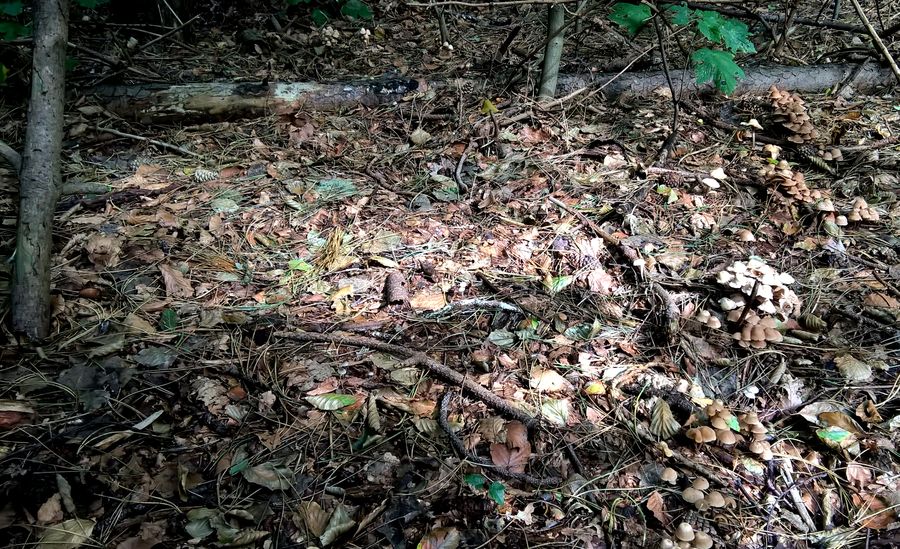
The park was full of these mushroom clusters. A very common species, but what a head-ache it gave me to find it. Finally I think it's Armillaria mellea. For such a common mushroom this should not have been so hard, but none of the pictures in books nor on the Internet really fit the shape and the markings. Finally this guide gave me certainty. The mushroom is bioluminescent but I did not check in the dark:
Bioluminescent fungi emit a greenish light. The light emission is continuous. It has been suggested that beneath closed tropical forest canopies, bioluminescent fruit bodies may be at an advantage by attracting grazing animals that could help disperse their spores. Conversely, where mycelium are the bioluminescent tissues the light emission could deter grazing.
The situation is made even harder because young mushrooms look totally different from old mushrooms. You don't have these problems with "normal" plants. This species is often mistaken for Hypholoma fasciculare or Pholiota aurivella but neither of those gives a good match. Dutch Wikipedia says it's inedible, Czech Wikipedia says that after cooking it's edible and tasty. A big difference between myco-phobic and myco-philic cultures!

Finally I became so desperate that I did an image search in Google, expecting no answer. And I was pleasantly surprised when Google found one very good match of Armillaria mellea.
In the same park I also found a few possible Armillaria lutea. This genus has some surprising members. Strange how such a primitive life-form can feel so ancient and majestic. Like communing with living fossils or aliens:
A mushroom of this type in the Malheur National Forest in the Strawberry Mountains of eastern Oregon, U.S. was found to be the largest fungal colony in the world, spanning 8.9 square kilometres (2,200 acres) of area. This organism is estimated to be 2,400 years old.
I also plucked one of the hypothetical Marasmius oreades to get a better look at the gills. The mushrooms were old, spent and dry, but they seemed to confirm my initial identification. The ecology also matches: "frequently growing among coastal grasses in dunes." These should be edible and very good.
A cluster of tiny mushrooms on a rotten log could be Mycena arcangeliana. It is probably no Psathyrella because these are dark-spored mushrooms and I see no dark colours on the gills. This is an older cluster and the caps have started to dry out. And the angelic name reminds me of the strange theories about mushrooms and Christianity.

I've become aware of the big changes that mushrooms undergo during their life-cycle and it makes identification even harder. And it increases my wonder at these elusive creatures. I don't believe the strange theories of Terence McKenna but could they be "intelligent" in some non-human manner? Distributed, self-organizing, aware of their surroundings and goal oriented?
Finally a mysterious white blob that could be Oligoporus stipticus. There's a great French video of this species on YouTube. A very thorough description that's almost Zen-like in its attention to details. It should be inedible and extremely bitter: I should start tasting my specimens, but I'm afraid.
And let's finish with a summary from H.P. Lovecraft:
Those fungi, grotesquely like the vegetation in the yard outside, were truly horrible in their outlines; detestable parodies of toadstools and Indian pipes, whose like we had never seen in any other situation. They rotted quickly, and at one stage became slightly phosphorescent; so that nocturnal passers-by sometimes spoke of witch-fires glowing behind the broken panes of the foetor-spreading windows.

Friday, October 23, 2015

Urban mushroom diary - autumn update 4

The previous chapters of this diary are here, here and here. This might go on for a long time. I have no idea when the urban mushrooms season ends. I never paid so much attention to fungi.

4 October 2015 - I'm looking so hard that I have mushroom hallucinations. Urban lawns present me with mushroom mirages: fallen leaves and crumpled wads of paper show their hidden mushroom faces. I really thought I saw mushrooms here, until I took a close look.
A beautiful mushroom presents me with a Rumpelstiltskin puzzle: "What's my name?" And I really have no idea! Maybe it is some Russula and I know that you could taste a little piece on your tongue, but I don't dare to do that yet. And the stem looks too thin for a Russula. Could it be Entoloma incanum?
This is again in the no-mans-land between the bicycle path and the road. Are these semi-forgotten places ideal for mushrooms? Or is it just selection bias: that I see most fungi where I drive my bicycle?

This place is full of beautiful mushrooms. The most striking ones are the big, dark-spored mushrooms. I suspect they're Agaricus silvaticus. I've learned to smell the mushrooms now and they have a "pleasant spicy" smell. That means that they're probably not Agaricus praeclaresquamosus that have a "strong unpleasant" smell.
And the Leccinum Duriusculum has sprouted again in the grass under the poplar trees. The last time I saw a big group of them was on 13 september. Beautiful boletes that smell good and look very edible.
I'm now starting to apply the tricks I learned from the YouTube videos: picking up one mushroom, smelling it, looking at spore colours, looking at the attachment of gills to the cap and the stem. I know better what to look for and so I see more.

Sunday, October 18, 2015

Urban mushroom diary - autumn update 3

The previous chapters of this diary are here and here. This might go on for a long time. I have no idea when the urban mushrooms season ends. I never paid so much attention to fungi.

28 September 2015 - Clusters of fresh new mushrooms are appearing in the place between the bicycle path and the road. Too young to guess what they are. They look like puffballs but most probably they're not. I'll call this place "spot A" for conciseness.
30 September 2015 - Spot A is bare again. All the mushrooms are gone or are broken into fragments. The mycologists on my videos say that this not bad, that it helps to spread the spores more widely. I don't think a mower did the damage, there is no grass to speak of here. It could be a garbage sweeper truck or a dog-shit sucker.

2 October 2015 - And although my favorite mushroom spot has been razed, I see a flood of mushrooms in the most unexpected places. Culture is taking over from nature and during a visit to Gouda I see fungi spreading to restaurant menus. Wild mushroom soup with chestnut puree and Pernod.
And mushrooms are invading restaurant terrace decorations. The Amanita muscaria (harshly hallucinogenic and nausea inducing, but edible when prepared correctly) is the prototypical mushroom. Most likely the cause is the Dutch children's song: "on a big mushroom, red with white spots". These fly agarics are often combined with grape leaves. But you don't want one in your restaurant dish.
They appear in cosmetics shops and suddenly contain doors for gnomes or elves. But mushrooms don't belong here. You wouldn't want a fungal infection on your skin sprouting nice red fruiting bodies. Something like this good, but too horrible book that I couldn't finish.
Fungi in cheese shops are in their natural habitat. But this is the wrong species of fungus. Also notice the grape leaves. The ultimate autumn combination.
In chocolate shops mushrooms are combined with edible (chocolate) chestnuts and fallen (chocolate) leaves for the "autumn assortment". They look like the well known button (Agaricus) mushrooms.
But the hipster Amanita is used on the packaging of the chocolates.
3 October 2015 - Once again the Amanita is used as food decoration in Rotterdam. A nice chocolate cake with mushrooms, acorns and fallen leaves. Guarded by a squirrel. Interesting that a myco-phobic culture like the Dutch still loves its mushrooms when tame.

Monday, October 12, 2015

Urban mushroom diary - video selection

The best mushroom videos I've found on YouTube as yet.


Saturday, October 10, 2015

Urban mushroom diary - autumn update 2

The previous diary is here. Note: None of my species determinations should be trusted!

23 august 2015 - I dream that I'm walking along a narrow and winding path through the woods. The soil is covered with pine needles and no plants seem to grow here. Along the path I see big, wheel-sized, mushrooms. They grow in a perpendicular direction to normal mushrooms so that the lower part of the stem and the cap is submerged below the ground. I don't know if they're supposed to grow this way or if they've been toppled somehow.
10 september 2015 - New mushrooms are growing  along the bicycle path to the city center. The grow from barren, sandy and relatively fresh soil. They rise from the deep and have a lot of earth-moving power. Probably Agaricus bitorquis.
17 september 2015 -The Agaricus bitorquis (?) mushrooms have returned to the spot between the bicycle path and the road. It took them approximately three weeks to regrow after the mowing. The mycelium is strong with this spot.
20 september 2015 - Discovered a nice fairy ring in the park at the outskirts of Hoek van Holland. It's difficult to see in the strange light and even in real life it took me some time to see it. This could be Marasmius oreades. I really have to start picking the mushrooms and at least photographing the gills in more detail. I still miss too many determining characteristics.
In the same park there were many clusters of mushrooms growing from dead wood. But not many growing from the soil. Impossible to determine from just the photograph. Does not fit Psilocibe nor Stropharia. Could it be Coprinellus micaceus? Have to give up ...

21 september 2015 -  A new species in the spot between the bicycle path and the road. A big trumpet shaped mushroom with very solid flesh. Rain water forms a pool in the hollow of its cap. It could be a Lactarius controversus because that one lives together with poplars. But Lactarius chrysorrheus looks like better match. I should have tested for milk sap on the gills.
22 september 2015 - A single shaggy ink cap (Coprinus comatus) has appeared in the grass between two asphalt roads in an office area. This species is edible. It was gone quickly and no new ones have appeared. Wikipedia says: It grows in places which are often unexpected, such as green areas in towns. It occurs widely in grasslands and meadows in Europe from June through to November.
23 september 2015 - Suddenly there are pictures of mushrooms in the free Metro newspaper sent in by readers. These are of course Coprinus comatus, Amanita muscaria and Macrolepiota procera.
25 september 2015 - A beautiful group of Agaricus has appeared around the trumpet-shaped mushroom. Also more trumpets have appeared. For such a dreary, boring place it's surprisingly rich in mushrooms.
On the same date I again saw the (probable) Tricholoma mushroom. At first I thought it was myomyces but that one seems to grow under pine trees. So more probably this is Tricholoma populina which grows under poplar trees. This one needed approximately two weeks to regrow after mowing. So this place has at least three species of mushrooms!
26 september 2015 - There are many adult colouring books in the Donner bookshop. There is an autumn version that contains several pages of mushrooms. Most of the pictures are of edible mushrooms.
One lonely Coprinus comatus in the Kralingse bos city park. I'm surprised that there are so few of them these year because this is a very common and typical mushroom of our region.
An enormous cluster on an old dead tree. Looks like Psilocybe fascicularis (Hypholoma fasciculare). There are more of these clusters in this area (near the pine tree forest in the park). Wikipedia says: The "Sulphur Tuft" is bitter and poisonous; consuming it can cause vomiting, diarrhea and convulsions.
A beautiful mysterious mushroom growing from similar rotting tree trunk. The young ones have this beautiful transparent pink colour, the older ones are bigger and black. This could be Pluteus salicinus. This one might be hallucinogenic if I've got the name correctly (I will not try that).
 
Sources:
Michigan mushroom hunters
Urban mushrooms
Mushroom determination lecture
Pluteus salicinus grown for hallucinogenic properties

Sunday, September 20, 2015

Minor curiosities - Alsace trip report

There's a statue of Mary along the E411 highway. I was unable to locate it on Google maps and it's not mentioned on the Internet. The (unintentional?) combination with advertising is ironic. I posted this on Facebook and Twitter but got no answers. Then I simply followed the highway on Google satellite view and found the spot in a few minutes. Using the place-name I found some close-up pictures. And from these I could identify the madonna as Our Lady of Beauraing, a place of pilgrimage 40km distant.
It took me some time to grasp that the structure on the left is a nest for storks. At first I thought it was a renaissance astronomic device or similar Lovecraftian apparatus. Later I saw more of them. Around Colmar they love storks (and wine and cheeses and cakes).
The Statue of Liberty in Colmar is mentioned on Wikipedia:
A 12 m (39 ft 4 in) replica of the Statue of Liberty in Colmar, the city of Bartholdi's birth, was dedicated on July 4, 2004, to commemorate the 100th anniversary of his death. It stands at the north entrance of the city.
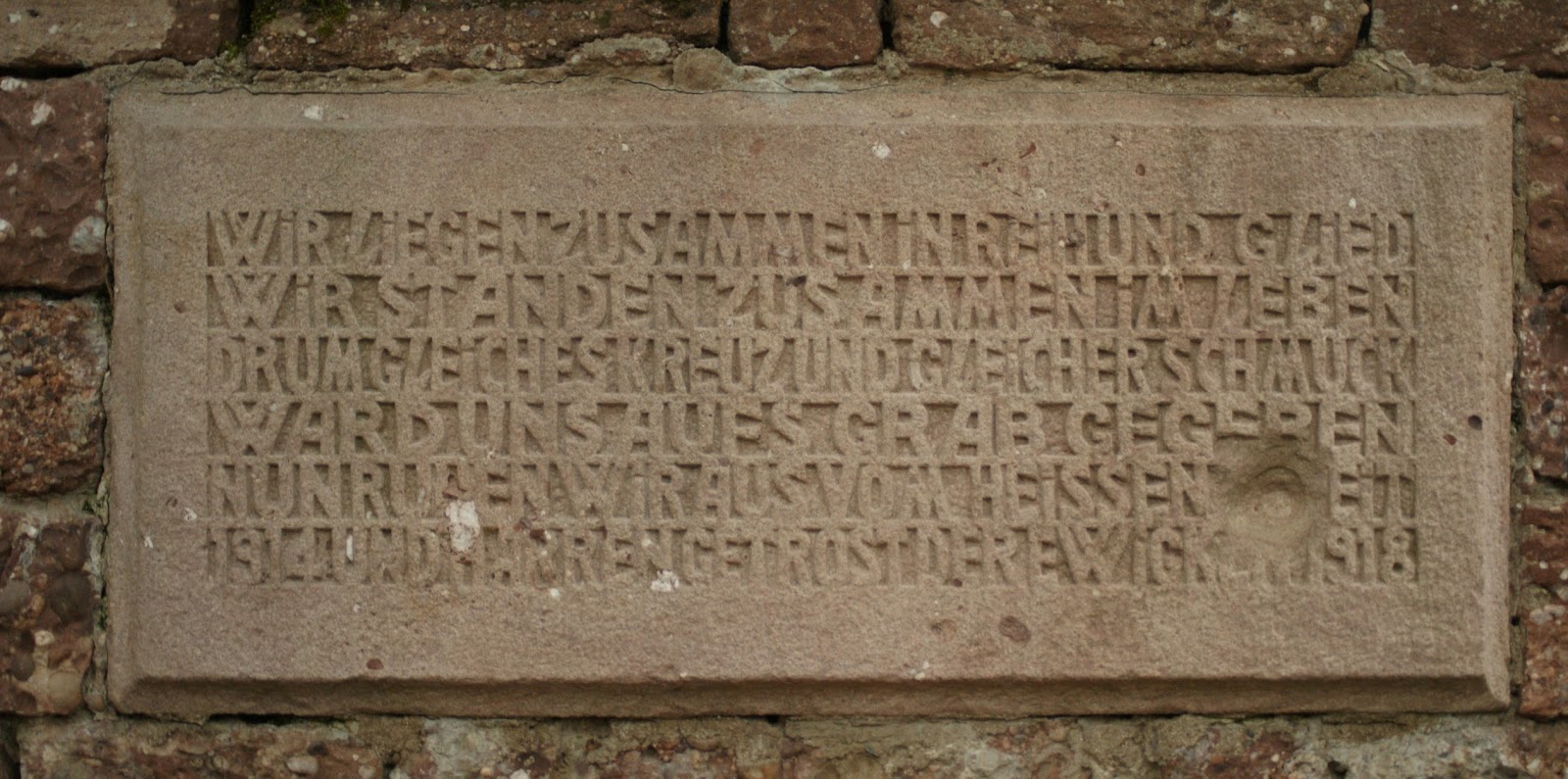
 The Battle of the Linge is also mentioned on Wikipedia. The monuments of the German cemetery were defaced by bullet holes. I could not see if these were from WW-II or if they were just modern vandalism.
It was a bloody encounter with gas and flame throwers being used. Approximately 10,000 Frenchmen and 7,000 Germans were to be killed but after the fighting the front line positions were to remain much the same until the end of the war in November 1918.


The function of these Roman dodecahedrons remains a mystery. This was the first time I saw them, in the Strassbourg museum. They too have their Wikipedia page:
No mention of them has been found in contemporary accounts or pictures of the time. Speculated uses include candlestick holders (wax was found inside two examples); dice; survey instruments; devices for determining the optimal sowing date for winter grain; gauges to calibrate water pipes or army standard bases.

In Colmar this strange book was advertised in the bookshops. I don't think Roland Barthes was ever murdered. But I think he wrote about the "death of the author". And Binet is the writer of "HhhhH", a nice postmodern book. My French is insufficient to research this further. A nice little mystery.
While walking in the woods in Alsace I saw this lifeform. I don't think they're insect eggs. I suspect some kind of fungus, lichen or slime mold. The length of the things is 2-3mm. A search of Flickr supports the slime mold hypothesis. And a question on the Fortean Times Forum yielded an identification: now it has been identified as Leocarpus fragilis.
And I saw another mysterious object in the German city of Alzey. I leave this as an exercise for the reader.

Wednesday, September 16, 2015

Two trips - two crises

In 2011 while on a holiday trip through the Schwarzwald we were haunted by reports of the financial debt crisis sweeping Europe. Then I started photographing the newspaper stands with their messages of doom (13 July 2011):
  • Italy's debt costs soar in Greek contagion
  • Steinbruck warns of anti-European sentiments because of debt crisis
This year I had the same experience and the same reaction. This time it's not the debts (that was earlier this year) but the refugee crisis sweeping Europe (15 september 2015):
  • No consensus on refugee quotas
  • The new Europe of border controls
  • Europe becoming a no-entry zone
  • Europe running out of  resources
  • Refugee crisis splits Europe
Europe has more problems than a simple mind can understand. I'm reminded of: the unstable international situation at the beginning of WW-I, the generals and politicians mishandling the battles of WW-I because of old-fashioned strategies and of the unstable political situation in the Weimar Republic and its failing democratic system. I hope I'm wrong. Europe is a project of modernity and progress that shouldn't fail.