Monday, April 29, 2013

The stones of home


Each time I visit Prague I discover new books by the psycho-geographer and psycho-geologist Vaclav Cilek. This writer has a special attraction for me, because he is not just a psycho-xxxx amateur (like me), he is a professional geologist, archaeologist and climatologist. But he combines his scientific thoroughness with the spatial, historic, cultural sensitivity and humour of writers like Nick Papadimitriou, Iain Sinclair and Phil Smith. Unfortunately none of his books have been translated into English.

The book Stones of Home describes a collection of rock and soil types that are most typical for the Czech landscape, history and national spirit. Each rock type is lovingly analyzed and connections are made between physical and geological facts and emotional effects. Who said science is cold and rational?

During my stay in Prague I went to visit some of the stones that Vaclav Cilek writes about. Below I have translated a few quotes from his book and added them to my own photographs.

And because I had been sensitized by Vaclav Cileks book I started seeing beautiful stones everywhere. And later, back in Rotterdam, I discovered several websites describing the stones of Prague. I know from bitter experience that determining rock types is extremely frustrating for the amateur. All rocks look the same and the one you try to determine is never mentioned in the encyclopedia (the same frustration applies to clouds, birds and plants). But with these guides it became a pleasant puzzle.

Prague stones mentioned by Vaclav Cilek in "The stones of home"
Granite - Facade of Komercni Banka, Vaclavske Namesti
Marble can be impressive on a small scale, but granite requires a large scale to be effective, a scale we know from Egyptian sculpture. If we want to experience this "Egyptian" monumentality on our own territory, we can respectfully circumambulate the obelisk of the Legionnaires near the Emmaus church or the gigantic semi-pillars of the Commercial Bank at the Venceslaus Square, that were carved from one single piece of rock.
Granite - Facade of Komercni Banka, Vaclavske Namesti
Granites and granodiorites are monotonous, practical stones that are more likely to suppress the imagination than to stimulate it. But we should realize that, if we didn't have granite and granodiorite, we would be using more concrete and artificial stone, and our lives would be poorer. Granite is like iron. It is not easy to become friends with it, but if you succeed, you will gain faithful and strong allies.
Pecerad gabbro - Facade of Komercni Banka, Vaclavske Namesti
Gabbro is a festive rock, but the fine grained dark varieties create a funereal atmosphere. It is interesting to consciously experience a graveyard dominated by light, usually limestone gravestones, and a graveyard with heavy dark stone, like for example the Old Jewish graveyard in the Old Town, compared with the New Jewish graveyard in the Olsany quarter. In the first one we may smile and listen to the birds, in the second we are compelled to compulsory sadness and formal heaviness.
 Black and white marble - Vaclavske Namesti
Red marble - Vaclavske Namesti
Czech red marbles are much older than all the other middle-european varieties. They are 350 million year old Devonian marbles called "slivenecky mramor". We used to think that the red colour was caused by iron oxides. But today we know that the situation was more complex and that the red colour is caused by bacteria living on the walls of tiny channels inside the limestone.
Sandstone - Charles Bridge
The trajectory of sandstone starts on the continent, where rocks crumble, rain dislodges sand grains and rivers deposit them onto beaches and into shallow shelf seas. There they are caught by strong sea currents and spread along the whole coast. Sandstone belongs to the Czech territory in the same way marble belongs to the Mediterranean. Czech sandstones have the colour of local bread and the taste of potatoes.
Prague stones mentioned by other urban geologists
Pozary granite (diorite?)- Pedestal of the King Venceslas statue, Vaclavske Namesti
Sedlcanska granite (?) - Metro station exit Museum,
Vaclavske Namesti, above the King Venceslas statue

Unknown but interesting stones I found myself
Syenite (?) - New wing of the National Museum, Vaclavske Namesti
Granite (?) - Stairs of the National Gallery, Veletrzni Palac
Granite - Facade at Vaclavske Namesti (forgot to note which one)
 
Sources:
Decorative Czech stones:
Stones of Prague monuments:


Friday, April 26, 2013

Berlin cartography

I love the area around the Anhalter Bahnhof. The mix of high urbanity, sport fields, water and old buildings makes it a varied and interesting terrain. During my stay in Berlin I collected several  tourist maps. The cartography is strikingly different between the four of them.
 

Sunday, March 31, 2013

The death of newspapers

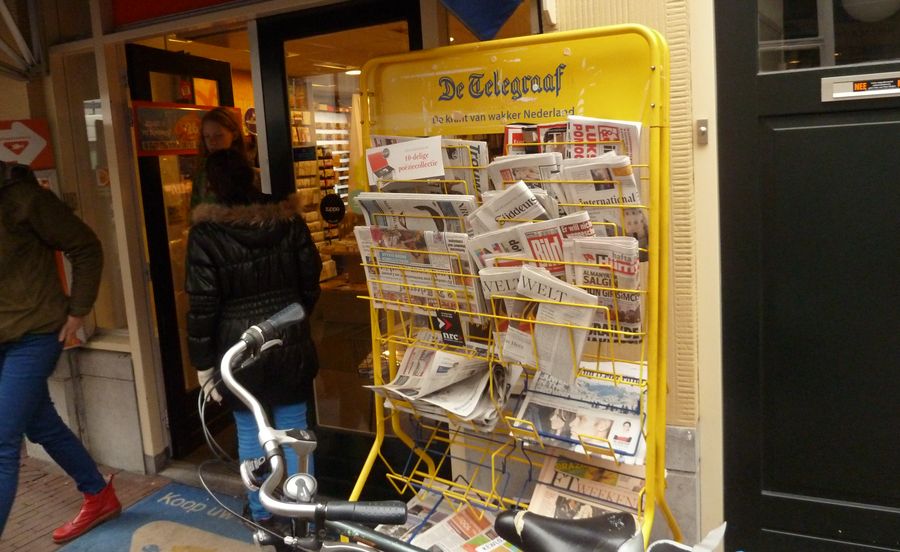
Once a month - or more often - I invest in some good newspapers and I read them front to back. My favorites are The Financial Times (not as republican as the WSJ) and the Sueddeutsche Zeitung (a bit more socialist than the Frankfurter Allgemeine). I also buy the dutch Financieel Dagblad (financial daily) regularly, especially when there's fraud, scandal and nationalisation of banks.
Unfortunately less and less shops sell these newspapers. Bookshops en news outlets have trimmed their selection and you can only buy dutch newspapers there. The only shops that sell international newspapers are the combination shops, that sell tobacco, lottery tickets, writing utensils and newspapers.

These shops are not found in the upper class neighborhoods. I think there are not enough smokers and lottery players there. Most often I find these in older, poorer areas of Rotterdam and in smaller cities.
In Gouda I asked the shop owner:
- "Do these newspapers sell a lot or am I the only idiot that buys them?"
The owner answered:
- "Sir, I'm afraid you are the only ----- that buys them."
He omitted the word "idiot" while smiling heartily.

I will not speculate on the future of paper newsprint. But I will miss it.

Sunday, February 24, 2013

Memory gift from a stranger

I have received many undeserved gifts from the Rotterdam book market but one of the most important I received from Mr. J.H. van Roijen, an ambassador working and reading in 1956. 
 
I bought the book The outsider by Colin Wilson because of the tiny calendar that I found inside. I'm fascinated by these personal details, notes, postcards, newspaper cuttings and other ephemera. I try to gauge the personality and interests of the previous owners. It is an exercise in nostalgia and melancholy.

The past is a strange land. In 1956 I could never have joined the social circles where someone was an ambassador who could spend 500 guilders on a membership of the Red Cross. But now I have his book in my hands with his most intimate notes.
The content does not interest me very much. I admire Colin Wilson for his ability to write about almost anything, but this existentialist book and its bleak view of life does not resonate with me. But there is something very ingenious written on one of the first pages of the book. A personal index!
The numbers are, of course, pointers to page numbers. And on the pages themselves the relevant paragraphs are underlined. From this list I conclude that the owner of the book had both a pessimistic view of life - he underlines many very tragic texts - but was also aware of the possibility of experiencing the sublime - he underlines many texts about escaping the limits of human perception.(Also note how the difference in writing materials proves that this index was not written in one sitting! Just like Alexander Marshack proves in his research of paleolithic notations.)
There is no meaning in life. It just "is" - a senseless, devil ridden chaos. The intelligence that makes man only makes him more brutal than any beast.
The outside world is is infinite and eternal, and would appear so to everyone if everyone could see things without the grime on their windows of perception. 
This is a classic technique, of course, but I had never thought of it. I was using sticky notes to mark interesting paragraphs and useful quotes. This lead to nice and colourful books, but things would get sticky and complicated. And glue damages books in the long run so pencil is a much better solution. (Never use a pen, this makes secondhand book dealers cry.)
And later I was reminded of the habit of Michel de Montaigne who made notes and summaries in his books to compensate for his weak memory:
A little to aid the weakness of my memory (so extreme that it has happened to me more than once, to take books again into my hand as new and unseen, that I had carefully read over a few years before, and scribbled with my notes) I have adopted a custom of late, to note at the end of every book (that is, of those I never intend to read again) the time when I made an end on't, and the judgment I had made of it, to the end that this might, at least, represent to me the character and general idea I had conceived of the author in reading it; and I will here transcribe some of those annotations.
Below you see some of my own notes. If you own these books you can see which parts made the biggest impression on me. Those are also the parts that I might write about on this blog.

References:
The past ... http://quotes.yourdictionary.com/strange
Alexander Marshack - http://en.wikipedia.org/wiki/Alexander_Marshack
Montaigne Essays: http://www.gutenberg.org/files/3600/3600-h/3600-h.htm#link2HCH0067
Write Simple Notes in Your Media to Remind You of Your Opinion
On forgetfulness - http://www.cbsnews.com/2100-501763_162-3365949.html
London Orbital - great book - http://contemporarylit.about.com/cs/reviews/a/londonorbital.htm
SCARP - equally great book - http://londonist.com/2012/06/book-review-scarp-by-nick-papadimitriou.php

Saturday, February 9, 2013

Enigmatic books - 2

Books are not dead
I wrote about enigmatic books, an enigmatic encyclopedia, mystery books and an enigmatic bookshop. Even with modern media, e-readers, PDF-files physical books are still fascinating objects. I fully agree with Joe Qeenan - and I think McLuhan said similar things:
A noted scientific writer recently argued that the physical copy of a book was an unimportant fetish, that books were “like the coffin at a funeral.” 
Despite such comments, I am not worried about the future of books. If books survived the Huns, the Vandals, and the Nazis, they can survive noted scientific writers. 
One friend says that in the future “books will be beautifully produced, with thick paper, and ribbons, and proper bindings.” People who treasure books will expect them to look like treasures. And so they will have ribbons. Another says, wistfully, that books will survive “as a niche, a bit like taking a carriage ride in Central Park. But more than that.”
Parallel evolution or copy?
Recently I saw five of such "classic" books - beautifully produced, with thick paper, and ribbons, and proper bindings - in Boijmans Museum in Rotterdam:
The Wiki Truth, is a series of five gigantic books. For these books Kyra van Ineveld selected the largest articles on Wikipedia and printed the top five. She printed them on her home-printer and made classic encyclopedias out of it. On the bottom of the book you read the first sentence that was ever written in this article; and at the top of the book you see the article as it is now. You see the information being created, being changed, being criticized, and being deleted.
I was struck by the similarity of this work to a conceptual artwork by James Bridle:
This particular book—or rather, set of books—is every edit made to a single Wikipedia article, The Iraq War, during the five years between the article’s inception in December 2004 and November 2009, a total of 12,000 changes and almost 7,000 pages. It amounts to twelve volumes: the size of a single old-style encyclopaedia. It contains arguments over numbers, differences of opinion on relevance and political standpoints, and frequent moments when someone erases the whole thing and just writes “Saddam Hussein was a dickhead”.
 James Bridle's artwork predates Kyra van Ineveldts artwork. I am not clear if it's independent parallel evolution - the idea is "in the air" - or a conscious or unconscious copy. I hope it is not a copy, because then the story is much more interesting.

Unreadable books
The E.A.Poe story "The man of the crowd" contains the quote from an unnamed German author: “Es lässt sich nicht lesen” (It does not allow itself to be read). I have seen and read many of the books: Gravity's rainbow (Pynchon), Of Grammatology (Derrida), The road to reality (Penrose) but I stumbled on a very interesting sample at Witte de With gallery in Rotterdam.
Edited by General Books LLC it is a "print on demand" book in a spartan layout with a text that is almost impossible to read because of all the OCR-errors. A fascinating book! Who would publish such a thing?
 The editors fully acknowledge the problems with OCR-technology in their FAQ:
  • Why are there so many typos in my paperback?
  • Why are illustrations missing from my paperback?
  • Why is text missing from my paperback?
But still they charge $9.99 per book of $14.99 per subscription. When you have access to Archive.org and Gutenberg, why would you want to have these books? Is it some kind of scam? If so, it is very interesting, conceptual scam. I'm tempted to buy this book.

Code books
And in the same gallery they have The Marque of the Third Stripe by Alexandre Singh. Yet another mysterious book.
It has a very pleasant size and weight. Bible-like, a little specialist encyclopedia filled with strange codes and abbreviations. Is this philosophy? Or a digital version of the I-Ching?
But then there is this classic story. Gothic indeed.
This book is on Amazon, for $59. And it has one enthusiastic review. I'm inclined to agree with the reviewer.
Wonderful light
The books are beautiful in the cool winter light of the gallery. A nice place to sit and read.
Sources
“Es lässt sich nicht lesen”: Poe and the Inscrutable
A few fascinating scaned books, available for free:
Waves of the Sea and Other Water Waves (1910)
Waves of sand and snow and the eddies which make them (1914)
Alexandre Singh in Witte de With: http://www.wdw.nl/event/the-humans/
Alexandre Singh:
Artist as Circumlocutor
http://www.artbook.com/9780982139509.html
http://www.aptglobal.org/Pages/Article/2393
http://www.aptglobal.org/Artist/Show/6770/8440
http://ensembles.mhka.be/items/5223?asset=13207

Saturday, February 2, 2013

Melanchton Park

Rotterdam - places of pilgrimage - 5

This afternoon I took my bicycle to inspect some parks in the North of Rotterdam. I had memories of one park looking like London. A green area surrounded by city buildings. Tops of city buildings poking through treetops. I was not sure then which park it was: the Melanchton or the Argonaut park.
Now I am sure : it was the Argonaut park. But I went in search of the London effect anyway, even though I was in the wrong place.
And doing some web research afterwards I got the idea for a new exploration project: to visit all the parks of Rotterdam. According to the city council there are 19 of them. I only know 7 of these in detail. And if you don't know a place in detail it does not count as "knowledge".

The Melanchtonpark has a strange geometry. It is all circumference and no surface. You can look into it from all sides, but it is difficult to be inside it. The municipal website describes it thus:
The Melanchtonpark in the municipality of Hillegersberg-Schiebroek was constructed in the mid-1970s. ' Back to nature ' was the trend at that time and you can see that in the design of the park. With its playful paths and varied vegetation you can imagine being inside a forest.
It is not possible to imagine being in a forest, with all these expensive houses in the neighborhood. You need other parks for that, like the Kralingse Plas (Kralingen Lake). But the website is correct in describing the variety of trees. And I think I saw the birds, just in a flash:
    The view of the houses is obscured by alder, maple, oak, beech and pollarded willows. There are many small songbirds. For example: the long-tailed tit, a nice little ball-shaped bird with a long tail, that flies in groups from tree to tree.
Parks are places to meet surreptitiously. To hold cryptic conversations. To have statues looking down on you. (There are none in this park. There should be!)
They had reached the top of the steps. The founder of India, one foot casually upon a plateau of vanquished bronze, stared contentedly past them into the glades of the Park.
'They've kept the doors open.' His voice was tender with reverence. 'They're on the weekday schedule. My, they are going it. Well,' he remarked, receiving no admiring echo, 'you go your way, I go mine. Mind you,' he added shrewdly, 'it could do us a lot of good.  

Parks are places to leave mysterious objects to be retrieved by strangers. Dead drops, dead letter boxes.
A cool, cleaning wind was blowing from the south; he could have walked all day. But he still had the parcel and he had to get rid of it. The little wastebaskets were too small; he'd look absurd trying to push his parcel into one of those. He sat down on a bench and put the parcel beside him, not too close, and moved a little away from it. After a couple of minutes he walked back toward the footpath, leaving the parcel where it lay.
And parks are places to see apparitions. And to not be sure if you've seen them or not. Like with the "London effect". With a lot of effort I could see high buildings through the trees, but they did not look metropolitan.
He turned down the empty street toward the park. It was foggy. Some way down the road - not far, twenty yards, perhaps a bit more - stood the figure of a man in a raincoat, short and rather plump. He was leaning against the railings of the park, silhouetted in the shifting mist. As he approached, the mist seemed to thicken, closing in around the figure at the railings, and when it parted the man was gone.
Sources
List of parks in Rotterdam - http://www.rotterdam.nl/tekst:parken
Melanchtonpark - http://www.rotterdam.nl/tekst:melanchtonpark
Ball-shaped birds - http://en.wikipedia.org/wiki/Long-tailed_Tit
Description of several parks and their trees - http://www.erikvanloon.com/sistercities/osaka-hillegersberg.htm
A SMALL TOWN IN GERMANY - John le Carré
THE SPY WHO CAME IN FROM THE COLD - John le Carré

Sunday, January 27, 2013

Argonaut Park

Rotterdam - places of pilgrimage - 4
Emergency meeting, drove me round and round the park in a car, yelling blue murder. Said I was so plastered these days I didn't know fact from fiction. All that stuff.
This afternoon I took my bicycle to inspect some parks in the North of Rotterdam. I had memories of one park looking like London. A green area surrounded by city buildings. Tops of city buildings poking through treetops. I was not sure which park it was: the Melanchton or the Argonaut park. Conclusion: it was the Argonaut park, but the park has been restructured in the meantime, destroying the London effect.
Better still, the neighbourhood possessed no social identity and demanded none. Some of the houses had been turned into one-roomed flats, and had ten door bells laid out like a typewriter. Some were got up grandly and had only one.
The cause of the destruction was this completely new quarter. It was not there when I last visited the area (5 - 10 years ago). Generic modern buildings. Apartments costing 250.000 euros. The park had been re-landscaped to accommodate this project.
It was terribly cold. The wind seemed to come from the river, across the park. He looked up and down the road. It was empty. He walked a hundred yards or so toward the power station, changed his mind and turned back. He was sleepy. It was a curious illusion that even in the street he still heard the telephone ringing.
In some directions the London effect was still visible. Older city buildings at the edges of a wide green field. A clear border, an enclave. A few people walking their dogs. Some families with children. Cold wetness. Typical Dutch winter weather.
And come the dawn, do you know what we did? I will tell you. We walked solemnly down to the parks, I sit on a bench with a stopwatch, big Jim gets into his running kit and lopes twenty circuits. Twenty. I was quite exhausted.
At home I did some research on the place. There were a lot of documents on the restructuring of the park with many interesting details. Things I wouldn't have thought about:
  • Bicycle and pedestrian traffic will be separated.
  • Trees with different colours and shapes will be planted (amelanchier - krentenboompje).
  • Digging more ponds is not possible for geotechnical reasons. The ponds will get sloping, more natural banks enhancing biodiversity.
  • Asphalt paths are less natural than sea-shell paths. But sea-shell paths are difficult to maintain. Grass grows through them. Wheels leave tracks.
  • The dog- and child areas have been separated. The dog area cannot be moved towards the water. Water quality would suffer. Dogs cannot roam freely, playing children dislike free running dogs.
  • The police has advised to keep several paths dark so that people will not walk there at night.
  • The work had to be interrupted because of the nesting season of the wood pigeons. (In the countryside the shoot these, as pests.)
He went to functions, lectures, strolled in the park, played a little tennis and short of giving sweets to the kids he couldn't have been more respectable.
Some comments from the public:
  • The child playing area is always swampy.
  • Parents won't let their children play in one park area because it is too dark. This will not be changed. Maybe some bushes can be thinned-out.
  • Asphalt paths and the new bridge might attract unwanted scooter traffic from the neighboring school.
  • Park benches along the water might attract boisterous youths. Also the stairs and the green slope might attract loiterers. (The area has a higher than average percentage of old folks.)
The pickups were variously contrived. At Green Park, by way of a recognition signal, he carried a Fortnum Mason carrier-bag. At the embankment, on the other hand, he clutched an out-of-date copy of Time magazine, bearing by coincidence the nourished features of Chairman Mao on the cover. Big Ben struck six and Jerry counted the chimes, but the ethic of such meetings requires they do not happen on the hour nor on the quarter, but in the vaguer spaces in-between, which are held to be less conspicuous.
General remarks about the area:
  • In 2008 someone left mysterious packages in several parks on the north side of Rotterdam. Black garbage bags containing many platsic wrapped packages. Each package containing a coconut and one half lemon. Or a coconut and cotton wool. Or a coconut and some coloured powder. This has never been explained.
  • There are problems with the ground-water levels damaging the foundations of buildings.
  • The older parts of the area lie much higher because the village of Hillegersberg has been built upon a fossil sand dune from the ice age.
Sources
Samenvattend verslag van de informatieavond schetsontwerp Argonautenpark op donderdag 1
juli 2010 vanaf 19.30 uur in het deelgemeentekantoor van de deelgemeente Hillergersberg-Schiebroek - http://www.deelraadinfo.nl/dsresource?objectid=59983&type=org
De herinrichting van het Agonautenpark loopt volgens planning - http://www.rotterdam.nl/DG%20Hillegersberg%20-%20Schiebroek/PDF/2012-09-20%20-%20stand%20van%20zaken%20Argonautenpark%202011.pdf
http://www.rotterdam.nl/DG%20Hillegersberg%20-%20Schiebroek/PDF/Gebiedsvisie%202011-2014/Analyses,%20ambities%20en%20actiepunten%20Hillegersberg-Noord.pdf
Mysterie: kokosnootpakketjes in parken - Argonautenpark - http://www.ad.nl/ad/nl/1038/Rotterdam/article/detail/2111351/2008/04/10/Mysterie-kokosnootpakketjes-in-parken.dhtml
THE LOOKING GLASS WAR - John LeCarré
Tinker Tailor Soldier Spy - John le Carré