Thursday, May 4, 2023

Thomas Ligotti - The strange designs of Master Rignolo 4

Using OpenAI to illustrate my favorite Thomas Ligotti story, and to make my inner pictures visible for you. And for myself. First I fed the story text directly into the AI. Now I make my own description of what happens in the story. This works better.

You can read, and see, the whole story here:

While Nolon was gazing at one of Rignolo's landscapes, Grissul seemed unable to shake off a preoccupation with the artist himself, though he was obviously making the effort. But the more he tried to turn his attention away from Rignolo, the more easily it was drawn back to the flabby skin, the faded complexion, the undisciplined shocks of hair. Finally, Grissul gave a little nudge to Nolon and began to whisper something. Nolon looked at Grissul in a way that might have said, "Yes, I know, but have some sense of decorum in any case," then resumed his contemplation of Rignolo's excellent landscapes.

They were all very similar to one another. 


Given such titles as "Glistening Marsh,” 

"The Tract of Three Shadows," 
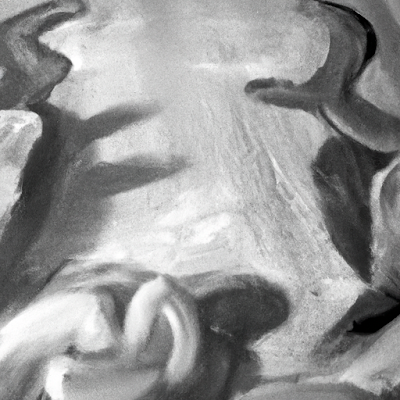
and "The Stars, the Hills," 

they were not intended to resemble as much as suggest the promised scenes. 

A vague hint of material forms might emerge here and there, some familiar effect of color or outline, 

but for the most part they could be described as extremely remote in their perspective on tangible reality. 

Grissul, who was no stranger to some of the locales purportedly depicted in these canvasses, could very well have expressed the objection that these conglomerations of fractured mass, these whirlpools of distorted light, simply did not achieve their purpose, did not in fact deserve connection with the geographical subjects from which they took their titles. 

Perhaps it was Rignolo's intuition that just such a protest might be forthcoming that inspired - in the rapid, frantic voice of a startled sleeper - the following outburst.

"Think anything you like about these scenes, it's all the same to me. Whisper to each other, my hearing is wonderfully bad. Say that my landscapes do not invite one's eyes to pass into them and wander, let alone linger for the briefest moment. Nevertheless, that is exactly their purpose, and as far as I am concerned they are quite adequate to it, meticulously efficient.

I have spent extraordinary lengths of time within the borders of each canvass, both as maker and as casual inhabitant, until the borders no longer exist for me and neither does... that other thing.

Understand that when I say inhabitant, I do not in any way mean that I take my clumsy feet tromping up and down staircases of color, or that I stand this stunted body of mine upon some lofty ledge where I can play the master of all I see. 
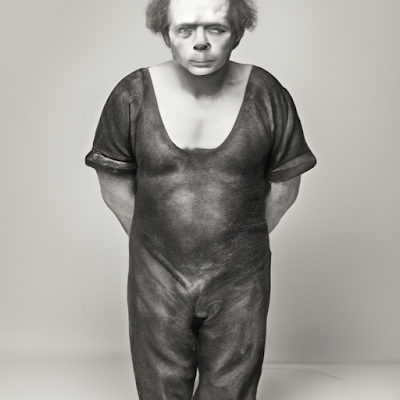
There are no masters of these scenes and no seers, because bodies and their organs cannot function there - no place for them to go, nothing to survey with ordinary eyes, no thoughts to think for the mighty brain.

And my thoroughfares will not take you from the doorstep of one weariness to the backdoor of another, and they cannot crumble, because they are burdened with nothing to convey — their travelers are already there, continuously arriving at infinite sites of the perpetually astonishing. Yet these sites are also a homeland, and nothing there will ever threaten to become strange. What I mean to say is that to inhabit my landscapes one must, in no figurative sense, grow into them.
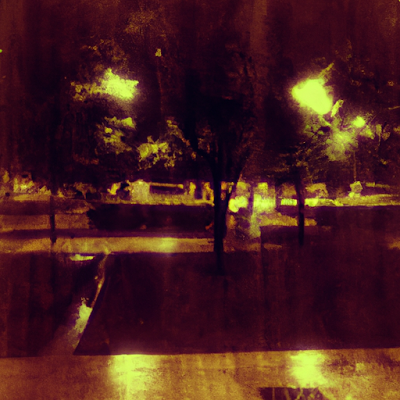

At best they are a paradise for sleepwalkers, but only those sleepwalkers who never rise to their feet, who forget their destination, and who may thus never reach that ultimate darkness beyond dreams, but may loiter in perpetuity in these lands of mine, which neighbor on nothingness and stand next door to endlessness. So you see, my critics, what we have in these little pictures is a living communion with the void, a vital annihilation and a thoroughly decorative eternity of — "

Wednesday, May 3, 2023

Thomas Ligotti - The strange designs of Master Rignolo 3

Using OpenAI to illustrate my favorite Thomas Ligotti story, and to make my inner pictures visible for you. And for myself. First I fed the story text directly into the AI. Now I make my own description of what happens in the story. This works better.

You can read, and see, the whole story here:

"Don't just walk stepping everywhere," Rignolo told his visitors as they all entered the studio.

He was a little out of breath from the climb up the stairs, wheezing his words, quietly muttering to himself, "This place, oh, this place." 

There was hardly a patch of floor that was not in some way cluttered over, so he need not have warned Nolon, or even Grissul. 

Rignolo was of lesser stature than his guests, virtually a dwarf, and so moved with greater freedom through that cramped space. 

"You see," he said, "how this isn't really a room up here, just a little closet that tried to grow into one, bulging out every which way and making all these odd niches and alcoves surrounding us, this shapeless gallery of nooks. There's a window around here, I suppose, under some of these canvasses. But those are what you're here for, not to look out some window that who knows where it is. Nothing to see out there, even so."

Rignolo then ushered his visitors through the shrunken maze composed of recesses of one sort or another, indicating to them a canvass here or there. Each somehow held itself to a wall or was leaning against one, as if with exhaustion. 

Having brought their attention to this or that picture, he would step a little to the side and allow them to admire his work, standing there like a polite but slightly bored curator of some seldom-visited museum, a pathetic figure attired in over-sized clothes of woven... dust. 

His small ovoid face was as lifeless as a mask: his skin had the same faded complexion as his clothes and was just as slack, flabby; his lips were the same color as his skin but more full and taut; his hair shot out in tufts from his head, uncontrolled, weedy; and his eyes showed too much white, having to all appearances rolled up halfway into his forehead, as if they were trying to peek under it.

Monday, May 1, 2023

Thomas Ligotti - The strange designs of Master Rignolo 2

Using OpenAI to illustrate my favorite Thomas Ligotti story, and to make my inner pictures visible for you. And for myself. First I fed the story text directly into the AI. Now I make my own description of what happens in the story. This works better.

You can read, and see, the whole story here:

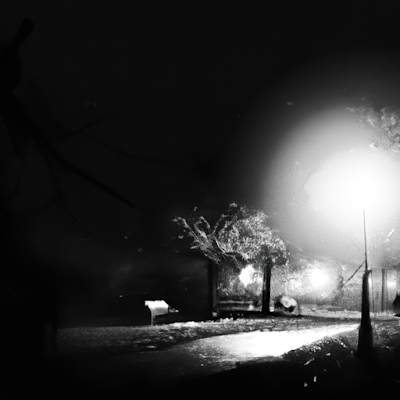
It was well into evening and for some time Nolon had been been seated at a small table in a kind of park.

This was a long, thin stretch of land - vaguely triangular in shape, like a piece of broken glass - 

bordered by three streets of varying breadth, varying evenness of surface, and of varying stages of disintegration

as each thoroughfare succumbed in its own way and in its own time to the subtle but continuous movements of the slumbering earth below.

From the far end of the park a figure in a dark overcoat was approaching Nolon's table, 

and it appeared there was going to be a meeting of some sort.

There were other tables here and there, all of them unoccupied, 

but most of the park was unused ground covered with a plush, fuzzy kind of turf. 

In the moonlight this densely woven pile of vegetation turned a soft shade of aquamarine, almost radiant. Beyond the thinning trees, stars were bright but without luster, as if they were made of luminous paper. 

Around the park, a jagged line of high roofs, black and featureless, crossed the sky like the uneven teeth of an old saw.

Nolon was resting his hands at the edge of the small, nearly circular table. In the middle of the table a piece of candle flickered inside a misshapen bubble of green glass, and Nolon's face was bathed in a restless green glare. He too was wearing a dark overcoat, unbuttoned at the top to reveal a scarf of lighter shade stuffed inside it. The scarf was wrapped about Nolon's neck right to the base of his chin.

Every so often Nolon glanced up, not to look at Grissul as he proceeded across the park, but to try and catch sight of something in that lighted window across the street:

a silhouette which at irregular intervals slipped in and out of view.

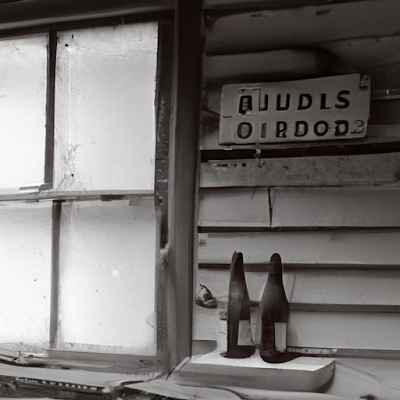
Above the window was a long, low roof surmounted by a board which appeared to be a sign or marquee.

The lettering on this board was entirely unreadable, perhaps corroded by the elements or even deliberately effaced. 

But the image of two tall, thin bottles could still be seen, their slender necks angled festively this way and that.


Sunday, April 30, 2023

Thomas Ligotti - The strange designs of Master Rignolo 1

 I tried to use OpenAI to illustrate this great story:

You can read, and see, the whole story here:

“So I was going to tell you,” Grissul began, “that I was out in that field, the one behind those empty buildings at the edge of town where everything just slides away and goes off in all directions. And there’s a marsh by there, makes the ground a little, I don’t know, stringy or something. No trees, though, only a lot of wild grass, reeds, you know where I mean?”

“This was a little before dark that I was there. A little before the stars began to come out. I really wasn’t planning to do anything, let me say that. I just walked some ways out onto the field, changed direction a few times, walked a ways more. Then I saw something through a blind of huge stalks of some kind, skinny as your finger but with these great spiky heads on top. And really very stiff, not bending at all, just sort of wobbling in the breeze. They might well have creaked, I don’t know, when I pushed my way through to see beyond them. 

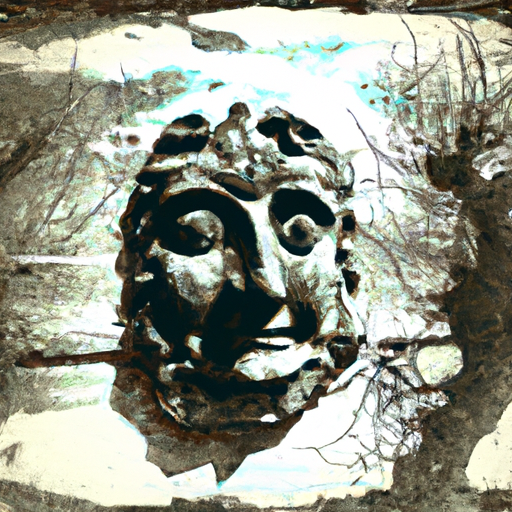
Then I knelt down to get a better look at what was there on the ground. I’m telling you, Mr. Nolon, it was right in the ground. It appeared to be a part of it, like—”

“The face,” he said, leaning back in his chair. “It was right there, about the size of, I don’t know, a window or a picture hanging on a wall, except that it was in the ground and it was a big oval, not rectangular in any way. Just as if someone had partly buried a giant, or better yet, a giant’s mask. Only the edges of the face seemed not so much buried as, well, woven I guess you would say, right into the ground. The eyes were closed, not shut closed—it didn’t seem to be dead—but relaxed. The same with the lips, very heavy lips rubbing up against each other. Even complexion, ashy gray, and soft cheeks. They looked soft, I mean, because I didn’t actually touch them in any way. I think it was asleep.”

Saturday, April 15, 2023

Cyclonopedia by Reza Negarestani


I had a chat about Cyclonopedia with ChatGPT. We agree on a lot of things. It's a difficult but fascinating book:

The book is an ambitious attempt to use philosophy and literature to challenge conventional wisdom about the role of oil in contemporary society and to offer a new way of understanding the relationship between politics, economy, and the environment.

To fully understand the philosophical ideas presented in "Cyclonopedia," some background in continental philosophy, particularly the works of Gilles Deleuze and Félix Guattari, may be helpful. However, one can still engage with the book's ideas without a deep knowledge of philosophy, as long as they are willing to approach the text with an open mind and a willingness to grapple with complex ideas.

There are at least three layers of narrative in "Cyclonopedia." The first layer involves the narrator's search for the writings of the archaeologist, which serves as the overarching framework for the book. The second layer is the narrative of the archaeologist himself and his research on the connections between oil, culture, and history. And the third layer is the presentation of the archaeologist's ideas, which are interspersed throughout the book in the form of theoretical reflections, philosophical speculations, and allegorical fictions.

In addition to these three layers, there are also other narrative threads that run throughout the book, including the themes of horror and science fiction, the use of metaphor and allegory, and the exploration of Middle Eastern politics and culture. These threads are intertwined with the main layers of the narrative, adding depth and complexity to the book's overall structure.

The book presents a vision of the Middle East as a place where the lines between the past and the present, the natural and the supernatural, and the human and the non-human are blurred. The author argues that this "haunting" is not simply a metaphor, but is a real and tangible phenomenon that has shaped the region's history and politics.

Monday, April 10, 2023

From a strange planet - 61

 E134 Vats

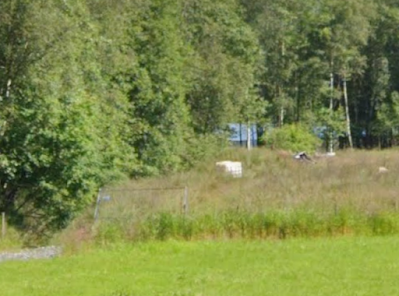
Do you see the white cube in the background?
We will search for it.

The woods are magical. They hint at hidden things behind them.
And then there is the white unnatural object.

What could it be?

  • It's most probable that the cube is a plastic water container. Plastic containers can sometimes be mistaken for cubes or rectangular shapes, and they can be used to store water or other liquids in outdoor environments.

It could also be:

  • A small bridge or culvert used to cross the stream
  • An old, abandoned concrete block or pillar
  • A survey marker or boundary stone
  • A discarded piece of construction or roadwork material
  • An outdoor artwork or sculpture
  • A naturally occurring white rock or mineral formation
  • An optical illusion caused by the lighting or camera angle
  • A small garden gnome or other decoration
  • A leftover prop or set piece from a movie or TV shoot
  • A piece of debris from a nearby aircraft or satellite.

Maybe we can look on streetview.

Here's the cube again.
It's not along stream, but along a gravel road.
And indeed, it looks very much like a water container.
Those plastic ones with a mesh of tubing around them.
The 2018 streetview confirms this hypothesis.
The cube is visible on Google satellite view.
Maybe there is a suggestion of it on Microsoft satellite view.
There's a trace of the gravel road on the topographic map.

Sunday, March 26, 2023

From a strange planet - 58

Here we discover two trees in the darkness.
Birch trees are very northern, Siberian and shamanic.
Then we look at the water and the the hills shaping the the horizon.

E39 Sokn 1 - Streetview

Two ragged birch trees at a parking lot. A beautiful landscape.
The same trees on streetview. From another direction.
Similar trees can be seen on a Munch drawing.
Edvard Munch - Norwegian Landscape
Freeman's: Art and Design
Water, hills and mountains. And a buoy.
Buoys are always mysterious.
But they have so many literal meanings, that their symbolic meanings vanish into the noise.
A 1,200-pound Soviet buoy kicked up along the shores of Dania Beach after Hurricane Irma swept through town.
A mysterious iron sphere that washed up on a Japanese beach has baffled authorities and sent social-media users into a frenzy.
There are hills or mountains on the horizon.
But they are far away. They are not on the island of Sokn.
They are on the island of  Åmøy.