Saturday, February 20, 2016

Rotterdam - Places of pilgrimage - 6

I'm building a mental map of Rotterdam. There is one rule: I have to remember the place myself, without artificial memory aids like archives, books and photographs. It has to be personal.

The previous lists of pilgrimage destinations are here: part 1part 2part 3part 4 and part 5.  The complete map can be browsed on Google maps.
 
Street numbers
This edition will be dedicated to "street numbers": numbers found on (usually older, brick) cobblestones throughout Rotterdam.

Numbered bricks are rare but often they form clusters. If you search for them actively they're nowhere in sight. Then you go for a random walk and you see several of them. And afterward it takes several years to see new ones.

The numbers are handwritten and they point to a pre-industrial age without labels and barcodes, when administration was done on "the thing itself." I don't know the age of these cobblestones and I don't know where I could find more information.
 
Note: I'm not the only one obsessed by details like this. The "Forgotten NY" website has a whole chapter on cobblestones. They have bricks but they don't mention numbers.

This is my current list. Note: I have not kept records of the earliest street number locations. They could be incorrect:
  1. Cobblestone bricks numbered: 15 and 87 - Crossing of Pr. Beatrixlaan and Konijnenlaantje in the Kralingse Bos. Seen in 2009.
  2. Cobblestone bricks numbered: 21x34 and 46. - Between Steiger and Vlasmarkt. Seen in 2009.
  3. Cobblestone brick marked: 43 - Crossing of Pr. Beatrixlaan and Doorkijk in the Kralingse Bos. Seen in 2011.
  4. Cobblestone brick marked: 2DW - Crossing of Pr. Beatrixlaan and Hoogtaludpad in the Kralingse Bos. Seen in 2012.
  5. Cobblestone brick marked: 7DW - Near the crossing of 's-Lands Erf and Willem Ruyslaan. Seen in 2013.
  6. Cobblestone bricks marked: 66, 66.4 and 21x34. - Between Steiger and Vlasmarkt. Seen in 2013 and 2015.
  7. Cobblestone brick marked: 75 - Crossing of Parklaan and Parkstraat. Seen in 2015.
  8. Cobblestone bricks marked: 42 and 26 - Charloisse Hoofd, behind the Maatunnel bicycle entrance. Seen in 2015.


The map demonstrates the random distribution of numbered cobblestones. Some clustering is predictable because one batch of bricks will be laid in one specific area. And - assuming that during road works bricks are dug up, laid aside and then replaced again - a cluster of numbered bricks can stay in place for many years.

Modern numbered cobblestones also exist. But they're numbered industrially and not by hand. Example from Hardinxveld-Giessendam (2011) and the Hague (2014).
 

Sunday, February 14, 2016

Nature near home - 2

In an older post I cited John Burroughs (1918):
  • The birds about his own door are his birds, the flowers in his own fields and wood are his, the rainbow springs its magic arch across his valley, even the everlasting stars to which one lifts his eye, night after night, and year after year, from his own doorstep, have something private and personal about them.
Magpie construction site
My personal birds give me much pleasure, especially since they've started to make their nest opposite my kitchen window. You can see the progress on their building site:
 06 February
 13 February

Exactly like their Wikipedia article they build their nest in:
  • ... tall trees ... firmly attaching them to a central fork in the upper branches. A framework of the sticks is cemented with earth and clay, and a lining of the same is covered with fine roots. Above is a stout though loosely built dome of prickly branches with a single well-concealed entrance.
Bird count
Each year I try to participate in the National Garden Bird Count. My area is almost standard and has all the top-10 birds, except the sparrow. We have no sparrows in our territory, even though they're nr.1 in the national bird-count.

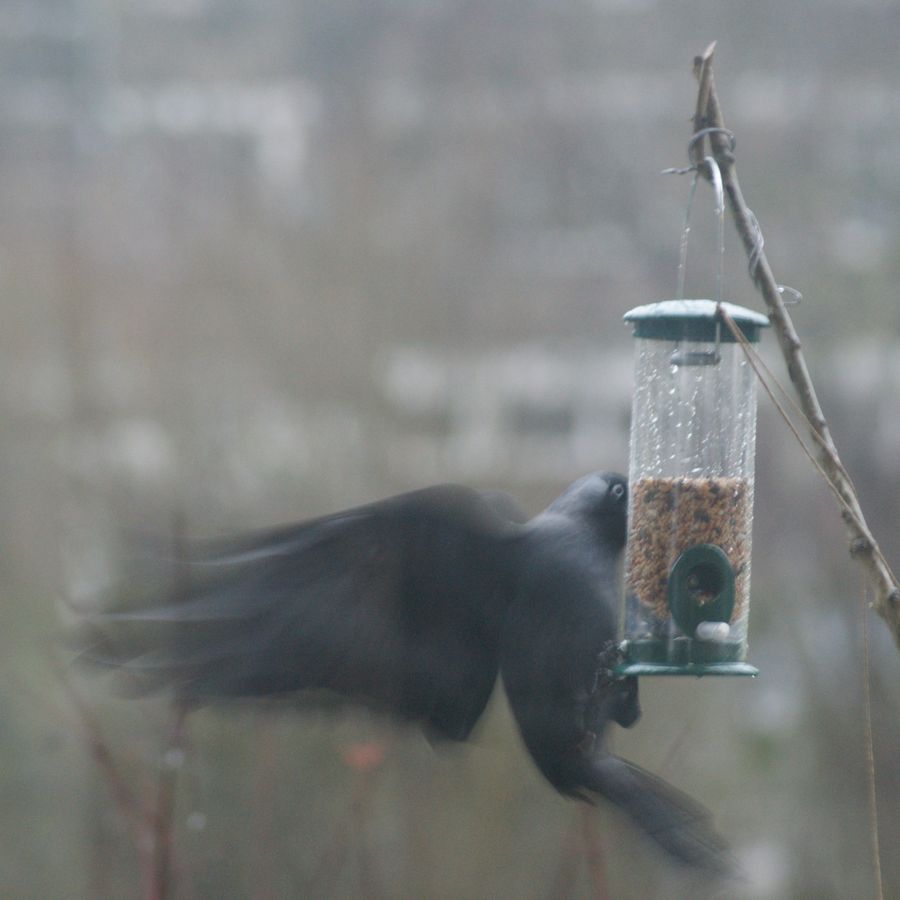
Last year I tried to photograph all my local birds and, using our balcony bird-feeder, I recorded some of them on my own doorstep. I add their rank in the national bird count below.

I have no pictures of the following top-25 birds that I have seen on my doorstep:
  • Eurasian collared dove, starling, Eurasian jay, great spotted woodpecker, European herring gull, feral pigeon.
And birds, not in the top-25, that I have seen on my doorstep more than once:
  • stork, grey heron, cormorant, great crested grebe, Egyptian goose, chicken, Eurasian coot, common moorhen, common chiffchaff. And we have a tawny owl somewhere that I hear at night.
In total: 28 bird species on my doorstep and only 12 pictures. I have more work to do.
 02
 04
 --
 13
 08
 10
 03
 09
 06
 21
 24
 18

Monday, January 25, 2016

Rotterdam - Places of pilgrimage - 5

I'm building a mental map of meaningful places in Rotterdam. There is one rule: I have to remember the place myself, without artificial memory aids. I cannot use my photo archive and I cannot use books. It has to be personal.

The previous lists of pilgrimage destinations are here: part 1part 2part 3 and part 4. And there are
also these pages about specific destinations: a park, another park and an allotment garden.
The complete map can be browsed on Google maps.

Surprising how difficult it is to locate these places on the map of Rotterdam. In my memory they're stored like a chain of places: A > B > C, how to travel from A to C. Not: where am I on the map. I have to re-travel this path to re-discover the exact location.
I had to search my archives to locate these places. I still don't have the map of Rotterdam in my head.

Building personal Google maps is very processor-intensive. Too hard for my old laptop. I need a stronger computer.
  1. The strange school tower, Den Hertigstraat - This is a spooky tower on a school building. It has no visibly obvious function (probably stairs or elevators) and has face-like windows at the top. Like some abstract, but ominous guard.
  2. The strangely truncated poplar trees, Millinxpark - These trees have been cut through the middle, leaving them shapelessly decapitated.
  3. The glass display case, Millinxstraat - I think local children can display their treasures here. I saw porcelain animals and model trains.
  4. Strange school tower, Blazoenstraat - Several schools in this area have towers, chimneys or stairways that look slightly threatening. Like some abstract, but ominous guard tower.
  5. Strange school and tower, Zwartewaalstraat, Gaesbeekstraat - This large old school has towers (chimneys, stairways or escalators) that look slightly threatening. They are topped by tiny houses. There are also a few free standing utility-buildings shaped like tiny houses. A strange ensemble.
  6. Strange school tower, Hoogvlietstraat - This large old school has towers (chimneys, stairways or escalators) that look slightly threatening. They are topped by tiny houses.
  7. The passage between the churches, 's-Gravendeelstraat - A green passage between two old schools/churches. American-style evangelist congregations are housed here (I think). It is a peaceful place, not accessible for cars.
  8. The telephones, Oostendam, Lange Hilleweg - Behind the glass, inside this cluttered antique shop several old telephones are gathering dust. Massive Bakelite dials and buttons, textile covered cables. Reminds me of the cold war and Dali. Would this shop ever sell something? How long will it last?
  9. The playing cards, Oostendam, Lange Hilleweg - Here I found several playing cards laying in the street. Scattered by the wind, moistened by the rain. It's not rare to find them scattered in city streets. I always wonder what happened.
  10. The dark, massive school building, Lange Hilleweg - A large, dark school building with an arched entrance. Inside there must be long tiled floors and high tiled walls and massive stone stairways with metal and wood railings. Something to haunt your youth. Later I found out it was the convent of St. Francis.
  11. The ornate lingam, Paul Krugerstraat, Afrikaanderplein - A postmodern obelisk, well-made, coloured, ornamented. Many different materials. Looks out over the park and echoes the crescent moon above the dome of the mosque. Later I found out it's the "Monument for migrant workers".
  12. The magpie tree, Hoogvlietstraat - A tree on the corner where once I saw a gathering of more than 20 magpies.
  13. The convent, Putselaan - It is also called "The convent" and has two saints guarding the front entrance.
  14. The ornate fence around the playground, Putselaan, Hillevliet - A low fence made from thick metal bars. This looks more like something from Paris than from Rotterdam.

Thursday, January 14, 2016

Conversa #51 background material

Thomas Walskaar - My Hard Drive Died Along With My Heart
Had a wonderful evening at Conversa #51 with:
  • Thomas Walskaar (My Hard Drive Died Along With My Heart)
  • Petr Kazil (The Materiality of Cloud Technologies)
  • Sijing Zhang (Translation Intuition)
Below is some background material for the cloud talk.
Picture credits Oana Clitan and Berenice Staiger
James Bridle has several interesting essays on the materiality of the Internet:
And he has a longer and more detailed description of traceroute:
Amsterdam datacenter tour with Tijmen
These are nice books on the materiality, economics and power-relations of the Internet:
This is a great site on High Frequency Trading and its microwave towers. There are many parts to this story, among them:
Amsterdam datacenter tour with Tijmen
And two good books on HFT and the underlying technology
A few relevant weblogs about cloud and mobile technology:


Idea for projects - if anyone thinks this is fun, then contact me through Facebook:
  • Visiting the landing sites for the undersea cables - probably nothing to see there
  • Finishing the tour of Amsterdam datacenters - more boring steel boxes
  • Publishing the "26 Amsterdam datacenters" booklet
  • Visiting the Rotterdam telecom substations - more boring utility buildings

Sunday, January 10, 2016

Datura search

In my university days I discovered the writings of Carlos Castaneda. Inspired by him (and though I don't think his writings are "true") I bought the book Gift und Arzneipflanzen in Mitteleuropa (Poisonous and medicinal plants of Middle-Europe) for a more scientific insight into this fascinating subject. Since then I've been actively looking for edible, medicinal and poisonous plants. And especially for Datura Stramonium, the thorn-apple, because it is beautiful and uncanny.
Datura Stramonium along a parking lot in Wachendorf, Germany
It took years before I saw my first datura. This was a tiny plant in the Rotterdam harbour growing along a deserted warehouse. Nowadays this place has been gentrified and the ecology has been erased.
I collected the seeds and later planted them on my balcony and along the railway embankment on my way to work. Both plantings prospered but neither had staying power. No plant returned the next season. Now I suspect that the soil was too rich and the ecology too friendly. This fiendish plant likes fiendish surroundings.
An egde-land area reminiscent of the Amsterdam Datura sighting.
The following years I had a few rare sightings of Datura. In Germany I saw many plants in bloom at the edge of a parking lot, but it was too early for seedpods. On the outskirts of Amsterdam I saw a beautiful ripe plant, but I was on a business trip and couldn't visit managers while carrying a dry poisonous bush.
Datura in bloom in the dunes of Hoek van Holland.
Recently I discovered many vigorous datura plants in Hoek van Holland. The first time was frustrating because the plants were in bloom and the seedpods were green and closed. But in December I revisited this area and collected many ripe seedpods. This is not easy, the stems of the plant are extremely tough and the seedpods are hard and very prickly.
I hope that the many families with children that visit the dunes stay away from these plants, they are surprisingly abundant here.
I will never try this and neither should you! - I think you should never experiment with Datura. It is highly poisonous and the margin between a deadly dose and a hallucinogenic dose is very thin. And the concentration of active ingredients is highly variable. So you never know how much you ingest. Finally Datura is a deliriant drug and many Datura trips are highly unpleasant.
Just looking at this plant and reading about its scary properties is sufficiently mind-bending for me.
I intend to plant the seeds somewhere out of reach of humans and especially children. I now have a better idea of the ecology this plant likes: highly disturbed and recently disturbed sandy soil. I know a few places where it could feel at home. We will see what happens next.

Monday, December 28, 2015

Ephemera experiment - pre-zine - 2

Background - I'm thinking about making a one-page zine. And I'm looking for ideas.
I also need more room in my home, so I'm sorting my ephemera to see what I don't want to keep. Just like in my previous experiment. This time I'll keep almost 90% and I had hoped for less.

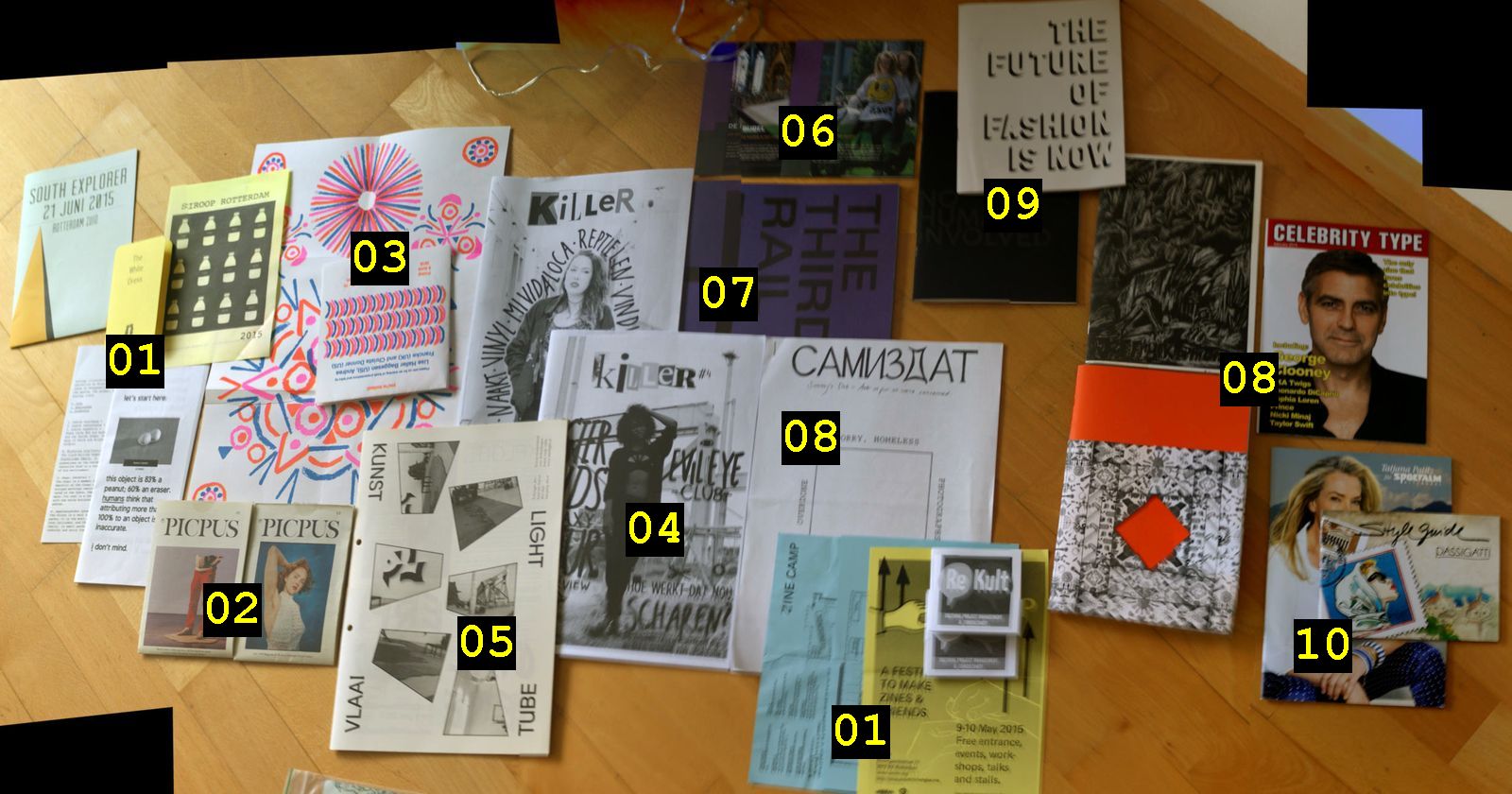
Which ephemera will not be kept? - You can click the picture for a bigger view.
What kind of ephemera will not be kept? These are the first raw data. The numbers in square quotes refer to my previous experiment:
  1. Events and exhibits I didn't visit - these were picked up just in case. [3,4] And events that I did visit, but that I'm unlikely to forget, so I don't need no souvenirs.
  2. Picpus magazine - A very nice free zine that I see in random places. These will not be kept in their entirety, but the most interesting pictures and texts will be cut out and pasted in my personal scrapbook. There they will be more alive than in my archive.
  3. Mini posters - These PrintRoom posters are beautifully designed and (riso) printed but I have no place to exhibit them nor to store them. Some details will go into my scrapbook.
  4. Killer magazine - A very nice free A4-zine from Amsterdam. Interesting articles on fashion, airport life, liberal arts, gender and much more. I read it with pleasure. I'll take care to put it somewhere where it will be read by more people.
  5. Tubelight magazine - A free art magazine mostly found in galleries. The most interesting pictures and texts will go in my scrapbook.
  6. Religious brochures - I picked these up in churches I visited. But I know most of the theology already.
  7. The Third Rail - A wonderful free art magazine. But the format is too big for me to store anywhere. I'll re-distribute it in the city.
  8. Zines - A few zines, hand-made in the classic  (copy and staple) manner. But these are too cryptic for my enjoyment. - And a few nicely produced zines (print and bind) they don't fit my criteria, these are mostly purely informational or purely artistic. I'll take care to put them somewhere where they will be read by more people.
  9. Exhibition catalogs from Tent and Witte de With - Great galleries but these exhibitions inspired me less than others. [7]
  10. Fashion catalogs - I collect these for the glamorous realities, pictures and stories they create. A wonderful fictional world that tells a lot about how we see ourselves. But these do not tell this story very well.
Which ephemera will be kept? - A personal hypothesis:
  • I'm not collecting zines for the information content nor for their souvenir value. Also not for their artistic value (but artistic value is a bonus).
  • I'm collecting zines mostly for their "high strangeness" value. I collect booklets and brochures that are "far out" and evoke feelings of wonder, mystery or puzzlement.
  • But they should not be so "far out" that they become totally incomprehensible. They should hover on the edge between sense and chaos. Those are rare.

Sunday, December 6, 2015

From a strange planet - 10

Road webcam fascination

The silent pictures of Scandinavian traffic-webcams have a strange fascination for me. My previous outpourings of webcam obsession are here: part 1part 2part 3part 4part 5part 6 part 7part 8 and part 9I've  used video, fiction, literary criticism, art, topography and surveillance technologies to think through this window on far-away places.

Hypothesis
These webcam images are a modern equivalent of romantic landscape painting. And it's good to study the details. The key to the meaning is in the details.

Details and events
Sometimes (rarely) things happen in these far-away places. The images are so static and devoid of human action that anything is enhanced, however small it is. Noticing even minor events is strangely satisfying. See also part 7 for more events.

Especially if it's something exotic like reindeer, and more reindeer. Far away and close by.
 
 
Or foxes (probably) or cats?
 
But also when it's relatively banal like buzzards and crows.
 
Or even broken road-sign flapping in the wind.
And a garbage bin, waiting for the garbage-truck at the side of the road.
And more garbage bins and luggage (this sounds like an Ed Ruscha book-title).
 
 Travelers and passengers.
 
 Sheep, sheep and more sheep.
  
 
 And more walkers.
 
See if you can spot some new events! 

Sources:
http://webkamera.vegvesen.no/kamera?id=100080
http://webkamera.vegvesen.no/kamera?id=100109
http://webkamera.vegvesen.no/kamera?id=110409
http://webkamera.vegvesen.no/kamera?id=110411
http://webkamera.vegvesen.no/kamera?id=110414
http://webkamera.vegvesen.no/kamera?id=112323
http://webkamera.vegvesen.no/kamera?id=791209
http://webkamera.vegvesen.no/kamera?id=832796