The previous chapters of this diary are here and here. This might go on for a long time. I have no idea when the urban mushrooms season ends. I never paid so much attention to fungi.
28 September 2015 - Clusters of fresh new mushrooms are appearing in the place between the bicycle path and the road. Too young to guess what they are. They look like puffballs but most probably they're not. I'll call this place "spot A" for conciseness.
30 September 2015 - Spot A is bare again. All the mushrooms are gone or are broken into fragments. The mycologists on my videos say that this not bad, that it helps to spread the spores more widely. I don't think a mower did the damage, there is no grass to speak of here. It could be a garbage sweeper truck or a dog-shit sucker.
2 October 2015 - And although my favorite mushroom spot has been razed, I see a flood of mushrooms in the most unexpected places. Culture is taking over from nature and during a visit to Gouda I see fungi spreading to restaurant menus. Wild mushroom soup with chestnut puree and Pernod.
And mushrooms are invading restaurant terrace decorations. The Amanita muscaria (harshly hallucinogenic and nausea inducing, but edible when prepared correctly) is the prototypical mushroom. Most likely the cause is the Dutch children's song: "on a big mushroom, red with white spots". These fly agarics are often combined with grape leaves. But you don't want one in your restaurant dish.
They appear in cosmetics shops and suddenly contain doors for gnomes or elves. But mushrooms don't belong here. You wouldn't want a fungal infection on your skin sprouting nice red fruiting bodies. Something like this good, but too horrible book that I couldn't finish.
Fungi in cheese shops are in their natural habitat. But this is the wrong species of fungus. Also notice the grape leaves. The ultimate autumn combination.
In chocolate shops mushrooms are combined with edible (chocolate) chestnuts and fallen (chocolate) leaves for the "autumn assortment". They look like the well known button (Agaricus) mushrooms.
But the hipster Amanita is used on the packaging of the chocolates.
3 October 2015 - Once again the Amanita is used as food decoration in Rotterdam. A nice chocolate cake with mushrooms, acorns and fallen leaves. Guarded by a squirrel. Interesting that a myco-phobic culture like the Dutch still loves its mushrooms when tame.
Urban exploration - Scientific observation - The invisible city - Psychogeography - Conceptual art
Sunday, October 18, 2015
Monday, October 12, 2015
Saturday, October 10, 2015
Urban mushroom diary - autumn update 2
The previous diary is here. Note: None of my species determinations should be trusted!
23 august 2015 - I dream that I'm walking along a narrow and winding path through the woods. The soil is covered with pine needles and no plants seem to grow here. Along the path I see big, wheel-sized, mushrooms. They grow in a perpendicular direction to normal mushrooms so that the lower part of the stem and the cap is submerged below the ground. I don't know if they're supposed to grow this way or if they've been toppled somehow.
10 september 2015 - New mushrooms are growing along the bicycle path to the city center. The grow from barren, sandy and relatively fresh soil. They rise from the deep and have a lot of earth-moving power. Probably Agaricus bitorquis.
17 september 2015 -The Agaricus bitorquis (?) mushrooms have returned to the spot between the bicycle path and the road. It took them approximately three weeks to regrow after the mowing. The mycelium is strong with this spot.
20 september 2015 - Discovered a nice fairy ring in the park at the outskirts of Hoek van Holland. It's difficult to see in the strange light and even in real life it took me some time to see it. This could be Marasmius oreades. I really have to start picking the mushrooms and at least photographing the gills in more detail. I still miss too many determining characteristics.
In the same park there were many clusters of mushrooms growing from dead wood. But not many growing from the soil. Impossible to determine from just the photograph. Does not fit Psilocibe nor Stropharia. Could it be Coprinellus micaceus? Have to give up ...
21 september 2015 - A new species in the spot between the bicycle path and the road. A big trumpet shaped mushroom with very solid flesh. Rain water forms a pool in the hollow of its cap. It could be a Lactarius controversus because that one lives together with poplars. But Lactarius chrysorrheus looks like better match. I should have tested for milk sap on the gills.
22 september 2015 - A single shaggy ink cap (Coprinus comatus) has appeared in the grass between two asphalt roads in an office area. This species is edible. It was gone quickly and no new ones have appeared. Wikipedia says: It grows in places which are often unexpected, such as green areas in towns. It occurs widely in grasslands and meadows in Europe from June through to November.
23 september 2015 - Suddenly there are pictures of mushrooms in the free Metro newspaper sent in by readers. These are of course Coprinus comatus, Amanita muscaria and Macrolepiota procera.
25 september 2015 - A beautiful group of Agaricus has appeared around the trumpet-shaped mushroom. Also more trumpets have appeared. For such a dreary, boring place it's surprisingly rich in mushrooms.
On the same date I again saw the (probable) Tricholoma mushroom. At first I thought it was 26 september 2015 - There are many adult colouring books in the Donner bookshop. There is an autumn version that contains several pages of mushrooms. Most of the pictures are of edible mushrooms.
One lonely Coprinus comatus in the Kralingse bos city park. I'm surprised that there are so few of them these year because this is a very common and typical mushroom of our region.
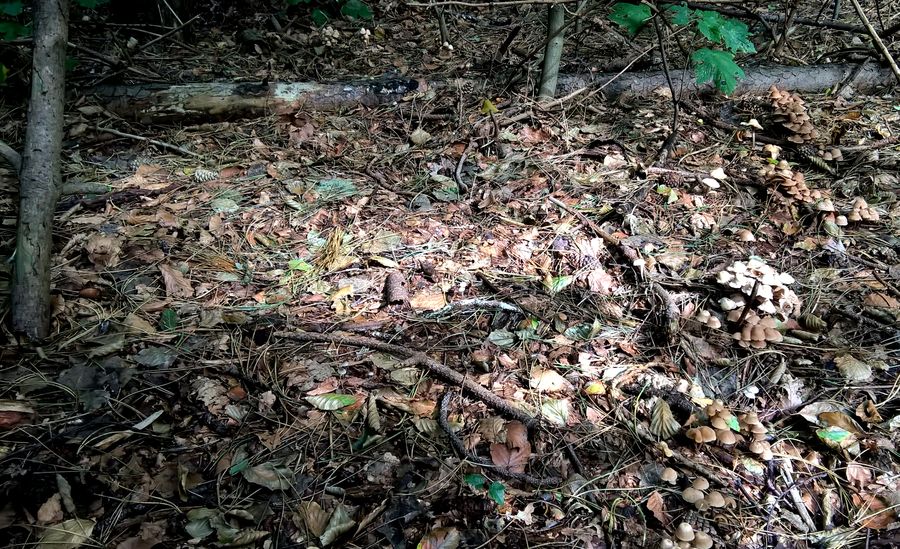
An enormous cluster on an old dead tree. Looks like Psilocybe fascicularis (Hypholoma fasciculare). There are more of these clusters in this area (near the pine tree forest in the park). Wikipedia says: The "Sulphur Tuft" is bitter and poisonous; consuming it can cause vomiting, diarrhea and convulsions.
A beautiful mysterious mushroom growing from similar rotting tree trunk. The young ones have this beautiful transparent pink colour, the older ones are bigger and black. This could be Pluteus salicinus. This one might be hallucinogenic if I've got the name correctly (I will not try that).
Michigan mushroom hunters
Urban mushrooms
Mushroom determination lecture
Pluteus salicinus grown for hallucinogenic properties
Sunday, September 20, 2015
Minor curiosities - Alsace trip report
There's a statue of Mary along the E411 highway. I was unable to locate it on Google maps and it's not mentioned on the Internet. The (unintentional?) combination with advertising is ironic. I posted this on Facebook and Twitter but got no answers. Then I simply followed the highway on Google satellite view and found the spot in a few minutes. Using the place-name I found some close-up pictures. And from these I could identify the madonna as Our Lady of Beauraing, a place of pilgrimage 40km distant.
It took me some time to grasp that the structure on the left is a nest for storks. At first I thought it was a renaissance astronomic device or similar Lovecraftian apparatus. Later I saw more of them. Around Colmar they love storks (and wine and cheeses and cakes).
The Statue of Liberty in Colmar is mentioned on Wikipedia:
A 12 m (39 ft 4 in) replica of the Statue of Liberty in Colmar, the city of Bartholdi's birth, was dedicated on July 4, 2004, to commemorate the 100th anniversary of his death. It stands at the north entrance of the city.
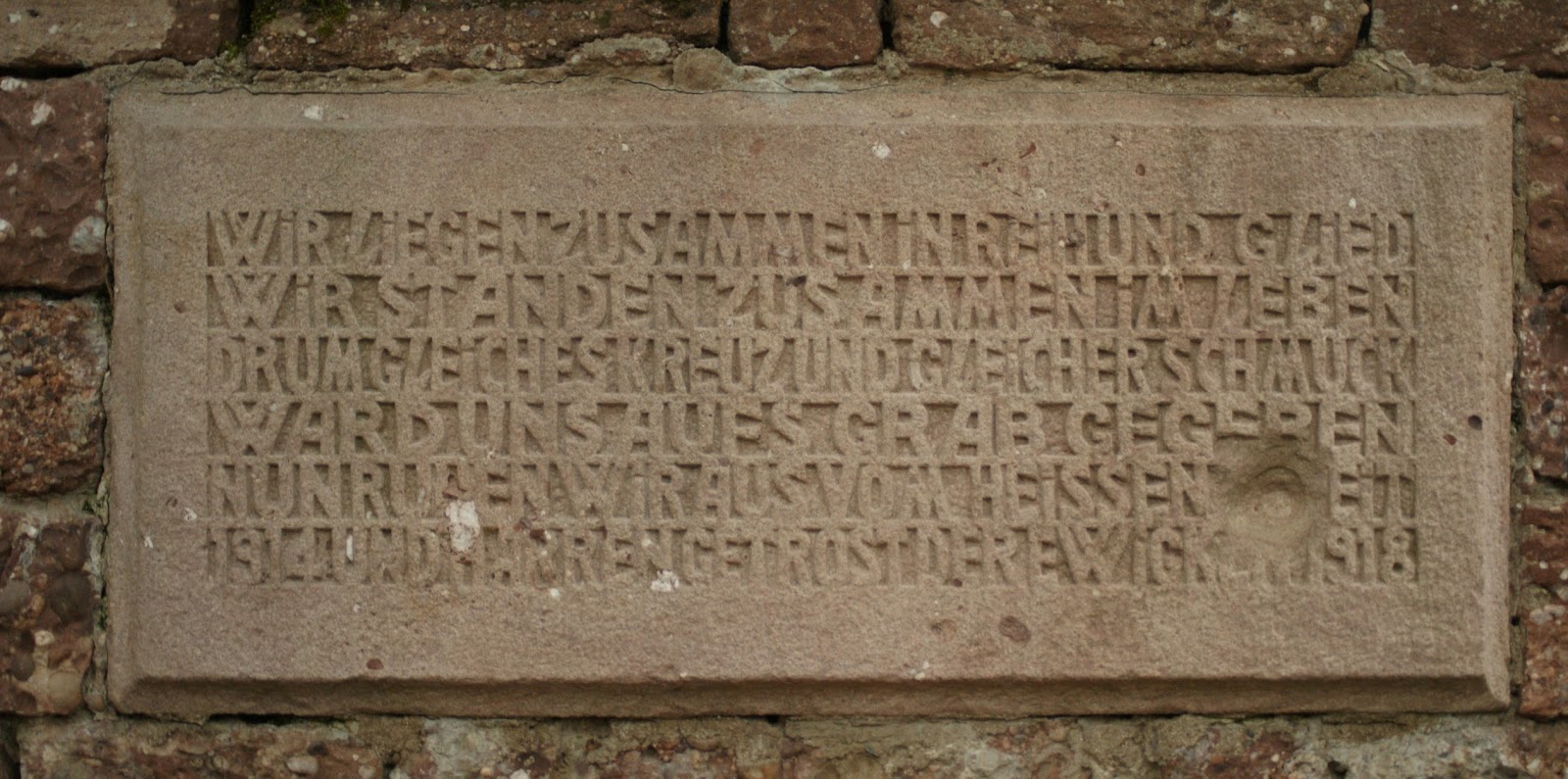
The Battle of the Linge is also mentioned on Wikipedia. The monuments of the German cemetery were defaced by bullet holes. I could not see if these were from WW-II or if they were just modern vandalism.
It was a bloody encounter with gas and flame throwers being used. Approximately 10,000 Frenchmen and 7,000 Germans were to be killed but after the fighting the front line positions were to remain much the same until the end of the war in November 1918.
The function of these Roman dodecahedrons remains a mystery. This was the first time I saw them, in the Strassbourg museum. They too have their Wikipedia page:
No mention of them has been found in contemporary accounts or pictures of the time. Speculated uses include candlestick holders (wax was found inside two examples); dice; survey instruments; devices for determining the optimal sowing date for winter grain; gauges to calibrate water pipes or army standard bases.In Colmar this strange book was advertised in the bookshops. I don't think Roland Barthes was ever murdered. But I think he wrote about the "death of the author". And Binet is the writer of "HhhhH", a nice postmodern book. My French is insufficient to research this further. A nice little mystery.
While walking in the woods in Alsace I saw this lifeform. I don't think they're insect eggs. I suspect some kind of fungus, lichen or slime mold. The length of the things is 2-3mm. A search of Flickr supports the slime mold hypothesis. And a question on the Fortean Times Forum yielded an identification: now it has been identified as Leocarpus fragilis.
And I saw another mysterious object in the German city of Alzey. I leave this as an exercise for the reader.
Wednesday, September 16, 2015
Two trips - two crises
In 2011 while on a holiday trip through the Schwarzwald we were haunted by reports of the financial debt crisis sweeping Europe. Then I started photographing the newspaper stands with their messages of doom (13 July 2011):
- Italy's debt costs soar in Greek contagion
- Steinbruck warns of anti-European sentiments because of debt crisis
- No consensus on refugee quotas
- The new Europe of border controls
- Europe becoming a no-entry zone
- Europe running out of resources
- Refugee crisis splits Europe
Thursday, September 10, 2015
Urban mushroom diary - autumn update
July 2015 - Watched many mushroom lectures on Youtube and the only thing I could understand was: "Mushrooms are weird organisms. They're aliens with extremely complicated life-cycles and growth patterns."
2 august 2015 - My first mushroom of 2015 was encounterd in Rotterdam along the bicycle path to the city center. Busy footpath and active dog-walking area. Still the mushrooms had time to mature and hopefully spread their spores. I've seen them here before and I suspect that they may have been planted by the German artist Klaus Weber. I think it's an Agaricus Bitorquis.9 august 2015 - One unidentified mushroom was seen in the bushes in the botanical garden in Utrecht. Looks a bit like Leucoagaricus leucothites.
Utrecht - I bought a beautiful book about mushrooms by Jens Petersen in the bookshop of the botanical garden. This again confirmed that these are weird alien creatures. Genetically closer to humans than to plants.
13 august 2015 - A beautiful group of Leccinum duriusculum was seen along another bicycle path, busy footpath and dog-walking area. I took one home for further research and it had a wonderful strong mushroom smell. A Czech mushroom site calls it "excellent" but a Dutch mushroom site says "good when young, unpleasant garlic taste when older". They grow in symbiosis with poplar trees.
18 august 2015 - In the Kralingen wood. Possibly Laetiporus sulphureus. This one should be edible, who would have thought that! But I would never dare to eat it without expert guidance.
23 august 2015 - Puffballs in the Ockenburg estate in The Hague, possibly Lycoperdon umbrinum (umber-brown puffball). Likes sandy soils (yes) and coniferous woods (no).Ockenburg - Possibly Bjerkandera adusta. I have no other method of identification than walking through the whole mushroom encyclopedia of 270 pages and searching for a look-alike. None of my identifications should be taken seriously!
Ockenburg - Possibly Psathyrella marcescibilis. My wife: "Please stop photographing everything you see!".
Ockenburg - Spooky fungal layers on dead wood. Probably not Meriopsis corium.
26 august 2015 - A beautiful group of Agaricus (possibly bitorquis) between the road and the bicycle path. Unfortunately the (almost nonexistent!) grass was mown the next day and all the mushrooms were shredded.6 september 2015 - In the Kralingse Bos along a bicycle path. Neither Agaricus impudicus nor Agaricus campestris give a good optical fit.
8 september 2015 - A small group of mushrooms between the road and the bicycle path. Another species in the same place where the grass had been mown in august. Subtle colors and markings. Difficult to photograph with a mobile phone. Could be Tricholoma myomyces or some other member of this family.
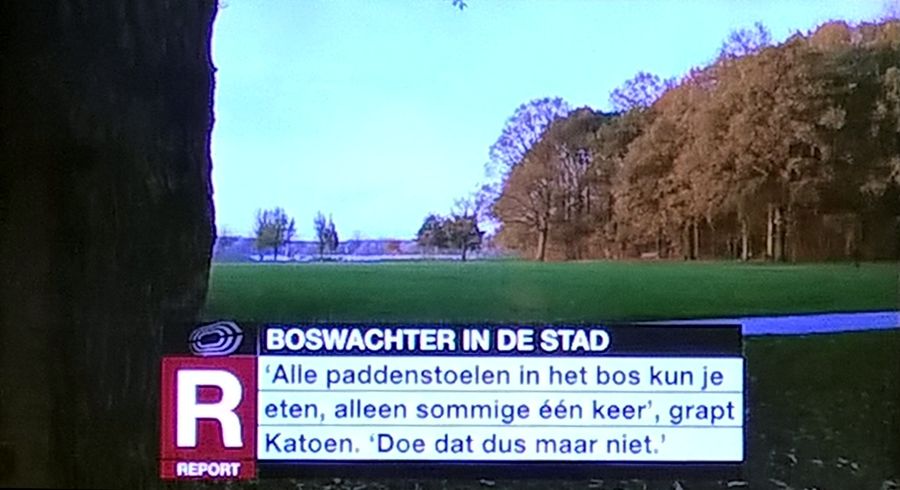
9 september 2015 - A video is playing in the Rotterdam metro on the platform TV's. The Rotterdam park forester says: "You can eat any mushroom in the woods. But some of them only once ... so it's better not to do that."
Summary: I'm totally hopeless at mycology, just like I'm hopeless at geology. But it's fun to try!
Sources:
http://cubittartists.org.uk/2004/04/07/klaus-weber/
https://cs.wikipedia.org/wiki/Koz%C3%A1k_topolov%C3%BD
Sunday, September 6, 2015
Book envy - geologic version
Last week I had an appointment in The Hague, in the offices of TNO, a Dutch research institute. While waiting for my host I noticed a large, heavy book in one corner. A gorgeous photograph of a layered outcrop on one page and a detailed geologic description, with several maps on the other page. So large that you had to plan your moves before turning a page.
Other pages contained more delights. The geology under Europe ... layers, ages, structures ... maps, pictures, text. More than any human could absorb. In a monumental A2-size. Something physical, like from another age but seemingly modern. A scientific achievement to be proud of.
I want to have this book. It's expensive but not unreachable for 225 euros, the price of a modern smartphone. But I'm not going to buy this book. I would never find time to read it and it would just gather dust somewhere. But it's uplifting to know that it exists and that such Mercator-like books are still being made.Note: This book is so different that Amazon doesn't even list a price.
Sources:
Petroleum-geological-atlas-of-the-southern-permian-basin
amazon.com - Petroleum-Geological-Atlas-Southern-Permian
Subscribe to:
Posts (Atom)