Friday, September 27, 2013

The bookshop of doom

I was in this prematurely air-conditioned supermarket and there were all these aisles. And there were these bathing caps that you could buy that had these kind of Fourth-of-July plumes on them that were red and yellow and blue. And I wasn't tempted to buy one, but I was reminded of the fact that I had been avoiding the beach.
No ...
I was in this bookshop in Thun, Switzerland. And there were all these aisles. And there were all those books predicting the downfall of Western Civilization. And they were red, white and grey. And I wasn't tempted to buy one, but I was reminded of the fact that we're living in the end times. Just look at the titles above:
 
The fun stops where money begins
The Euro liars
The billion debt bomb
Cold foreclosure
How much bank does a man need?

And at the other side of the aisle:
He who loses culture loses everything
The West and the rest of the world
The downfall of the West
The next cold war, China against the West
 
And a few steps further:
How much is enough?
Why nations fail?
Crime scene Euro

May you live in interesting times ... well, whoever ordered them, he can have them back ...

References:
Einstein on the beach - http://www.youtube.com/watch?v=IeR9l1sxHLQ
Thalia bookshop Thun

Sunday, September 1, 2013

Hopeless geology - 4 - Beach phenomena

Introduction
The motto of hopeless geology is a quote from Bob Dylan:
Because something is happening here
 But you don't know what it is
 Do you, Mister Jones ?
And it's main emotion is frustration. But we need not give in to frustration. We may not explain everything we see, but we may be proud that we noticed some phenomenon. That we noticed something that many others ignore.
 
Parallel questions - Hoek van Holland
A simple stroll in January along the beach can raise more questions than hours of (Internet) research can answer. And the situation becomes even more puzzling when two separate walks raise the same questions. 
During two walks I saw these little cliffs of shells at the beach. They raise questions like:
  • Were they created by accumulation like dunes?
  • Or were they created by erosion?
  • Are they old or recent?
I can only speculate, but I suspect that they are recent and that they have been created artificially when sand was suppleted to strengthen the natural dunes.

This again raises some questions:
  • Are the seashells recent or are they (young) fossils?
  • Are they near-shore or deep-sea species?
  • Where did the sand come from?
It is certain that sand was suppleted here in 2009. But I could not find more detailed information for Hoek van Holland. But there are suggestions that the shell-cliffs are artificial and that the sand comes from the deeper continental shelf. The strongest evidence is this piece of fossil bone. In the Ice Ages the Dutch continental shelf was dry and was inhabited by mammoths and sabre-tooth tigers.
Parallel questions - Rockanje
Similar shells cliffs can be found on the beach at Rockanje. These are lower and they contain much  strange material.
Some information is available in the magazine of the Geology Working Group of the Royal Scientific Society of the Zeeland Isles. Fossils from the Pliocene (5.3-1.8 My) and Tertiary (65.5-5.3My) epochs have been found. These come from sand that has been artificially moved here from deeper parts of the coast.
But here there is so much modern-looking material that I cannot understand where this came from: brick, burnt wood, gravel and slag. This cannot be fossil material. But on the other hand it looks old and eroded, like it lay in the sea a long time. A mystery.
For example, this piece of basalt cannot be natural. There is no volcanic rock anywhere in the Netherlands (or the whole Benelux). The rock is imported to strengthen the dikes. This rock means that the sand cannot be older than 300 years. It must have lain in the sea a long time because it has been polished smooth.
Even more mysterious is this heavy glistening pebble. It is not shale, it is not mica, it is not aluminum. I speculate that it is chromium ore. This must have lain in the sea a long time because it has been rounded by the wave action. 
Deeper in the dunes nature is reclaiming its territory. Much of the sand has been solidified, probably through colonization by algae. The first grass and plants are probing the empty area. Traces of wildlife are everywhere. 
 
Notice the color difference  between the sand from Rockanje (left) and Hoek van Holland (right). I would need a microscope to investigate this further. And I recently realized that the sand grains might be extremely old, even Precambrian.
There are no Precambrian rocks in the Netherlands and they are rare in the whole of Europe. But you can find Precambrian material even at the surface. Many of the grains of sand in Dutch rocks are breakdown products of rocks that were formed in the Precambrian and were recycled by geological history. These grains have roamed our surrounding areas. The average Dutch grain of sand is two billion years old!
Sources

Sunday, August 25, 2013

Three lost memories

I'm trying to recover three lost memories. Maybe you can help me? Below I describe them, going from the easiest to the hardest.
 
1 - The novel
A few years ago I downloaded a scanned book. A thriller / fantasy story concerning an author and some (of his ?) fictional characters. No one I asked knows this book. I remember two scenes:
  • A ghost (or daemon) explains the phases of detachment of the soul of a deceased person and their names. In each phase the soul is less attached to the world, like: when some of your body still exists, when someone living still remembers you, when your name is still recorded somewhere etc.
  • The author sees a young man hide in an urban corner and then he sees him transform into an angel. The angel looks highly irritated. Later someone explains that this was one of the archangels and that he is very much pissed off because he hates coming to earth. If he has to troubleshoot the situation his solutions might be drastic.
2 - The artist
A few years ago I found an art book in the Rotterdam library. It was about a contemporary, still living artist who fled (from South America ?) and settled in the US (in New York?). In the book was a picture of a sympathetic, short, older (60?) man with a grey moustache (and beard?), slightly tinted.  He could not find employment in the US as an artist, so he took a job (as a teacher, or librarian?).
But he kept making art. Small (10-30 cm) conceptual, very physical but highly abstract objects exploring shape, color and texture. Most of them were made from wood or other cheap materials using simple tools. Very original work with conceptual titles like: "Box with three different shapes, two colored and one burnt".
The library has sold the book and I cannot remember the title. It might have contained the phrase: "a Sunday artist".
 

3 - The strange shop window
 
Many years ago the Van Oldenbarneveldstraat 138 looked neglected and uninhabited, even though it was in the Rotterdam city center. The shop window was dusty and contained a collection of curious objects. Maybe the shop had been a pharmacy. But it might have been an antique sex shop.
The ornate wood and glass shop window contained several yellowed boxes with disreputable looking aphrodisiacs. There might have been a box of "Spanish fly" powder or pills. Maybe there were a few pin-up pictures. There might have been a few glass bottles, flasks or laboratory equipment. I was most impressed by the glass and rubber contraption for administering enemas. That one looked especially sinister.
But the most memorable was a commercial slogan in the back of the shop window advertising some patent medicine for male malfunction: "Impotent? ZUMBA helpt!" (Impotent? Zumba helps!) 
I was not the only one who was fascinated by this shop window. I once saw a photograph of the Zumba slogan in a Rotterdam cultural magazine. Maybe there exist more pictures.
In recent years the area has been gentrified. The shop front was kept intact but the shop window and its contents are lost forever. I would like to see it again.

Tuesday, July 30, 2013

Uncanny sewing machines

I believe in synchronicity. And when several threads come together I have to write about it. So this time I'll write about uncanny sewing machines.
I'm scouring Rotterdam for places with atmosphere. They are difficult to find. But last December I started exploring the Feijenoord area, on the South (poor) side of the river. And here I found this upholstery shop.
Feijenoord was the first expansion area of Rotterdam south of the river Nieuwe Maas. The district is surrounded by old docks, the old harbours and the river. It is bisected by the railway line between Rotterdam and Dordrecht. The district was founded in 1870 when the Rotterdam population grew with 32,000 inhabitants. Speculators had free reign and the quality of the housing was low. Most buildings were demolished after 1970 and replaced by social housing. The majority of the inhabitants are immigrants.
The upholstery shop is a surviving relic of the 19th century and the industrial revolution. The ancient atmosphere is enhanced by the collection of old radios and sewing machines in the shop window. It fits the area perfectly.
The repressed retains its initial impulse, its urge to penetrate consciousness.
There is something old lurking in this area. The 19th century is still alive with its smoky, greasy and metallic atmosphere. With ghosts made of soot and poverty. With vampires hunting for drunks in dark streets. With working class mothers mending clothes for large families. Maybe the atmosphere of poverty and class struggle has never left the district.
The patterns on the sewing machines remind me of medieval armor and tarot cards. I'm sure that the owner of the upholstery shop is a master of occult arts and that he's been practicing his secret craft here since the 1800s. If I walk into the shop and say the right password I will be initiated in the secrets of this area.
Repressed contents are not destroyed in the unconscious: rather, they are forever re-emerging in the form of "derivatives of the unconscious". Such derivatives include fantasies, slips of the tongue, parapraxes and even certain character traits. They are expressions of the unconscious manifesting itself in consciousness, without this necessarily implying that the repressed becomes conscious: The repressed returns, but often remains unrecognizable.
The interaction of this area, the shop, the machines and the patterns enhances the uncanny atmosphere of this district. I'm pleasantly bewitched and obsessed and I have to return regularly. A weird kind of pilgrimage. The place charges some spiritual batteries I didn't know I had.
Freud describes uncanny effects that result from instances of  "repetition of the same thing," including incidents wherein one becomes lost and accidentally retraces one's steps, and instances wherein random numbers recur, seemingly meaningfully (here Freud may be said to be prefiguring the concept that Jung would later refer to as synchronicity).
So I have been sensitized to the uncanny character of sewing machines. Some of this is explained by their power to do real damage.
I learned that if a sewing machine will sew through quadruple-layer canvas coveralls, it will also sew through an eleven-year old's thumb. Thankfully, I did not have to learn that on my thumb; I learned it on my cousin Stacey's thumb. I also learned that it's better to learn from other peoples' mistakes.
This power to damage is recognized by Kafka, who has written a famous (and widely interpreted) short story about a sewing-machine like device.
"In the Penal Colony" describes the use of an elaborate execution device that carves the sentence of the condemned prisoner on his skin before letting him die, all in the course of twelve hours. The condemned prisoners experience a religious epiphany in their last six hours in the machine.
And the fantasies of Kafka are echoed in reality.
A 52-year-old man, called Zhou, has been arrested for injuring his girlfriend (42) by etching words across her body, a report said today. When the victim wanted to end their relationship, Zhou detained her in their residence and dipped a sewing machine needle in ink and carved out defamatory phrases, consisting of more than 100 Chinese characters, over her body.
There are more uncanny sewing machines in Rotterdam. I had forgotten about their existence. But during a recent visit to Boijmans museum they called to me and I came. The first sewing machine was in a painting by the magical realist Pyke Koch. I had picked up the signals correctly.
The radar tower could symbolize  consciousness, picking up signals in the dark, not using the normal senses.
The objects around the girl show an undeniable erotic connotation. In a Freudian way the artist investigates his own psyche, in this case his problematic feelings towards women: the candle, pin-cushion and sewing machine all seem to point in this direction. More specific, the girl's fruitless efforts to light the candle may indicate a physical or psychological impotence on the artist's part.
This fits wonderfully with my attraction to the district of Feijenoord and its strange atmosphere. I wonder what I'll discover if I visit the area more frequently. I don't think it is anything erotic. I suspect it is the lost city of Prague that I'm trying to rediscover. I miss that eternal city.
Basically, the Uncanny is what unconsciously reminds us of our own forbidden and thus repressed impulses perceived as a threatening force by our super-ego. Thus, the items and individuals that we project our own repressed impulses upon become a most uncanny threat to us, uncanny monsters and freaks akin to fairy-tale folk-devils, and subsequently often become scapegoats we blame for all sorts of perceived miseries, calamities, and maladies.
And there is another, hidden, sewing machine in Boijmans museum. And this one was also calling me. But it was also warning me: Do not disturb!


"The Mystery of Isidore Ducasse" from 1920 refers back to "Les Chants de Maldoror" that Ducasse wrote under the pseudonym Comte de Lautréamont. The book appeared in 1869 and was rediscovered in the 1920s by the Surrealists, who considered Ducasse to be a kindred spirit. In this book, which seems to have been written in a fit of delirium, they recognized their method of automatic writing. They also encountered anew their preference for absurd combinations of things which they believed were poetic sparks that would kindle a great fire. They adopted one sentence from the book as their motto: "as beautiful as a chance encounter of a sewing machine and an umbrella on a dissecting table".
Maybe I should be careful with my explorations of Feijenoord and stop trying to uncover the hidden secrets of this district? Should I be careful with absurd combinations of things, because they are poetic sparks that can kindle a great fire? Or should I just bring an umbrella next time?


References and sources of quotes
http://nl.wikipedia.org/wiki/Feijenoord_(wijk)
http://www.answers.com/topic/return-of-the-repressed
http://en.wikipedia.org/wiki/Uncanny
Pyke Koch - Sleeping Somnabulist - Better reproduction
Pyke Koch - Sleeping Somnabulist - Description
Sewing machine horror  Mighty_Emperor on Fortean Times forum
Old sewing machine restoration
Chance encounter of a sewing machine
In the Penal Colony
Man Ray Enigme Isidore Ducasse Boijmans Van Beuningen, Rotterdam

Sunday, July 28, 2013

Mis-interpreting the Saints

The Caesar clothing store in the Karel Doormanstraat is modern, luxurious and surprisingly expensive. It is not unusual to see sneakers priced at 300 euros and t-shirts priced at 100 euros. Like the store says:
Caesar Donna is one of the leading stores in luxury fashion. A visit to Caesar Donna can be compared with a treat in superior service and a qualified shopping experience in a luxurious atmosphere.
Looking in their store window is a heady mix of curiosity, amiration, envy, and disgust. Some designs are sleek and elegant, others are pompous and overdone. All are expensive and all are optimized for conspicuous consumption.
Last April I looked in the store and saw this elegant combination. An interesting mix of cultural memes. Especially the t-shirt with black lace and the 19th-century engraving of some saint. A remix of modern club-culture with bourgeois religiosity. How had the designer arrived at this result? Possibly influenced by Latino gang-culture with their Roman Catholic symbolism? Or an echo of the modern popularity of the rosary? Would the owner of this t-shirt ever realize this cultural incongruity?

At that moment I was only thinking about the iconography. I never realized that the story was even more complex. But somehow the name of the saint stuck in my memory.
Later that month I was in Prague for private business. I also visited the bell-tower of the St. Nicholas church in Mala Strana. And there I met Saint Agatha again. But in a very different context.
Saint Agatha (+225 in Sicily). Patron saint of bell-founders. She was cruelly tortured for her Christian faith. Among the tortures she underwent was the cutting off of her breasts. The shape of her amputated breasts gave rise to her attribution as the patron-saint of bell-founders.
Now this is weird!
  • The picture of a martyr is put on a t-shirt designed for partying.
  • The picture of a saint whose breasts were cut off, is placed on top of the breasts of the wearer.
But it gets even weirder!
  • The saint on the t-shirt is not carrying breasts on a platter, like St. Agatha most often does. The saint on the t-shirt is carrying pliers and a palm branch.
  • St. Agatha is rarely depicted with pliers, as an indication of an even more gruesome torture (and even less suitable for a woman's t-shirt).
  • The saint most often depicted with pliers is St. Apollonia, the patron saint of dentists (obviously).
It is possible that the designer simply mixed up the saints. Or he didn't dare to put breasts on a platter on the t-shirt. Or he knew what he (she?) was doing and made a conscious ironic joke. We will never know.

This says something interesting about our culture. But I'm not able to put it into words yet.

References:
http://www.caesarrotterdam.com/caesar-donna/about-caesar-donna.html
http://en.wikipedia.org/wiki/Conspicuous_consumption
http://en.wikipedia.org/wiki/Agatha_of_Sicily
http://www.flickr.com/photos/rfzappala/7756092034/ - Martyrdom of St. Agatha
http://www.flickr.com/photos/23748404@N00/4331746575/ - Martyrdom of St. Agatha
http://en.wikipedia.org/wiki/Saint_Apollonia

Saturday, July 20, 2013

Hopeless geology - 3

Beach visit
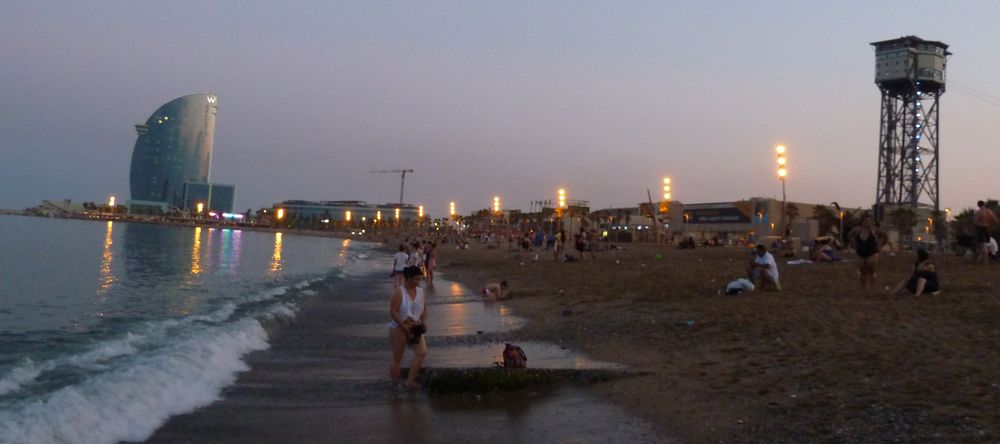
On our second day in Barcelona we visited the beach. It is impossible to describe this area with its combination of 17th, 19th and 21st century architecture so I will concentrate on the shoreline.
Barcelona beaches are a little dirty (sand and sea), especially the ones near the downtown. [8]
Catalonia is full of beaches since it is located in the east side of Spain and at the border of the Mediterranean sea. By coming at Barcelona, you are only at 25 minutes of the beach by walking from Plaza Catalunya. I will add that I don’t like much its beaches particularly the Barceloneta area, because it is dirty (sand and sea) – you can swim but it exists a high probability that you cross over a plastic bag in comparison to other ones. [10]

The gravel band
We dipped our feet in the water and I was immediately captivated by the mix of sand and gravel. The gravels were concentrated in a band of 2-3 meters width, parallel to the sea shore. There are two possible explanations:
  • This is caused by the size sorting effect of the waves.
  • This is a band (lens) of gravel that is enclosed between two layers of sand.
I can only speculate about the provenance of the gravel band. It might be local geology, but it might even be artificially transported foreign soil. In the city anything can happen.
The port area was quite amazing – the biggest floating mall in the world, a man made Egyptian sand beach, and lots of other businesses. [9]
Gravel sample
I did not have time to collect a large and representative sample. It was getting dark quickly and we were tired. And collecting stones is an antisocial activity if the others are not interested in geology. On my own I would have stayed longer and would have a more complete collection.
It is notoriously difficult to determine stone types. From this sample I can only recognize:
  • Granite - upper left
  • Limestone - center right - I should do an acid test to be completely sure, but I don't have hydrochloric acid available
  • Flint ? - lower right
  • Quartz ? - top middle right
All the others are a total mystery. Especially this one. 3 cm long with beautiful rectangular Crystals, a porphyritic structure. Very hard, certainly igneous rock.
Speculations
If the gravel band is natural it is most probably a river sediment. The rounded shapes are consistent with a long transport. It is most probable that the rounded shapes were not produced on the beach by wave action but during the river transport. This might have happened recently but also during one of the last ice ages.
[1]
 
Most likely the gravel comes from the Pyrenees or its promontories. The gravel might be relatively recent (1000-100.000 years).
Barcelona's coastal location and the proximity of the surrounding coastal mountain ranges leads to frequent flash flooding in the region. Many of the seasonal rivers on the outskirts of the city continue to pose flood risks. A normally dry river channel near Sant Pere de Ribes has evidence of a past flood level line in a river cliff. [3]
But the gravel might also be older (5-2 million years).
The lower Quaternary deposits overlie the Pliocene series, which is formed by a regressive sequence composed of marine blue marls followed by sands and marls associated with gravel lenses that pass progressively to the lower Quaternary sediments.
Quaternary alluvial detrital sediments are mainly composed of layers of red clay, yellow silt, and minor sand and gravel. The thickness of the alluvial detrital sediments is variable, attaining 20 m in the creeks. [2]
And the gravel might be even older (12 million years).
Twelve million years ago, the Mediterranean was taking on much of the shape it has today. Sea levels were dropping, and it would not be long, geologically speaking, before the Mediterranean became isolated from the Atlantic and, literally, dried up. Rivers were working tirelessly at the erosion of uplands old and new, pouring gravel, sand, and mud down to the ever-shifting coast. A great delta formed close to where Barcelona is today, its sediments eventually heaved up to form the mass of Montjuic. [11]
 And it might even be that the source of the gravel is an even older, conglomerate stone from the surrounding mountains.
 A spectacular example of conglomerate can be seen at Montserrat, near Barcelona. Here erosion has created vertical channels giving the characteristic jagged shapes for which the mountain is named (Montserrat literally means "jagged mountain"). The rock is strong enough to be used as a building material - see Montserrat abbey front at full resolution for detail of the rock structure. [4,5]
The granite
 The three rounded granites on the right are from the beach. The angular one on the left I picked up in a Barcelona park. They are definitely the same stone type.
Speculation
For economic reasons the granite I picked up in Barcelona must come from a nearby (max. 100 km) source. It would not be efficient to transport the heavy stone over long distances. This is confirmed by the same type granite I saw in the station at Figueres. (The colours look different in the pictures but in reality they were the same.)
Most probably it has been mined in one of the local stone quarries, like this one. I saw this one from the train between Barcelona and Figueres, but it is more probably a sandstone quarry that a granite quarry (from the shape of the incision).
This is further confirmed by this sample from the Barcelona museum. It is 600 - 300 million years old:

Granite: plutonic igneous rock - Dating:Upper Paleozoic - Provenance: Espanya,  Catalunya, Girona, Alt Empordà, Cantallops - The sample comes from the old quarry at Lamas, located on the highway from La Jonquera to Cantallops. The area is marked by widespread granite outcroppings from the axial zone of the Pyrenees, from the Upper Paleozoic superior. The granite has a granular texture with equigranular crystals of 4-6 mm. [6] 
And by this description of local Barcelona geology:
The Collserola mountain range forms the northern barrier to Barcelona's expansion. It overlooks the city. The Collserola is composed of two types of rock: metamorphic (slates, quartzites, metamorphic limestones) and igneous (granite). [7]


References:
http://www.planetware.com/map/spain-rivers-lakes-and-resevoirs-in-spain-map-e-e2.htm [1]
Variscan and Alpine structure of the hills of Barcelona: geology in an urban area,
Estructura herciniana y alpina de las colinas de Barcelona: geología en una zona urbana
P. Santanach, J. M. Casas, O. Gratacós, M. Liesa, J. A. Muñoz, F. Sàbat [2]
http://geographyfieldwork.com/besos_valley.htm [3]
http://geographyfieldwork.com/CovesdelCollbato.htm [4]
http://en.wikipedia.org/wiki/Conglomerate_(geology) [5]
Granite sample [6]
http://geographyfieldwork.com/Collserola%20Park.htm [7]
http://www.world-rt.com/travel/beach-barcelona.php [8]
http://sidetracked.gravel.co.nz/821 [9]
http://www.world-rt.com/travel/best-beaches-catalonia.php [10]
http://throughthesandglass.typepad.com/through_the_sandglass/2009/03/sandstones-of-barcelona-1.html [11]

Sunday, July 14, 2013

The Beginners Guide to Consent

Yesterday I participated in the Beginners Guide to Consent workshop. Under the guidance of Eleanor Greenhalgh we experimented with different voting methods to make group decisions. It was an interesting and pleasant experience.
I especially liked the manner in which the discussion was initiated. First voting session. Then all text fragments we had consensus about were put aside. The discussion continued about the fragments we did *not* have consensus about. In this way two hours passed quickly. The most interesting insights (for me) were:
  • There exist many voting methods, more than I thought.
  • All of them are logical and defensible.
  • They all lead to different results. Sometimes the differences are striking.
  • Interesting feedback loops exist. The voting results of one member influence the voting results of other members.
  • The results of voting don't always produce satisfaction in all group members.
  • Discussion about the results does produce more satisfaction than straight voting.
  • Voting is scalable to large groups. Satisfying discussion is difficult to scale.
 
The exercise raises some interesting questions about group dynamics:
  • Can consensus be reached in all situations and for all group compositions?
  • Do groups strive for an optimizing or a satisficing strategy?
  • Does discussion and voting bring groups closer together? Or can it create factions and harden the differences between them?
In hindsight these results might seem obvious. But there is a big difference between reading about group decision processes and experiencing these processes. My awareness of these processes has been sharpened. I like self-experimentation, and this was an interesting experiment. And I also have a nice zine booklet, as a tangible result of our work.

The Beginners Guide to Consent is a zine-making workshop. Come and create your own edition of The Beginners Guide to Consent: A pseudo-democratic group experiment on consent, curation and collaboration, facilitated by Eleanor Greenhalgh. (In V2_Institute for the Unstable Media.) [1]

What do you think should be included in a beginners guide to consent? Come and create your own democratically-edited print edition of The Beginners Guide to Consent zine. During the workshop we will explore the problem of editing a zine democratically, and experiment with different 'consensual' systems. By the end you will have three different zines to take home. [2]

References:
http://v2.nl/events/the-beginners-guide-to-consent [1]
http://v2.nl/archive/people/eleanor-greenhalg
http://www.worm.org/home/view/event/7620 [2]
http://en.wikipedia.org/wiki/Satisficing