Friday, May 17, 2013

Wild nature victorious

This is the season of the cherry blossom. Everywhere the trees are in full bloom. Each year it is a spectacular sight. But if we look closely we see a horror scenario, like something from the movie "Alien".
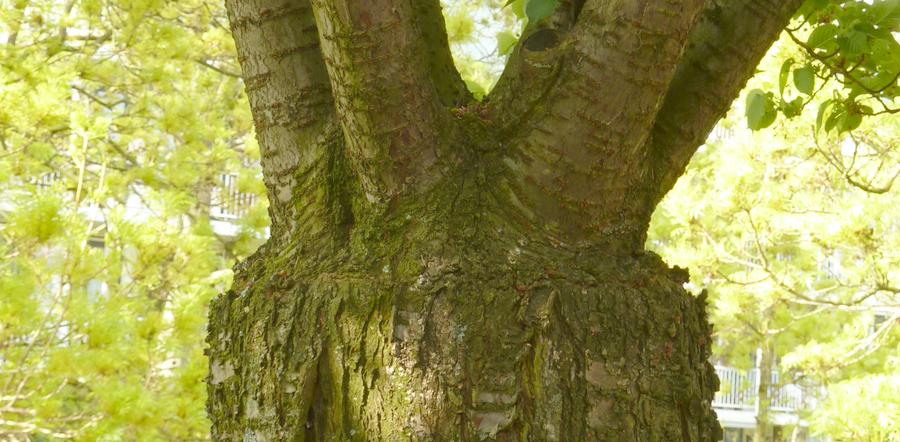
The beautiful Japanese cherry (Prunus Serrulata Kwanzan) is a cultivar. The branches with the double pink blossoms have been grafted upon a stock of wild cherry (Prunus Avium). The strong wild cherry has been mutilated and robbed of its branches. And then it has been enslaved. And now it is exploited by the weaker, decadent and artificially implanted (elite bourgeois) branches of the cultivated cherry.
But this is an unstable situation. Given the chance, the wild stock will try to make branches of its own. And being wild and more vigorous it quickly starts to overpower the weaker branches of the cultivated scion. If left unchecked, the white, smaller and more natural looking flowers will win.
This does not happen in all the trees, but just in a minority (1 in 10, as far as I can see, in my tiny sample). The ratio of pink to white flowers varies from tree to tree. But the wild variety grows much quicker and gradually overtakes the whole tree, leaving only a tiny bit of pink.
And sometimes the revolution fails and kills all everyone, both the exploiter and the exploited.

Note:
I could not resist mixing half-understood Marxism and traditional horticultural techniques. There are several things wrong with the metaphor. The scion still does a lot of work, it does photosynthesis and fruit production. The stock takes care of the root system, absorption of nutrients and mechanical stability. So maybe it is more a case of symbiosis than exploitation? But, from a different angle, the stock can only be truly "itself " when it produces its own leaves and flowers. The stock looks more "alienated" than the scion. But that is only an anthropocentric projection, because we appreciate flowers more than roots. So I'm still undecided.

References:
http://en.wikipedia.org/wiki/Grafting
http://en.wikipedia.org/wiki/Prunus_serrulata
http://en.wikipedia.org/wiki/Prunus_avium
http://en.wikipedia.org/wiki/Proletarian_revolution

Friday, May 10, 2013

Disappearances and memories

As most modern cities the skyline of Rotterdam  is dominated by the skyscrapers in its center. Many of these skyscrapers belong to financial institutions. And even though new skyscrapers are being built continuously, many of them stand empty and unused. The financial crisis has made victims.  
One of the victims is the office of Fortis bank in Rotterdam. First a consortium of Royal Bank of Scotland, Fortis and Banco Santander bought the Dutch ABN-AMRO bank with plans to break it up and to distribute it among themselves. Then the financial crisis hit. Fortis couldn't raise the 24 billion it needed and tried to sell it's share of ABN-AMRO to raise the necessary funds. The sale failed and Fortis had to be nationalized together with the ABN-AMRO bank. 
Now the Fortis logo has disappeared from the facade of the building. Even before the failure of the bank the operations had been moved to the main office in Utrecht, costing Rotterdam 1000 jobs.
The empty space that once held the logo reminds me of The Detachment, an art project by Sophie Calle from 1996:
  • I [Sophie Calle] visited places in Berlin where the symbols of East Germany have been removed. I asked passers-by to describe the objects that once filled these empty spaces. I photographed the absence and replaced the missing monuments with their memories.
LIBRARY (BEBELPLATZ)
Personally, I don't notice the absence. When I walk past there now I don't see anything. I think it was a plaque made of plain copper, saying that Karl Marx or Lenin, one or the other, studied  there - It wasn't removed, it was stolen. In 1993 or 1994. It was made of grey chiseled stone. I'm not 100 percent sure what it said. Having walked past it for years, I didn't really notice it anymore. I took it for a sign specifying that Lenin lived there. Not exactly pretty. But the message was all right - There was a memorial plaque of some kind. Brownish, made of metal, almost vulgar. Could be that Lenin was on it, but it wasn't accurate so it was removed. That part of the library wasn't even built when Lenin stayed in Berlin
I wonder how many people still remember that Fortis logo. I almost didn't.

Sources: 

Thursday, May 9, 2013

Pynchon in public day - 8 May 2013


I did my best to celebrate the birthday of Thomas Pynchon. But here around Rotterdam I may have been the only one reading a Pynchon book. In The Hague I met one other Pynchonite, but he was a colleague. We had the same book. But mine was an older edition.
On the other hand ... he has finished reading Gravity's Rainbow. I only managed to read two-thirds of that book. Then I sold it. Now I'm planning to buy it again and this time to finish it. But this book has inspired one blog post and some calculations: http://uair01.blogspot.nl/2011/01/brennschluss-constellations.html
And I also quoted Mason&Dixon in one blog post: http://uair01.blogspot.nl/2012/09/sheep.html
Re-reading parts of "Lot 49" was a pleasant surprise. There is still so much to be discovered in this little book. See the references below.

References
@PynchonInPublic - #Pynchon2013 - http://www.pynchoninpublic.com/about/
The American Novel Since 1945 - Professor Amy Hungerford - 12. Thomas Pynchon, The Crying of Lot 49 - http://www.youtube.com/watch?v=3dtqt0bXb4Y

Sunday, May 5, 2013

The names of the skyscrapers

It was surprisingly hard to discover the names of all the buildings in this Rotterdam skyline. Most of them have extremely commercial names, harking back to the 16th century and suggesting wealth and prosperity. The names use false ancient Dutch spelling with "C" instead of "K" and "AE" instead of "AA". Most of them refer to water or shipbuilding. Most are artificial. None are memorable.

These buildings dominate the Rotterdam skyline but they are useless as landmarks or orientation points. There is nothing down there, just commercial businesses.

When I make an appointment I usually choose museums, churches, shops or pubs as orientation points. Smaller and lower buildings. Buildings with a pedestrian size and function.

1 - Robeco Tower - an investment bank, and it has a tower
2 - Maritime museum - a very nice museum, with some romantic exhibits
3 - Fortis bank - collapsed in the financial crisis, now nameless
4 - The White Emperor - how pompous can you get?
5 - Rabo bank - still there, no bailout needed
6 - The Old Merchant Navy - again, how pompous can you get?
7 - Blaak 8 - name is the address
8 - The Wine Harbour - building name is the name of this area
9 - The WaterCity Tower - on the edge of pretentiousness
10 - The Red Apple - WTF? what hipster came up with that name?
11,12 - Harbour Village - artificially quaint name for a skyscraper
13 - The Ship Makers Tower - just over the edge of pretentiousness
14 - The Maas - just the name of the river

I confess ... this is an example of the infamous "psychogeographic sneer" as described by Nick Papadimitriou. But why should pompous, capitalist names dominate my skyline?

References:
Sky Scraper City - Rotterdam

Monday, April 29, 2013

The stones of home


Each time I visit Prague I discover new books by the psycho-geographer and psycho-geologist Vaclav Cilek. This writer has a special attraction for me, because he is not just a psycho-xxxx amateur (like me), he is a professional geologist, archaeologist and climatologist. But he combines his scientific thoroughness with the spatial, historic, cultural sensitivity and humour of writers like Nick PapadimitriouIain Sinclair and Phil Smith. Unfortunately none of his books have been translated into English.

The book Stones of Home describes a collection of rock and soil types that are most typical for the Czech landscape, history and national spirit. Each rock type is lovingly analyzed and connections are made between physical and geological facts and emotional effects. Who said science is cold and rational?

During my stay in Prague I went to visit some of the stones that Vaclav Cilek writes about. Below I have translated a few quotes from his book and added them to my own photographs.

And because I had been sensitized by Vaclav Cileks book I started seeing beautiful stones everywhere. And later, back in Rotterdam, I discovered several websites describing the stones of Prague. I know from bitter experience that determining rock types is extremely frustrating for the amateur. All rocks look the same and the one you try to determine is never mentioned in the encyclopedia (the same frustration applies to clouds, birds and plants). But with these guides it became a pleasant puzzle.

Prague stones mentioned by Vaclav Cilek in "The stones of home"
Granite - Facade of Komercni Banka, Vaclavske Namesti
Marble can be impressive on a small scale, but granite requires a large scale to be effective, a scale we know from Egyptian sculpture. If we want to experience this "Egyptian" monumentality on our own territory, we can respectfully circumambulate the obelisk of the Legionnaires near the Emmaus church or the gigantic semi-pillars of the Commercial Bank at the Venceslaus Square, that were carved from one single piece of rock.
Granite - Facade of Komercni Banka, Vaclavske Namesti
Granites and granodiorites are monotonous, practical stones that are more likely to suppress the imagination than to stimulate it. But we should realize that, if we didn't have granite and granodiorite, we would be using more concrete and artificial stone, and our lives would be poorer. Granite is like iron. It is not easy to become friends with it, but if you succeed, you will gain faithful and strong allies.
Pecerad gabbro - Facade of Komercni Banka, Vaclavske Namesti
Gabbro is a festive rock, but the fine grained dark varieties create a funereal atmosphere. It is interesting to consciously experience a graveyard dominated by light, usually limestone gravestones, and a graveyard with heavy dark stone, like for example the Old Jewish graveyard in the Old Town, compared with the New Jewish graveyard in the Olsany quarter. In the first one we may smile and listen to the birds, in the second we are compelled to compulsory sadness and formal heaviness.
 Black and white marble - Vaclavske Namesti
Red marble - Vaclavske Namesti
Czech red marbles are much older than all the other middle-european varieties. They are 350 million year old Devonian marbles called "slivenecky mramor". We used to think that the red colour was caused by iron oxides. But today we know that the situation was more complex and that the red colour is caused by bacteria living on the walls of tiny channels inside the limestone.
Sandstone - Charles Bridge
The trajectory of sandstone starts on the continent, where rocks crumble, rain dislodges sand grains and rivers deposit them onto beaches and into shallow shelf seas. There they are caught by strong sea currents and spread along the whole coast. Sandstone belongs to the Czech territory in the same way marble belongs to the Mediterranean. Czech sandstones have the colour of local bread and the taste of potatoes.
Prague stones mentioned by other urban geologists
Pozary granite (diorite?)- Pedestal of the King Venceslas statue, Vaclavske Namesti
Sedlcanska granite (?) - Metro station exit Museum,
Vaclavske Namesti, above the King Venceslas statue

Unknown but interesting stones I found myself
Syenite (?) - New wing of the National Museum, Vaclavske Namesti
Granite (?) - Stairs of the National Gallery, Veletrzni Palac
Granite - Facade at Vaclavske Namesti (forgot to note which one)
 
Sources:
Decorative Czech stones:
Stones of Prague monuments:


Friday, April 26, 2013

Berlin cartography

I love the area around the Anhalter Bahnhof. The mix of high urbanity, sport fields, water and old buildings makes it a varied and interesting terrain. During my stay in Berlin I collected several  tourist maps. The cartography is strikingly different between the four of them.
 

Sunday, March 31, 2013

The death of newspapers

Once a month - or more often - I invest in some good newspapers and I read them front to back. My favorites are The Financial Times (not as republican as the WSJ) and the Sueddeutsche Zeitung (a bit more socialist than the Frankfurter Allgemeine). I also buy the dutch Financieel Dagblad (financial daily) regularly, especially when there's fraud, scandal and nationalisation of banks.
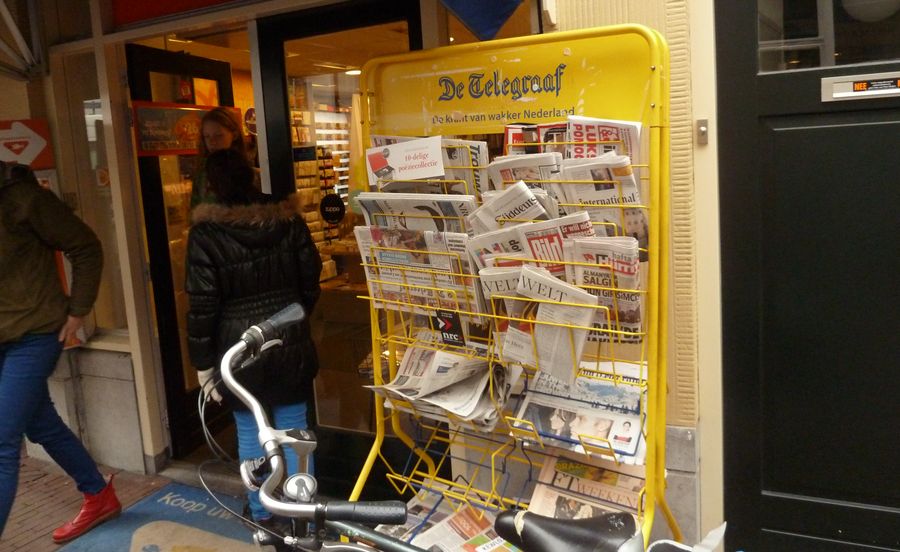
Unfortunately less and less shops sell these newspapers. Bookshops en news outlets have trimmed their selection and you can only buy dutch newspapers there. The only shops that sell international newspapers are the combination shops, that sell tobacco, lottery tickets, writing utensils and newspapers.

These shops are not found in the upper class neighborhoods. I think there are not enough smokers and lottery players there. Most often I find these in older, poorer areas of Rotterdam and in smaller cities.
In Gouda I asked the shop owner:
- "Do these newspapers sell a lot or am I the only idiot that buys them?"
The owner answered:
- "Sir, I'm afraid you are the only ----- that buys them."
He omitted the word "idiot" while smiling heartily.

I will not speculate on the future of paper newsprint. But I will miss it.