Camera's with light at night. And same scene by day. Around Bodø :
Wednesday, November 6, 2024


Thomas Ligotti - The strange designs of Master Rignolo 12
In previous posts I have illustrated my favorite Thomal Ligotti story "The strange designs of Master Rignolo". You can read, and see, the whole story here: Part 1, Part 2, Part 3, Part 4, Part 5, Part 6, Part 7, Part 8, Part 9, Part 10
I'm also working on a series of interpretations for this story, using mine and others' thoughts. The previous post is here: Part 11
But what makes this story so fascinating?

Let's ask OpenAI, and let's also correct its errors:
"The Strange Designs of Master Rignolo" by Thomas Ligotti. is a surreal and unsettling tale about an artist named Rignolo who creates bizarre and disturbing sculptures landscape paintings. The story explores themes of artistic obsession, the nature of reality, and the dark side of creativity. It is a notable work of horror fiction and has been included in several anthologies of weird fiction.
The story is set in a surreal and unsettling world that is reminiscent of a nightmare. The story is filled with bizarre and unnerving imagery, and the boundaries between reality and fantasy are blurred. The setting is described in a way that creates a sense of unease and disorientation, and the story's characters seem to exist in a world that is both familiar and alien. This surreal setting is an important aspect of the story's overall tone and contributes to its haunting atmosphere.
It does suggest that there are powerful forces at work behind the scenes. The story hints at the existence of a shadowy organization or cabal that has the ability to control and manipulate reality. However, the nature and identity of these entities remain mysterious and open to interpretation.
Some readers have speculated that these entities could represent a metaphorical manifestation of the human psyche, or a representation of the dark underbelly of society. Others have interpreted them as cosmic entities or beings from another dimension.
Ultimately, the story leaves many questions unanswered and invites readers to draw their own conclusions about the nature of these mysterious forces.
One interpretation is that the story is an allegory for the power of art to shape reality. According to this view, Rignolo's strange sculptures landscape paintings have the ability to alter the fabric of reality itself, and the shadowy forces that control the world are ultimately seeking to control and harness this power.
Another interpretation is that the story is a commentary on the nature of creativity and the artistic process. Rignolo's obsession with his art is seen as a metaphor for the artist's struggle to give shape and form to their innermost thoughts and emotions, while the strange entities that control the world represent the inner demons and anxieties that can accompany the creative process.
The unreliability of perception: The story blurs the boundaries between reality and fantasy, suggesting that what we perceive as real may be illusory or distorted. This theme is related to the idea of the "unreliable narrator" in literature, where the narrator's perspective on events may be unreliable or distorted.
The dark side of humanity: The story's surreal and unsettling imagery can be interpreted as a metaphor for the darker aspects of the human psyche, including fears, anxieties, and destructive impulses.
Cosmic horror: Some readers have interpreted the story's entities as cosmic beings or forces from another dimension, in keeping with the traditions of cosmic horror in the work of H.P. Lovecraft and other writers.
Tuesday, July 9, 2024
From a strange planet - 13
Road webcam fascination - The silent pictures of Scandinavian traffic-webcams have a strange fascination for me. My previous outpourings of webcam obsession are here: 1: Discovery, 2: From deep space, 3: Don DeLillo, 4: Scipting surveillance art, 5: Making movies, 6: Sightings and glitches, 7: More sightings, 8: Google streetview, 9: Changes in time, 10: Events, 11: Living streetlight and 12: Dino Buzzati. I've used video, fiction, literary criticism, art, topography and surveillance technologies to think through this window on far-away places.
See update from 2024 down below >>>
I've watched this curve in the road many times. It's not the road that's fascinating. It's not the view over the fiord towards the mountains that's fascinating. It's the silhouette of the house above that road that I find captivating. This is Fv17 Torsvika, and the silhouette is not perfectly visible in this view.


Then you'll notice that the house looks quite ordinary in sunny weather, when it's illuminated from the front and you see all the details. It's also not that impressive if you search it on Google maps, there you see that it's a nice, interesting but non-mysterious building. But when you look in the proper light, the house turns into an Ed Ruscha artwork.

In his book Leave any information at the signal : writings, interviews, bits, pages by Ed Ruscha (and Alexandra Schwartz) the artist says in one interview:
TB: Let’s talk about the dark paintings.
ER: I think they came mostly from photography, although they are not photographically done or anything. I feel that they are related to the subject of photography. I think these works somehow share something with photography. I don’t know why. I have a definite side to side horizontal brushstroke. It’s part of the concept of the landscape, I guess, and I painted all my pictures like that. These newer paintings are dark and strokeless. They’re painted with an air brush.

TB: What is the effect of absenting figures from your paintings? Particularly your gas station paintings, which are almost desolate.
ER: I think they become more powerful without extraneous elements like
people, cars, anything beyond the story. That’s why these lines, these planes in a gas station were more important than trying to create an Edward Hopper scene. It became something for me to investigate. I was able to subtract a romantic story from the scene - I wanted something that had some industrial strength to it. People would muddle it. There was a coldness that I liked when I painted those pictures.

BB: How do you make up the images, or do you make them up? How do you go from the elephant to the ship to the rows of houses?
ER: It’s the icon/logo concept, I suppose. Things that are immediately recognizable. The idea is that recognition and a silhouette go hand in hand. I get the imagery from all sources. I may have seen several ships and then I’ll work on a drawing, change it, put some masts over here, a sail here. I never consider the drawings anything but preparatory - they’re not things in themselves, that’s why I don’t show rough sketches. Finally, I just enhance the thing back to a silhouette position, a silhouette appearance. Then that goes on the canvas in the form of an outline, and that’s where I start working. The images just come from anywhere - a magazine, a photograph of an old ship.

For the last two or three years, Ruscha’s fantasies have also included “grand horizontal” paintings that nudge words and phrases into a kind of cosmic dialectic. The thirteen-foot-long rectangular backgrounds of these paintings represent Panavision-like sunsets or, more recently, the ionosphere at night, and serve as stage sets for expeditions from one extreme set of concepts to another. Tiny white letters on the left end of one canvas, for example, say “wolves/explosions/disease/poisons,” while on the other side of the curving globe, to the right, we find “home.” On another canvas “ancient dogs barking” is lettered on the far left corner, and “modern dogs barking” on the far right.

Update 2024
This is how it looks now. Still the same:

But the house has been blurred for privacy reasons.

This is the camera:

Saturday, February 17, 2024
Deleuze Guattari research
My pet peeve:
I can't make heads or tails of Deleuze-Guattari. But I also see that they're popular and influential. So I opened a request on Manifold Markets:
But as yet I've not had very useful suggestions. So I asked ChatGPT / Universal Primer, and this looked more clear.
But my pet peeve stays up: Are their ideas any better than the more concrete ideas like complexity theory, and network theory? These look more useful. Aren't their ideas just cool metaphors, that sound good, but don't lead to better understanding?
Technical Breakdown:
Desiring-Machines: The most crucial aspect of their concept revolves around "desiring-machines." This notion is meant to challenge the psychoanalytic views of desire as a lack or deficiency. Instead, Deleuze and Guattari see desire as a productive force, an endless process of connecting, breaking, and reconnecting between entities. In this sense, everything can be considered a machine insofar as it is involved in these processes of production and exchange.
Assemblages: Machines are components of larger entities that Deleuze and Guattari call "assemblages" or "arrangements." These assemblages are networks or conglomerates of interconnected machines that work together to produce something, be it tangible or intangible (like social systems, ecosystems, or even ideas).
Anti-Hierarchical: Their concept also carries a fundamentally anti-hierarchical stance. Unlike traditional views that prioritize certain elements (e.g., the mind over the body, the individual over the environment), Deleuze and Guattari’s machines operate on a flat plane of consistency where everything is interconnected and of equal importance in the production of reality.
Socio-Political Critique: They use this framework to critique capitalist societies, arguing that capitalism is a highly efficient "socius" that captures desires and channels them into its own reproductive machinery, turning social and individual desires into commodities.
Analogies for Understanding:
Network of Cities: Imagine each city as a machine. Cities have inputs (resources, people, information) and outputs (products, waste, culture). They are interconnected through various means (roads, the internet, trade routes) forming a larger assemblage: the country or the global economy.
The Human Body: Consider the human body as a complex of machines. Each organ (heart, lungs, stomach) is a machine with specific functions, inputs (oxygen, food), and outputs (carbon dioxide, energy). Together, they form an assemblage that is the individual, which, in turn, interacts with other "machines" (other people, society, the environment).
Key Areas of Application:
Political Economy: Scholars in political economy have used Deleuze and Guattari's ideas to analyze the nature of capitalism and neoliberalism. They focus on concepts like deterritorialization and reterritorialization to understand global financial flows, market dynamics, and the socio-political implications of economic policies.
Organizational Theory: In the field of organizational theory, researchers apply their concepts to understand the dynamics within organizations and the broader market. The idea of assemblages is particularly useful for analyzing how organizations adapt, evolve, and interact within complex economic ecosystems.
Marketing and Consumer Research: Their concepts have also been applied to marketing and consumer research, offering a fresh perspective on consumer desires, brand communities, and the production of consumer culture. This approach views markets as assemblages of desires, goods, consumers, and cultural meanings.
Innovation and Technology Studies: Deleuze and Guattari's work on machines and assemblages has been influential in studies of technology and innovation, particularly in understanding how technological advancements and information flows reshape economic and social landscapes.
Notable Economists and Scholars:
While specific economists who directly apply Deleuze and Guattari's theories might not be widely known in mainstream economic circles, interdisciplinary scholars like Brian Massumi, Manuel DeLanda, and others have extensively engaged with their ideas in ways that intersect with economic thought. Manuel DeLanda, for example, has applied Deleuzian theory to social complexity and materialist philosophy, offering insights that are valuable to economic analysis.
Challenges and Considerations:
Interdisciplinarity: The application of Deleuze and Guattari's ideas in economics often requires an interdisciplinary approach, blending insights from philosophy, sociology, anthropology, and cultural studies.
Critique of Mainstream Economics: Utilizing their concepts in economic research often entails a critique of the reductionist, equilibrium-focused models of mainstream economics, advocating instead for a more dynamic, non-linear understanding of economic phenomena.
Analogies for Understanding:
Imagine the global economy as a vast, interwoven tapestry, where each thread represents different elements (businesses, consumers, policies, technologies). Deleuze and Guattari's concepts help us see not just the patterns on the surface but how each thread is connected, how they influence the shape and texture of the tapestry, and how changing one thread can alter the entire design.
Application in Organizational Theory:
Application: In organizational theory, Deleuze and Guattari's idea of assemblages can be applied to understand how organizations are complex systems composed of various interconnected elements (people, processes, technologies).
This application reflects their theory of assemblages as heterogeneous networks where different components interact. It emphasizes the non-linear, dynamic relationships within organizations, challenging hierarchical, top-down management structures.
Analogy: Consider an ecosystem in a forest. Just as plants, animals, insects, and the environment interact in complex, unpredictable ways, organizational elements interact within the assemblage. Changes in one part of the ecosystem can have ripple effects, similar to changes within an organization.
Application in Political Economy:
Application: Their concepts of deterritorialization and reterritorialization are used to analyze global financial flows and the impact of neoliberal policies.
These processes describe how capital, labor, and commodities move beyond traditional boundaries (deterritorialization) and then re-establish themselves within new contexts or systems (reterritorialization), reflecting Deleuze and Guattari's interest in the fluid, ever-changing nature of social and economic landscapes.
Analogy: Imagine water flowing through various landscapes, constantly moving, shaping, and being shaped by the terrain (deterritorialization). It eventually settles in new areas, forming lakes or rivers (reterritorialization), analogous to the movement and reconfiguration of economic elements in new contexts.
Application in Marketing and Consumer Research:
Application: The concept of desiring-machines is applied to understand consumer behavior, focusing on how desires are not just individual psychological phenomena but are shaped by and embedded within social and economic networks.
This reflects Deleuze and Guattari's broader theory that desires are productive forces within assemblages, challenging traditional views that see desire as lack or deficiency. It underscores the idea that consumer behavior is deeply intertwined with the social and material assemblages in which individuals are embedded.
Analogy: Think of a shopping mall as an assemblage where consumers, products, advertisements, and social interactions create a dynamic environment. Each element influences and is influenced by the others, much like desiring-machines in Deleuze and Guattari's theory, producing desires and actions in a complex web of relations.
Reflections:
By examining these applications, we see a common theme: Deleuze and Guattari's work focuses on the dynamic, interconnected nature of systems, whether they are social, economic, or psychological. Their theories challenge us to think beyond traditional categories and hierarchies, emphasizing fluidity, networks, and the production of reality through desire and interaction.
Monday, October 23, 2023
From a strange planet - 62
E6 Gratangsfjellet - Streetview
Based on the text overlay in the image, which mentions "E6 Gratangsfjellet retning Bjerkvik (347moh)" and the scenic winter landscape, it suggests that this location might be in Norway. The E6 is a major road in Norway, and "Gratangsfjellet" and "Bjerkvik" are locations in the country. The term "moh" typically means "meters above sea level" in Norwegian. Therefore, it's likely that this picture is from Norway, specifically from the Troms og Finnmark county or its vicinity, given the locations mentioned. (OpenAI)

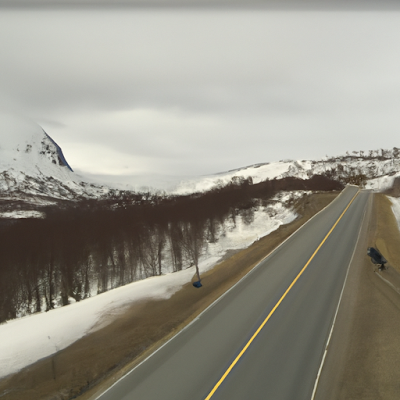
The picture shows a scenic winter landscape showing a highway alongside a calm river, with snow-covered banks and mountains in the background. There's a single vehicle traveling on the road.
The building on the left appears to be a small structure, possibly a shed, cabin, or storage facility. Given its location near the road and river, it could also be a utility or maintenance building. However, without more specific context, it's hard to determine its exact purpose. (OpenAI)
There are some beautiful spots around here: the neighbourhood, the neighbourhood.

I asked OpenAI to generate similar landscapes. There OpenAI generated some predictions about the neighborhood. I searched for these scenes in this neighborhood. It works about 70%.
The AI predicted a small building by the side of the road. There is one in the neighbourhood.


The AI predicted water on the right side of the road. It is there.


The AI predicted a side road. It is there.



Sunday, June 11, 2023
Thomas Ligotti - The strange designs of Master Rignolo 11
In previous posts I have illustrated my favorite Thomal Ligotti story "The strange designs of Master Rignolo". You can read, and see, the whole story here:
Part 1, Part 2, Part 3, Part 4, Part 5, Part 6, Part 7, Part 8, Part 9, Part 10

But why is this story so fascinating? Let's ask Twitter and Facebook first. We'll search other sources in the next posts:
Antígrafo - @AntigrafoGris - wrote a long and cogent analysis:
TBH I never had an interpretation. I usually don't look for them, and more so in Ligotti, for whom meaninglessness is so relevant. I'm haunted by the characters' relation, conspiratorial, paranoid, despondent and opaque. It's impossible to say anything certain about them.
And even more by the painting's design. The concept of a man-made void in which one can dissolve and "inhabit", waiting, empty of thought and even sight, for the stars to blink out, is perversely alluring to me.
If you forced me to torture out some sense, I could say that R thinks that he has found a way out of existence free of any effort and suffering, but it is in itself a trap. Rignolo exists reality two times betrayed. First, it's painful and, second, it's a mockery of his design.
And the unseen forces that observe and churn beneath it all is the same universe that R tries to cheat with his landscapes. He even states that you can inhabit his paintings unobserved. A solution to the presence in the window that worries N so much, we don't know why.
The bottle at the end it's what N and G wanted before all of this started and their reward for understanding that there's no easy way out, no sense or design possible and particularly for ignoring all of it.
And maybe that's the reason we all are so conspiratorial, paranoid, despondent and opaque, because we know that it's unavoidable, but we have to choose to ignore it to avoid the worst
Serhiy Krykun - made a very good illustration - it also fits my impressions of the story:
Rignolo made me doodle it while on the verge of falling asleep. An illustration to "The Strange Design of Master Rignolo" by Thomas Ligotti.

Nicole Cushing - @NicoleCushing:
"...countless stars stared down like the dead eyes of sculptured faces."
"The Strange Design of Master Rignolo" by Thomas Ligotti in NOCTUARY, magnificently dark.
And then I discovered that I myself had already made some illustrations for the story, based on real photographs of Rotterdam:

It was well into evening and for some time Nolon had been been seated at a small table in a kind of park. This was a long, thin stretch of land - vaguely triangular in shape, like a piece of broken glass - bordered by three streets of varying breadth, varying evenness of surface, and of varying stages of disintegration as each thoroughfare succumbed in its own way and in its own time to the subtle but continuous movements of the slumbering earth below. ... There were other tables here and there, all of them unoccupied, but most of the park was unused ground covered with a plush, fuzzy kind of turf.

" ... I was out in that field, the one behind those empty buildings at the edge of town where everything just slides away and goes off in all directions. And there's a marsh by there, makes the ground a little, I don't know, stringy or something. No trees, though, only a lot of wild grass, reeds, you know where I mean?"

“The face,” he said, leaning back in his chair. “It was right there, about the size of, I don’t know, a window or a picture hanging on a wall, except that it was in the ground and it was a big oval, not rectangular in any way. Just as if someone had partly buried a giant, or better yet, a giant’s mask."
Ian Davey - @unapersson:
Two men visit a landscape artist whose work has an otherworldly life of its own, and they help him reach its source.
Sunday, June 4, 2023
Manifold prediction market - icosahedron made of wood
I bet NO on the Manifold prediction market, that an AI will not be able to handle the prompt:
A regular icosahedron carved out of wood
by 2023-06-01
This is what OpenAI makes of it. It is disappointing:

Subscribe to:
Posts (Atom)